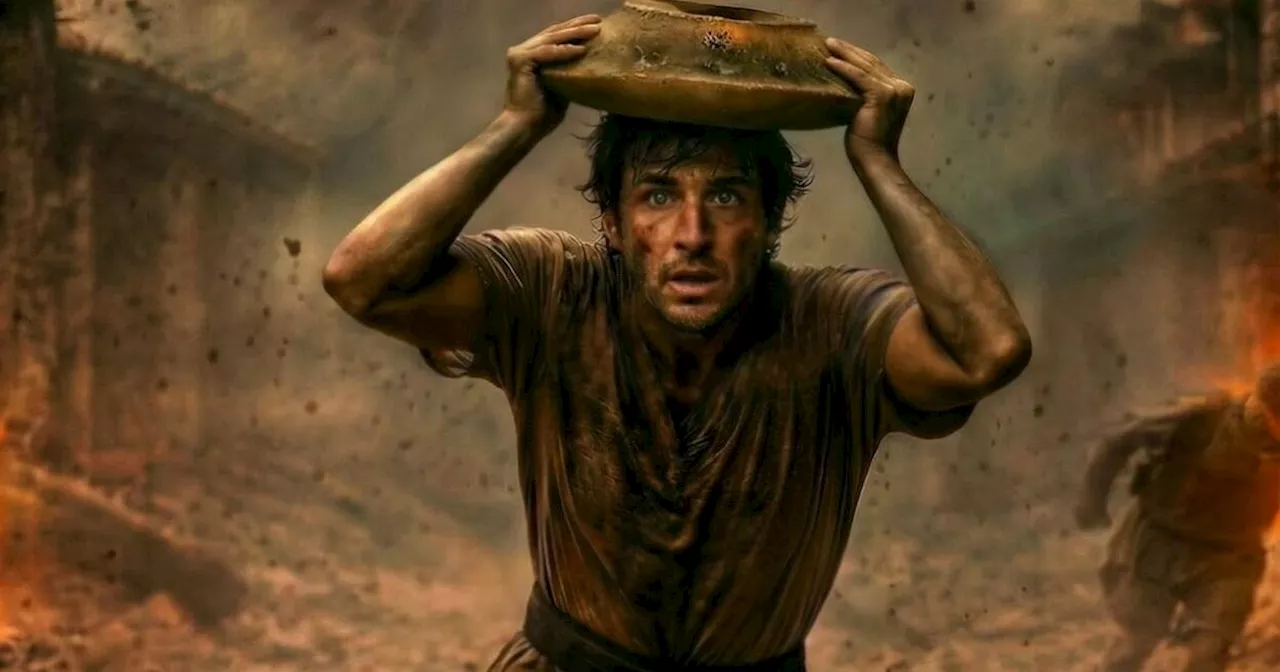
AI Brings Pompeii Eruption Victim’s Face Back to Life
Archaeologists at Pompeii have unveiled the face of an eruption victim using artificial intelligence for the first time, revealing a striking, realistic portrait of a man who perished during Mount Vesuvius’s devastating AD 79 eruption. This breakthrough digital reconstruction offers an unprecedented glimpse into the human tragedy amid one of history’s deadliest natural disasters.
The victim, an older man found near the ancient city’s Porta Stabia necropolis, was clutching a terracotta mortar, which experts interpret as an improvised shield protecting him from the deadly lapilli — small volcanic stones that relentlessly hammered Pompeii as it was buried under ash and pumice.
New Discovery Illuminates Final Moments
This man’s belongings, including an oil lamp, a small iron ring, and 10 bronze coins, were recovered alongside his remains, providing rare insights into everyday life moments before the catastrophe struck. Researchers believe he died earlier during the heavy fall of volcanic debris while trying to flee toward the coast.
Pompeii Archaeological Park, working with the University of Padua, developed the AI-driven digital portrait using detailed archaeological survey data, combining skeletal analysis and photo-editing technologies to render a lifelike human face from the remains.
“
The vastness of archaeological data is now such that only with the help of artificial intelligence will we be able to adequately protect and enhance them
,” said Pompeii park director Gabriel Zuchtriegel, emphasizing AI’s role in revitalizing classical studies and making ancient history more accessible and emotionally engaging.
Historic Context and Emotional Impact
Pompeii, preserved as a UNESCO World Heritage site near Naples, Italy, stands as a chilling time capsule frozen by volcanic disaster nearly two millennia ago. The discovery underscores the desperate attempts of residents to survive as volcanic chaos engulfed the city and highlights that many died outside city walls trying to escape.
Italian Culture Minister Alessandro Giuli praised the innovation, stating, “
Investigations conducted with these excavations demonstrate that innovative methodologies, used with care, can give us new historical perspectives
.” The ongoing use of advanced technology promises to deepen understanding of Pompeii and ancient Roman life.
These revelations come shortly after archaeologists revealed a 2,000-year-old love note and an illustrated gladiator fight scene on Pompeii walls, confirming the ancient city’s rich cultural tapestry preserved beneath volcanic ash.
What’s Next for Pompeii Research
The AI reconstruction project marks a major step forward in archaeological research, ensuring that the personal stories behind Pompeii’s tragedy are remembered with human faces attached. As digital methods evolve, archaeologists are poised to uncover further discoveries that connect modern audiences to a distant past.
For readers in Colorado and across the United States, this breakthrough highlights how advanced technology like AI reaches globally, transforming historical studies and offering immersive, tangible connections to humanity’s shared history.
As the Pompeii Archaeological Park continues its work, expect more discoveries and AI-driven reconstructions that bring ancient lives into sharp, moving focus—reminding us of the power of innovation to illuminate even the darkest chapters of the past.