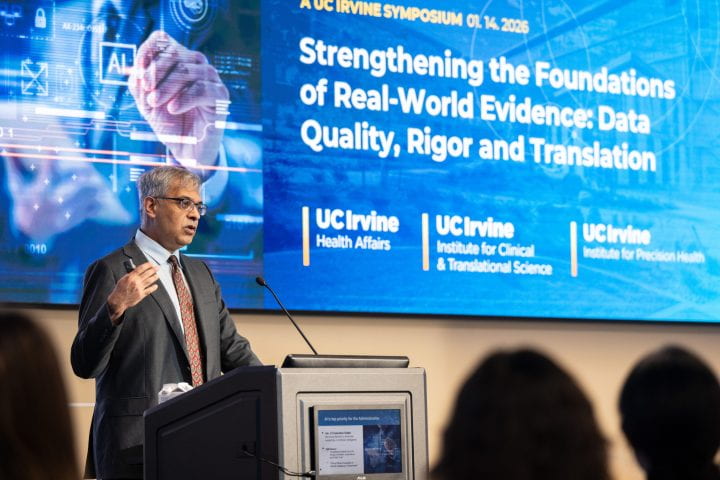
A significant dialogue on national health research unfolded at the University of California, Irvine (UC Irvine) on January 14, 2024, as Dr. Jay Bhattacharya, Director of the National Institutes of Health (NIH), met with faculty, researchers, students, and local business leaders. This visit marked only his second trip to California since his appointment, emphasizing a focus on the intersection of discovery, data, and healthcare.
The day was highlighted by the symposium titled “Strengthening the Foundations of Real-World Evidence: Data Quality, Rigor and Translation,” organized by UC Irvine Health Affairs, the Institute for Clinical & Translational Science (ICTS), and the Institute for Precision Health. Dr. Eric Vilain, Associate Vice Chancellor for Scientific Affairs and Director of ICTS, alongside Dr. Dan Cooper, Associate Director of ICTS, extended the invitation to Bhattacharya, underscoring UC Irvine’s commitment to translational science and collaborative research that bridges academic inquiry and patient care.
Connecting National Priorities with Local Research
UC Irvine serves as a vital hub for national health research, linking overarching federal priorities with ongoing work in laboratories, clinics, and communities. Bhattacharya’s visit fostered meaningful discussions that grounded health policy and funding conversations in practical research applications, emphasizing the necessity of aligning national objectives with real-world healthcare practices.
Engagement with Orange County’s biomedical and business executives highlighted the region’s growing influence in health innovation. Through initiatives like Beall Applied Innovation, UC Irvine facilitates the connection between research, industry, and patient care, translating scientific discoveries into practical applications that have national significance.
NIH funding is a crucial driver of innovation and economic growth, enabling UC Irvine scientists and clinicians to address complex health challenges. This investment supports public health efforts, promotes health equity, and improves patient outcomes across diverse populations at both local and national levels.
During the symposium, Bhattacharya delivered a keynote address focusing on the importance of real-world data, the concept of learning health systems, and the infrastructure necessary to ensure transparency and trust within the research community. These systems are designed to learn continuously from patient experiences, facilitating rapid translation of insights into improved healthcare practices.
Data Quality and Transparency in Biomedical Research
A central theme of the symposium was the NIH initiative, Data: Collect Once, Use Numerous Times. This effort aims to build a national data infrastructure that encourages responsible access to high-quality, real-world evidence. UC Irvine has been instrumental in shaping the strategy behind Data COUNTS, which seeks to establish a framework for collecting, sharing, and utilizing real-world health data effectively.
Data COUNTS is built on a trusted, federated architecture that connects diverse data sources using open standards, ensuring that researchers can access information that is findable, accessible, interoperable, and reusable while maintaining privacy and security. This initiative aligns with the NIH’s broader data science strategies and supports federal data management policies.
Dr. Steve Goldstein, Vice Chancellor for Health Affairs, has collaborated closely with NIH leadership to help refine this strategy, positioning UC Irvine as a leader in the national research landscape. Bhattacharya’s keynote emphasized that the success of Data COUNTS is integral to enhancing the rigor and reproducibility of biomedical research.
Bhattacharya, reflecting on his dual role as a researcher and policy maker, stressed that research profoundly impacts lives and informs health systems and policies. He articulated the NIH’s mission to facilitate responsible access to data that can ultimately enhance public health and longevity.
During his visit, Bhattacharya also engaged with students, offering insights into the importance of investing in early-career scientists as a means of advancing public health. The discussion highlighted the transformative potential of data in medical science; modern datasets now encompass electronic health records, genomic data, and extensive clinical information, providing unprecedented opportunities for analysis.
As the symposium concluded, presenters showcased how real-world data is already influencing prevention strategies, policy decisions, and population health. One notable example is COSMOS, a national real-world data platform launched in 2019, which has facilitated over 160 peer-reviewed publications, offering near-real-time insights that shape clinical and public health decisions.
Bhattacharya also toured UC Irvine’s latest healthcare investments, including the Falling Leaves Foundation Medical Innovation Building and the new UCI Health — Irvine hospital complex. These facilities exemplify how interdisciplinary teams are advancing clinical trials and improving patient outcomes through collaborative research.
Throughout his visit, Bhattacharya engaged with various leaders, including Dr. Shaista Malik, Executive Director of the Susan Samueli Integrative Health Institute. Their discussions centered on a shared commitment to advancing holistic care approaches informed by real-world data.
UC Irvine continues to play a pivotal role in bridging national health research dialogues with the realities of scientific discovery and patient care. While challenges such as stagnant life expectancy and rising chronic diseases persist, there is a significant opportunity to leverage data effectively to identify successful interventions for real-world populations.
Through its integrated approach that combines research, education, clinical practice, and innovation, UC Irvine is positioned as a trusted partner in advancing health outcomes and translating national research priorities into impactful public health initiatives.