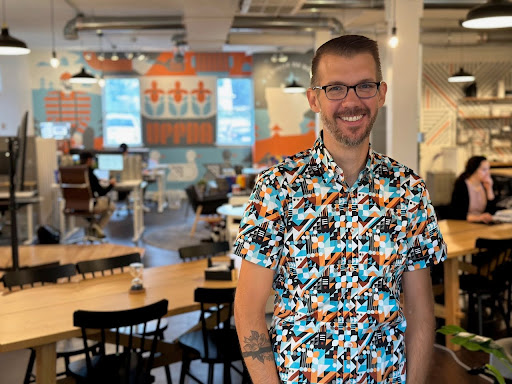
Lucas Langworthy, founder of Greyduck, is steering his company towards a future defined by spatial storytelling, a concept he believes is crucial as immersive technologies gain traction. With the global augmented reality (AR) and virtual reality (VR) market projected to surpass $387 billion by 2031, Langworthy is focused on how these technologies are utilized rather than the technologies themselves.
Langworthy’s journey began in the mid-2000s within the tech sector, where he developed a deep understanding of product culture and human-centered design. Reflecting on this experience, he states, “My time there was truly transformative. I understood the importance of innovation, of humanizing brands, and the people behind the products.” His career has evolved from live-action production to motion design, culminating in the establishment of a creative studio aimed at enterprise clients.
The studio specializes in creating immersive environments tailored specifically for the Apple Vision Pro. Langworthy emphasizes that this approach is not about producing generic virtual reality assets but rather about leveraging the unique capabilities of the device. “What can you do in this device that you can’t do anywhere else? For me, that’s where the real value lies,” he explains.
Addressing Loneliness Through Immersive Technology
In a society where over six in ten adults in the United States report feelings of loneliness, Langworthy identifies immersive computing as a potential remedy. He argues that current social platforms often exacerbate isolation rather than foster connection. “I believe the device is often sold to people who are either lonely already, or it contributes to causing loneliness,” he states. He advocates for a reimagining of how these technologies can be employed to encourage human interaction, suggesting that immersive experiences could transform remote communication.
Langworthy discusses the poignant example of waving goodbye to his 103-year-old grandmother through a nursing home window during COVID-19 restrictions. “In hindsight, such devices could have made a difference in how we said goodbye,” he reflects, underscoring the emotional potential of immersive technology in critical moments.
Healthcare Innovations and Responsible Use
Langworthy also sees significant possibilities in healthcare, envisioning advancements such as remote robotic surgeries and enhanced visualization for medical professionals. He believes that spatial collaboration among global medical teams could redefine the standards of care. “The same immersive accuracy that animates entertainment experiences has the potential to enable life-saving interventions,” he notes.
As a parent of two young children, Langworthy emphasizes the need for thoughtful boundaries in technology use. He asserts that defining age considerations, session limits, and ethical design standards is essential for integrating immersive systems into daily life.
As brands explore spatial environments for product launches and training modules, Langworthy anticipates a growing demand for specialized graphics expertise. “Abandoning technology isn’t going to solve the problem,” he asserts. “The responsibility is to build experiences that strengthen connection.”
Ultimately, Langworthy’s vision for Greyduck extends beyond mere technological advancement. He believes in the power of immersive media designed with emotional intelligence and technical precision, allowing for more meaningful connections in an increasingly fragmented world. “If in five years I can sit down, put on a headset, and feel like my kids are right there with me wherever they are in the world, then I’ll rest well knowing the technology is used in the way it’s meant to,” he concludes.