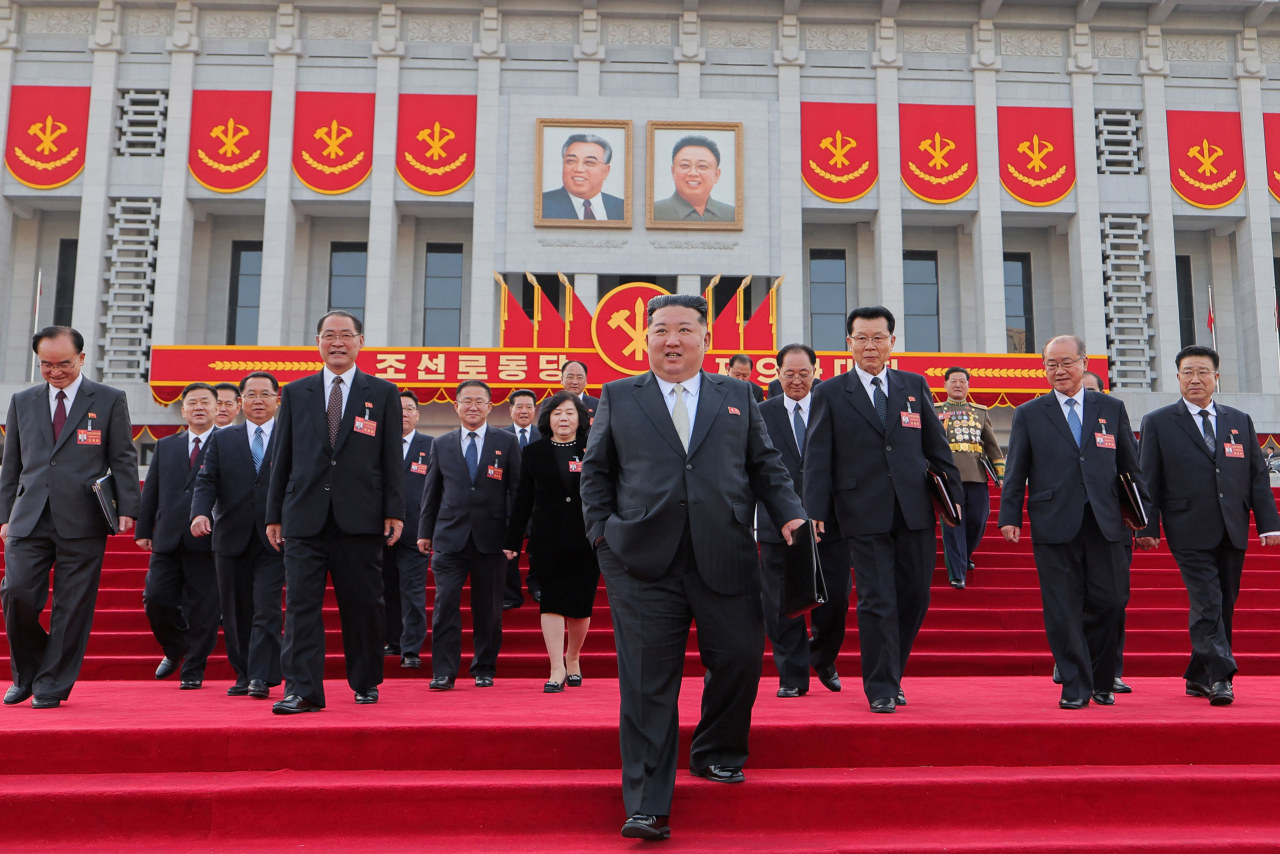
At a recent party congress in North Korea, Kim Jong Un articulated a dual approach towards potential engagement with the United States. During the five-yearly event, held in September 2023, he emphasized that any future relations would be contingent upon his country maintaining its nuclear arsenal.
In his address, Kim presented a stark choice: coexistence or confrontation. This announcement underscores North Korea’s long-standing strategy of leveraging its nuclear capabilities to negotiate with global powers, particularly the U.S. The congress, which took place in Pyongyang, is a crucial platform for the North Korean leader to outline his vision for national policy and international relations.
Kim’s remarks signal a willingness to engage with the U.S. but also serve as a reminder that North Korea views its nuclear weapons as essential to its sovereignty and security. He stated, “Our nuclear weapons are not a bargaining chip but a guarantee of our survival.” This assertion reflects the regime’s ongoing commitment to its military program despite extensive international sanctions.
The Korean Peninsula remains a focal point of geopolitical tension, with North Korea’s nuclear ambitions leading to increased scrutiny from regional and global powers. During the congress, Kim also reiterated that the country would pursue economic development alongside its military objectives. He argued that both elements are vital for ensuring North Korea’s future stability and growth.
The international community has responded with mixed reactions. Some analysts suggest that Kim’s statements could indicate a potential opening for dialogue, while others view them as a continuation of belligerent posturing. The U.S. government has yet to issue a formal response to Kim’s address, but officials are likely to analyze the implications of his remarks closely.
In the context of past negotiations, Kim’s insistence on retaining nuclear capabilities complicates the prospect of meaningful dialogue. Previous summits, notably with former President Donald Trump in 2018 and 2019, aimed at denuclearization have yet to yield significant results. The failure to reach a comprehensive agreement has left both parties at an impasse.
Looking ahead, the dynamics on the Korean Peninsula are expected to remain tense. North Korea’s commitment to its nuclear program, alongside its call for coexistence, presents a complex challenge for policymakers in Washington and beyond. The international community is watching closely to see how the U.S. will navigate these developments and whether new avenues for diplomacy will emerge.
As Kim Jong Un continues to assert his position domestically and internationally, the world remains on alert. The choices made in the coming months will be pivotal in shaping the future of peace and stability in the region.