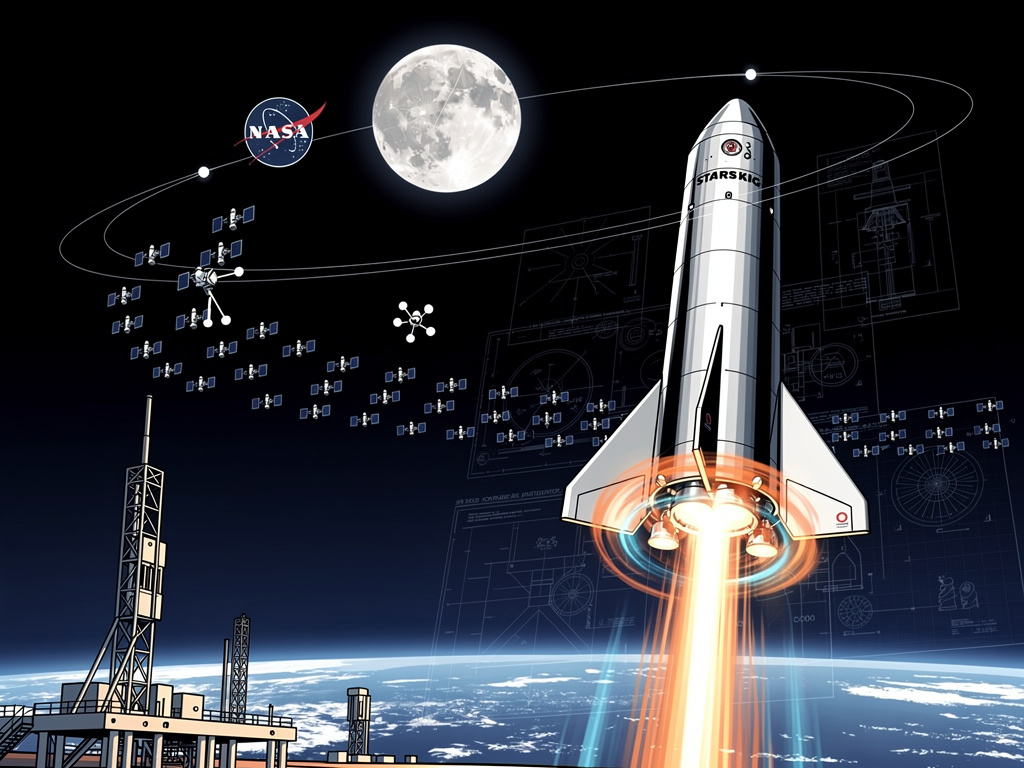
SpaceX is gearing up for a pivotal moment in its ambitious space program as its Starship rocket awaits its fourth integrated test flight. Positioned on the Texas coast, this stainless-steel marvel represents a critical juncture not only for SpaceX but also for NASA’s lunar ambitions and the broader economic landscape of space access. Following a significant test in March 2023, which saw the rocket achieve orbital velocity before succumbing during reentry, the primary aim of this next mission is straightforward yet crucial: to successfully survive reentry.
The success of this upcoming flight is vital for SpaceX, as proving the Starship can return safely from space is essential for validating its innovative rocketry approach, characterized by rapid iteration and a development strategy described by insiders as “hardware-rich.” A failure to demonstrate this capability could delay key projects, including the deployment of next-generation Starlink satellites and a multi-billion-dollar contract with NASA to facilitate American astronaut landings on the Moon.
Significant Achievements and Challenges
The third test flight, known as IFT-3, marked a watershed moment for SpaceX, despite the loss of both the Super Heavy booster and the Starship upper stage. The vehicle ascended flawlessly, performed a successful hot-stage separation, and coasted through space for nearly 50 minutes. During this time, it achieved critical objectives, such as opening and closing its payload bay door and conducting a propellant transfer demonstration, an essential technology for future deep-space missions. These accomplishments surpassed the limitations of earlier test attempts, which were often marred by explosive failures shortly after liftoff, as reported by NASASpaceFlight.com.
The dramatic conclusion of IFT-3 underscored the formidable challenge of atmospheric return. Both the booster, which failed to complete its final landing burn over the Gulf of Mexico, and the Starship, lost due to roll-control issues and severe thermal stress, highlighted the complexities involved. For the fourth flight, SpaceX aims for a controlled splashdown. “The main goal of this flight is to get through max reentry heating,” stated CEO Elon Musk in a post on X, the social media platform he owns. A successful outcome would indicate that the vehicle’s thousands of hexagonal heat shield tiles have withstood temperatures exceeding 2,700 degrees Fahrenheit, while its flight-control flaps ensured stability.
This focus on reentry is not just about recovering the vehicle; it is fundamental to SpaceX’s entire Starship business model, which emphasizes full and rapid reusability. Both the Super Heavy booster and the Starship upper stage are designed for multiple uses with minimal refurbishment. Achieving this requires not only surviving the return journey but also mastering powered landings, first in the ocean and eventually through a precision catch at the launch tower using giant robotic arms known as “Mechazilla.”
Production and Regulatory Hurdles
Supporting this ambitious testing campaign is a production system at SpaceX’s Starbase facility in Boca Chica, Texas, that resembles an automotive factory more than a traditional aerospace cleanroom. SpaceX is manufacturing new Starships and Super Heavy boosters simultaneously, allowing for immediate integration of lessons learned from test losses into the next vehicle in line. The hardware designated for the fourth flight, Booster 11 and Ship 29, includes numerous upgrades, exemplifying this iterative development philosophy.
This rapid pace of development stands in stark contrast to government-led programs, which often take years and billions of dollars to produce a single vehicle. SpaceX’s willingness to embrace public failure in real-world tests, rather than relying solely on ground simulations, has enabled it to drastically accelerate its timeline, a strategy that has defined its operations from the Falcon 9 to the Starlink satellite program.
Despite the speed of production, the flight schedule ultimately depends on regulatory approval from the Federal Aviation Administration (FAA). Each launch requires a license, and any anomalies, such as the failures experienced during IFT-3, initiate formal investigations. The FAA recently concluded its investigation into the third flight, detailing necessary corrective actions for SpaceX. Following these adjustments, the agency issued the crucial launch license for the fourth flight. This approval marks a significant milestone, yet factors such as weather conditions and technical readiness will ultimately govern the countdown.
The urgency surrounding the success of the Starship program extends beyond SpaceX’s own goals. The company holds a $2.9 billion contract with NASA to develop a lunar-optimized version of Starship as part of the Artemis program. NASA’s plans to return astronauts to the lunar surface for the first time since the Apollo era, currently projected for no earlier than late 2026, are entirely contingent on Starship’s operational reliability. Delays in the test program could have cascading effects on the Artemis timeline, a concern echoed by agency officials.
Equally pressing is Starship’s role in deploying SpaceX’s Starlink satellite internet constellation. While the Falcon 9 rocket has successfully launched thousands of first-generation satellites, the larger and more capable Starlink V2 satellites require Starship’s capacity. These next-generation satellites are crucial for enhancing the network’s capabilities and profitability, which in turn funds the capital-intensive Starship program. Reports indicate that Starlink has already reached a cash-flow positive state, but its sustained growth and market dominance are closely tied to the success of Starship.
As SpaceX prepares for the fourth flight, it stands at the forefront of a new era in space exploration. If successful, this mission could revolutionize the cost of launching payloads into orbit, unlocking possibilities that were once deemed science fiction, from expansive space telescopes to rapid cargo delivery on Earth. Ultimately, the success of this single rocket could play a pivotal role in Elon Musk’s long-term vision of colonizing Mars.
The upcoming launch is more than just a technical test; it represents a critical evaluation of SpaceX’s entire industrial and engineering philosophy. A successful splashdown would indicate that the company is on the verge of overcoming one of the most significant challenges of rocket reusability. Conversely, another failure would necessitate further corrective actions, regulatory scrutiny, and additional delays before the world’s most powerful rocket can fulfill its potential in the realm of space exploration. The implications are vast, with industry stakeholders, government partners, and competitors closely monitoring the unfolding events.