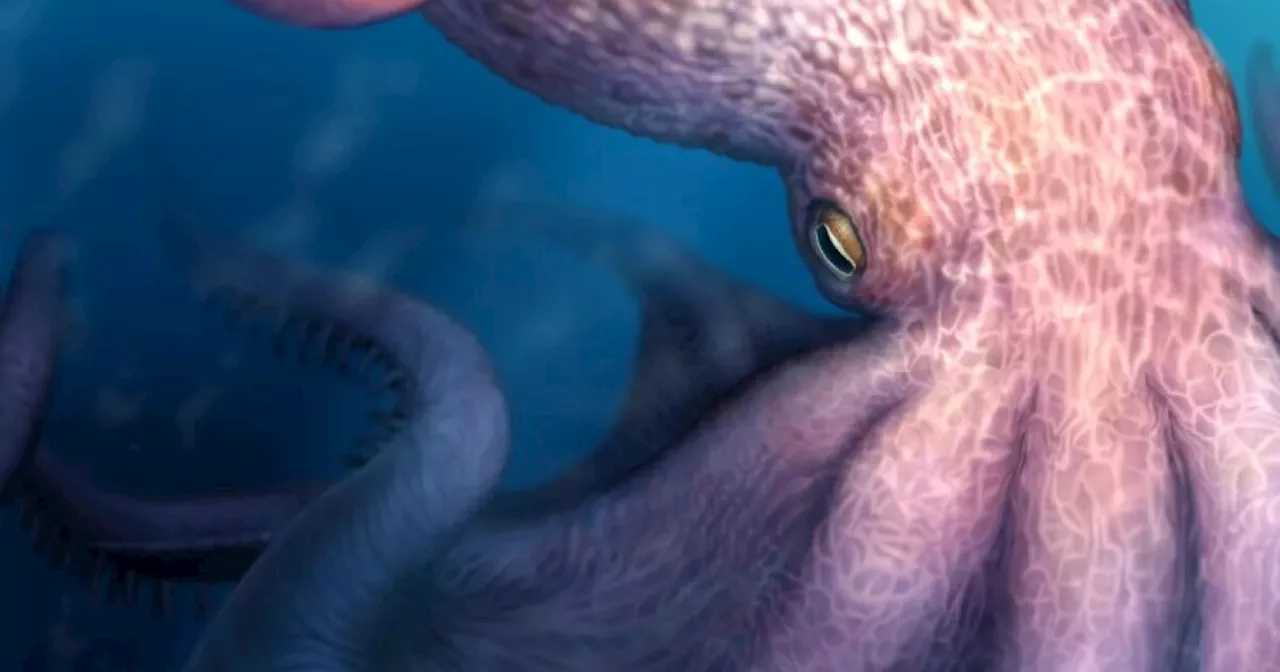
BREAKING: Scientists have discovered fossilized jaws of colossal octopuses measuring up to 60 feet, rivaling ancient ocean predators from 100 million years ago in northern Japan.
Paleontologists from Hokkaido University and Ruhr University Bochum revealed today the stunning find of the largest octopus jaws ever fossilized—an unprecedented window into the late Cretaceous marine ecosystem. These octopuses potentially reached lengths greater than a school bus, challenging previous understanding of ancient marine life.
The discovery was made inside concretions—large, fossil-bearing rocks formed on the seafloor—near what is now northern Japan. Using an innovative method called digital fossil-mining, researchers sliced the rocks thinly, photographed fossils, then applied AI to recreate detailed 3D images. This advanced technique helped uncover octopus jaws, which are among the few hard parts of these soft-bodied creatures that fossilize.
Gigantic Octopus Jaws Reveal Predator Power and Brain Evolution
Lead researcher Iba explained that the jaws, resembling bird beaks, consist of a ‘shovel-like’ lower jaw and an upper jaw, used by ancient octopuses to crush prey. Analysis of the jaws showed bite marks and chips, indicating these octopuses fed on hard-shelled animals like shrimp, lobsters, bivalves, and nautilus-like creatures.
The size of the jaws allowed scientists to estimate a body length that dwarfs the giant Pacific octopus—today’s largest species—whose arm span averages 16 feet. These prehistoric cephalopods were likely apex predators alongside mosasaurs, the giant toothy marine reptiles of their age.
Remarkably, the right jaw showed more wear than the left, suggesting single-sided usage and hinting that early octopuses already possessed complex brain functions similar to modern species. This indicates advanced intelligence dating back more than 100 million years during the Cretaceous period.
Revolutionizing Paleontology with AI and Digital Techniques
The discovery highlights how new technologies can unlock secrets from fossils traditionally hard to study due to their soft tissue composition. Octopuses rarely fossilize, as their bodies are primarily soft, lacking durable bones. This breakthrough changes how scientists interpret the evolution and ancient biodiversity of these elusive creatures.
Co-author Mutterlose said, “Just a few fossil specimens like these jaws can shed new light on the evolution of marine predators and the ancient biosphere.” These giant octopuses were part of an ecosystem teeming with hungry large predators, shaping the ocean’s food chain in ways previously unimagined.
What’s Next for Ancient Marine Predator Research?
Researchers plan to continue applying AI-driven fossil analysis to seek other rare soft-tissue creatures in ancient concretions worldwide. Understanding the behavior and ecological role of these giant octopuses aids in reconstructing the dynamic and dangerous ocean environments of the Cretaceous.
This discovery resonates beyond paleontology, revealing a lost chapter of Earth’s marine mysteries just waiting to be uncovered with cutting-edge science.
“Modern octopuses are intelligent and flexible predators. Our findings suggest these traits emerged over 100 million years ago,” said researcher Iba.
For readers in Colorado and the US, this remarkable fossil find emphasizes how ancient life forms can inform modern science and inspire technological innovation in research fields ranging from biology to robotics.