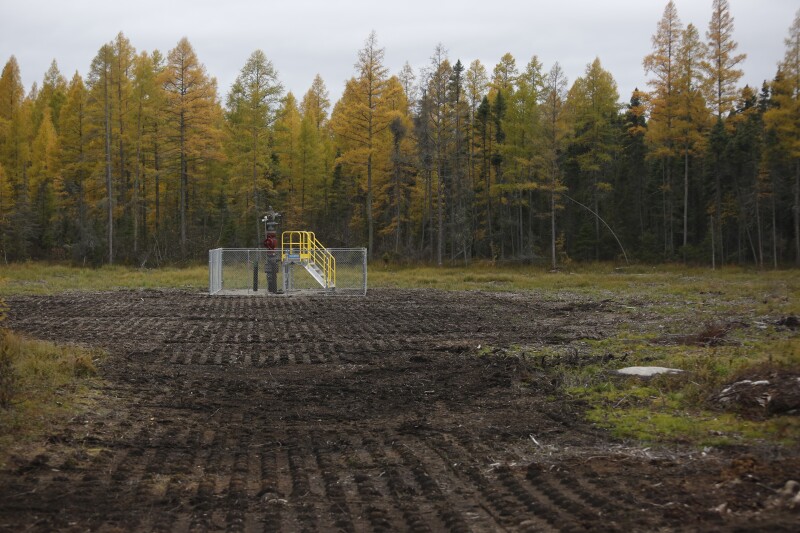
In a significant development for energy exploration, multiple companies are now investigating the potential for hydrogen in Northeastern Minnesota, following the earlier discovery of helium in the region. Pulsar Helium, the company that confirmed helium reserves beneath the surface two years ago, has intensified its operations, drilling an additional three wells since October 2022, bringing the total to five. This effort aims to more accurately assess the size of the helium reservoir, which is already regarded as one of the highest concentrations globally.
Pulsar Helium recently reported that helium extracted from its original well included helium-3, a rare isotope with applications in nuclear fusion and advanced computing. According to Cliff Cain, CEO of Edelgas Group, the value of this isotope is significant, with a cylinder the size of a forearm potentially worth $30 million.
Helium is particularly valuable due to its rarity on Earth, primarily sourced as a byproduct from decaying tritium in nuclear warheads. Given its abundance on the moon, there have even been discussions about sourcing helium from celestial bodies. However, the focus remains on the more accessible deposits in Northeastern Minnesota, where Pulsar is continuing to evaluate the helium and helium-3 content.
Exploration for Hydrogen Gains Momentum
The geology of the area, characterized by subterranean cracks and fissures, is believed to have trapped helium created from the breakdown of radioactive elements. This same geology is drawing interest from companies seeking hydrogen, which can often be found in proximity to helium reserves. Last month, Pulsar completed an acquisition of a hydrogen exploration company, acquiring private gas exploration rights across more than 59,000 acres in St. Louis and Itasca counties.
Thomas Abraham-James, President and CEO of Pulsar, noted that he is aware of several other firms exploring gas opportunities in the region. He views this interest as a validation of the area’s potential rather than competition. “It’s further validation of what we’ve done and the potential of this area,” he stated.
The interest in hydrogen comes largely due to its potential as a clean fuel that releases only water vapor when burned. Currently, most hydrogen is derived from fossil fuels, and while electrolysis can produce hydrogen from water, it requires substantial electricity. The possibility of naturally occurring hydrogen in Northeastern Minnesota has attracted significant attention.
Recent research by the U.S. Geological Survey has identified the Midcontinent Rift, which includes Minnesota, as a location where geological conditions might allow hydrogen to form. The interaction of water with iron in the earth’s crust could trap this hydrogen in underground reservoirs. Notably, Quebec Innovative Materials Corp. has announced plans to explore hydrogen in two townships on the Iron Range, while Koloma, supported by Bill Gates’ Breakthrough Energy Ventures, is preparing for exploratory drilling.
Geological Factors Favor Hydrogen Formation
Kristen Delano, Koloma’s Head of Government Affairs, explained that USGS data often serves as a starting point for hydrogen exploration, but the company is also analyzing existing geological surveys and employing artificial intelligence to refine drilling locations. “We have expert geologists and data that shows us in the Iron Range, you have the right type of iron-rich rock,” Delano said.
The geological history of Northeastern Minnesota contributes to its potential for hydrogen. The Midcontinent Rift, formed approximately 1.1 billion years ago, is known for its deposits of copper, nickel, and iron. The presence of iron(II), or Fe(II), is crucial, as it can generate hydrogen when combined with water. Latisha Brengman, an Associate Professor of Earth and Environmental Sciences at the University of Minnesota Duluth, noted that while reactions producing hydrogen likely occur frequently, only one known hydrogen reservoir exists in Mali.
Brengman emphasized the importance of innovative techniques to capture hydrogen by leveraging both natural and engineered processes. This could involve using iron near the surface or waste rock from taconite pellet plants to facilitate reactions that yield hydrogen. Industries aiming to replace fossil fuels could utilize this hydrogen as a carbon-free energy source.
Delano highlighted the transformative potential of regionally sourced hydrogen, particularly for hard-to-abate sectors like iron mining and steelmaking. “Natural hydrogen’s best use is being put to use for other energy needs and cleaning up those really hard to abate sectors,” she remarked.
Despite its promise, hydrogen does present challenges. As a small and light gas, it can easily leak, potentially contributing to indirect warming effects when it reacts with other greenhouse gases. Delano indicated that Koloma plans to be very active in 2026, conducting seismic studies to better understand the subsurface conditions.
As Brengman prepares to collaborate with the U.S. Department of Energy’s National Laboratory of the Rockies on predictive modeling for hydrogen production, she remains optimistic about the Midwest’s potential for discovering natural hydrogen sources. “The Midwest has a lot of great potential, because it’s a very old terrain, and so there’s lots of old-water rock interaction to map out,” she concluded.