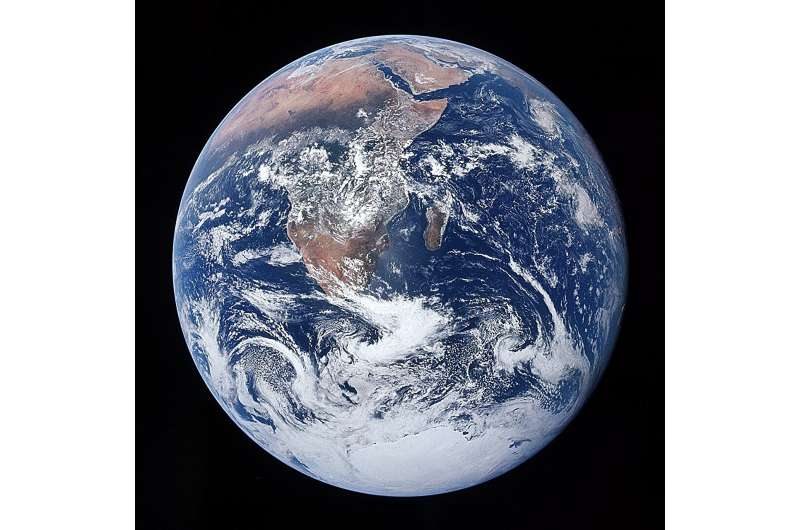
Research has unveiled that Mars plays a crucial role in shaping Earth’s climate, revealing the planet’s influence on long-term climate cycles. A team of researchers led by Stephen Kane conducted simulations to examine the effects of varying Mars’s mass on Earth’s orbital variations. Their findings, published on December 10, 2025, highlight the complexities of our solar system and its impact on Earth’s climate patterns.
Understanding Climate Cycles
Earth’s climate has fluctuated between ice ages and warmer periods for millions of years. These changes are primarily driven by variations in Earth’s orbit and axial tilt, known as Milankovitch cycles. While it is well-established that the gravitational pull of larger planets like Jupiter and Venus affects these cycles, the new study emphasizes that even the smaller Mars exerts significant influence.
The research team explored how altering Mars’s mass—from zero to ten times its current value—impacted Earth’s climate cycles. They discovered that the most stable feature across all simulations was the 405,000-year eccentricity cycle, which remains consistent due to interactions between Venus and Jupiter. This cycle provides a steady framework for understanding Earth’s climate variations.
However, the shorter cycles, approximately 100,000 years, crucial for ice age transitions, are significantly affected by Mars. As the simulated mass of Mars increases, these cycles both lengthen and gain intensity. Intriguingly, when Mars’s mass approaches zero, a critical climate pattern vanishes entirely.
The Grand Cycle and Its Implications
One of the most significant findings is the 2.4 million-year “grand cycle,” which influences long-term climate fluctuations. This cycle exists solely because Mars has sufficient mass to create the necessary gravitational resonance. It is linked to the slow rotation of Earth’s and Mars’s orbits, impacting the amount of sunlight Earth receives over millions of years.
Additionally, Mars’s gravitational influence affects Earth’s axial tilt, or obliquity. The well-documented 41,000-year obliquity cycle lengthens as Mars’s mass increases. With a Mars that is ten times its current mass, this cycle could shift to a period of 45,000 to 55,000 years, significantly altering the growth and retreat patterns of ice sheets.
The implications of this research extend beyond Earth. By understanding the gravitational interactions within a solar system, scientists can better assess the habitability of Earth-like exoplanets. A terrestrial planet with a massive neighbor in the correct orbital configuration might experience climate variations conducive to life, rather than extreme conditions that could lead to runaway freezing.
The study emphasizes that Earth’s climate dynamics are not solely a product of its relationship with the sun. Instead, they are influenced by the entire planetary neighborhood, with Mars playing a surprisingly important role in shaping our climate.
For further details on this research, refer to the article: Stephen R. Kane et al, The Dependence of Earth Milankovitch Cycles on Martian Mass, published on the arXiv preprint server, DOI: 10.48550/arxiv.2512.02108.