Astronomers have uncovered the long-hidden cause behind the peculiar behavior of the red supergiant star Betelgeuse. Using nearly eight years of observations from the Hubble Space Telescope and ground-based observatories, scientists have confirmed the presence of a companion star, known as Siwarha, which is creating a visible wake through Betelgeuse’s vast atmosphere. This discovery sheds light on the unusual fluctuations in the star’s brightness and atmospheric dynamics.
The findings were announced during a news conference at the 247th meeting of the American Astronomical Society in Phoenix and have been accepted for publication in The Astrophysical Journal. The study, led by researchers at the Center for Astrophysics | Harvard & Smithsonian, highlights how Siwarha’s movement through Betelgeuse’s outer layers produces swirling trails of dense gas, resolving one of the most enduring mysteries surrounding this prominent star.
Decoding Betelgeuse’s Behavior
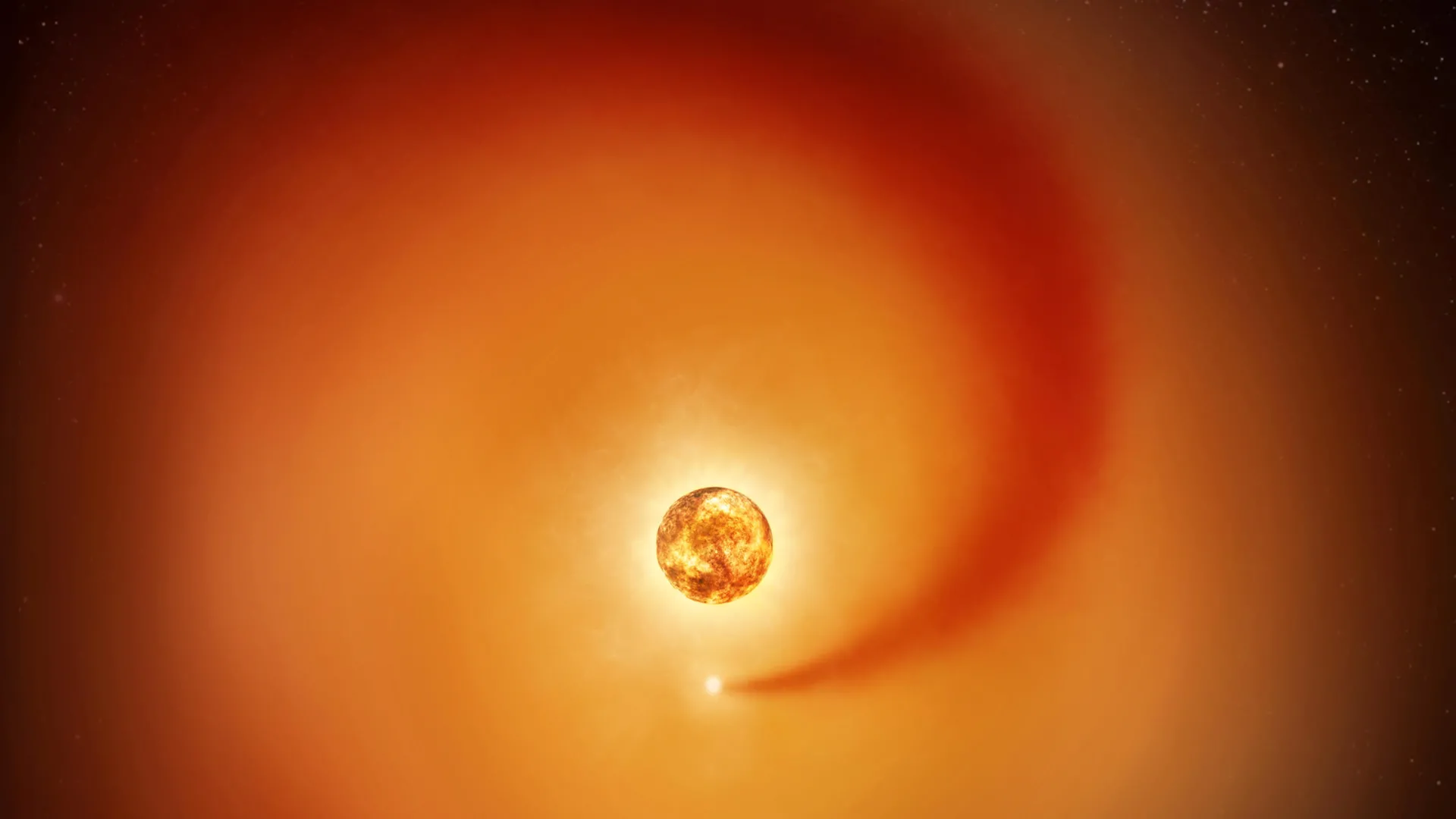
The influence of Siwarha was detected through meticulous measurements of Betelgeuse’s light over approximately eight years. These long-term observations revealed disturbances in the star’s atmosphere caused by the companion star, which had been suspected for some time. As Siwarha traverses Betelgeuse’s outer layers, it disrupts the surrounding gas, leading to a trail of denser material that directly correlates with the star’s erratic behavior.
Betelgeuse, located about 650 light-years from Earth in the Orion constellation, is a red supergiant large enough to contain over 400 million Suns. Its proximity allows astronomers to study its surface and atmosphere in detail, making it a crucial subject for understanding the life cycle of giant stars as they age, lose mass, and eventually explode as supernovae.
Patterns and Proof of Stellar Interaction
By integrating data from Hubble with observations from the Fred Lawrence Whipple Observatory and the Roque de Los Muchachos Observatory, researchers identified consistent patterns in Betelgeuse’s behavior. These patterns provided compelling evidence of Siwarha’s impact on Betelgeuse’s outer atmosphere, revealing changes in the star’s spectral output and gas motion.
The companion star produces a dense wake that becomes apparent each time it passes in front of Betelgeuse, approximately every 2,100 days. Andrea Dupree, an astronomer at the CfA and lead author of the study, likened the phenomenon to a boat moving through water, stating, “The companion star creates a ripple effect in Betelgeuse’s atmosphere that we can actually see in the data.”
This discovery not only clarifies the enigmatic behavior of Betelgeuse but also enhances understanding of the evolutionary stages of other massive stars nearing the end of their functional lives.
Understanding Stars Through Observation
Astronomers have closely monitored Betelgeuse for decades, particularly after the star’s unexpected dimming in 2020, an event described as a stellar “sneeze.” Researchers identified two primary cycles in Betelgeuse’s variability: a shorter cycle of 400 days linked to internal pulsations and a longer cycle of about 2,100 days, which is now explained by the presence of Siwarha.
Before this confirmation, various theories had been proposed to account for Betelgeuse’s long-term changes, including massive convection cells, dust clouds, magnetic activity, and the possibility of a hidden companion. The newly detected wake offers the strongest evidence yet that a companion star is actively influencing the atmosphere of Betelgeuse.
Dupree emphasized the significance of this finding, stating, “With this new direct evidence, Betelgeuse gives us a front-row seat to watch how a giant star changes over time.”
Future Research Directions
Currently, Betelgeuse is eclipsing Siwarha, but astronomers plan additional observations when the companion becomes visible again in 2027. This discovery not only enriches the understanding of Betelgeuse but may also illuminate similar mysteries concerning other giant and supergiant stars.
The Hubble Space Telescope, operational for over three decades, continues to contribute invaluable insights into the universe. A collaborative effort between NASA and the European Space Agency, Hubble’s mission operations are overseen by NASA’s Goddard Space Flight Center, with scientific operations managed by the Space Telescope Science Institute.
This remarkable discovery reinforces the importance of continued observation and research in the field of astrophysics, providing deeper insights into the life cycles of the universe’s most majestic stars.