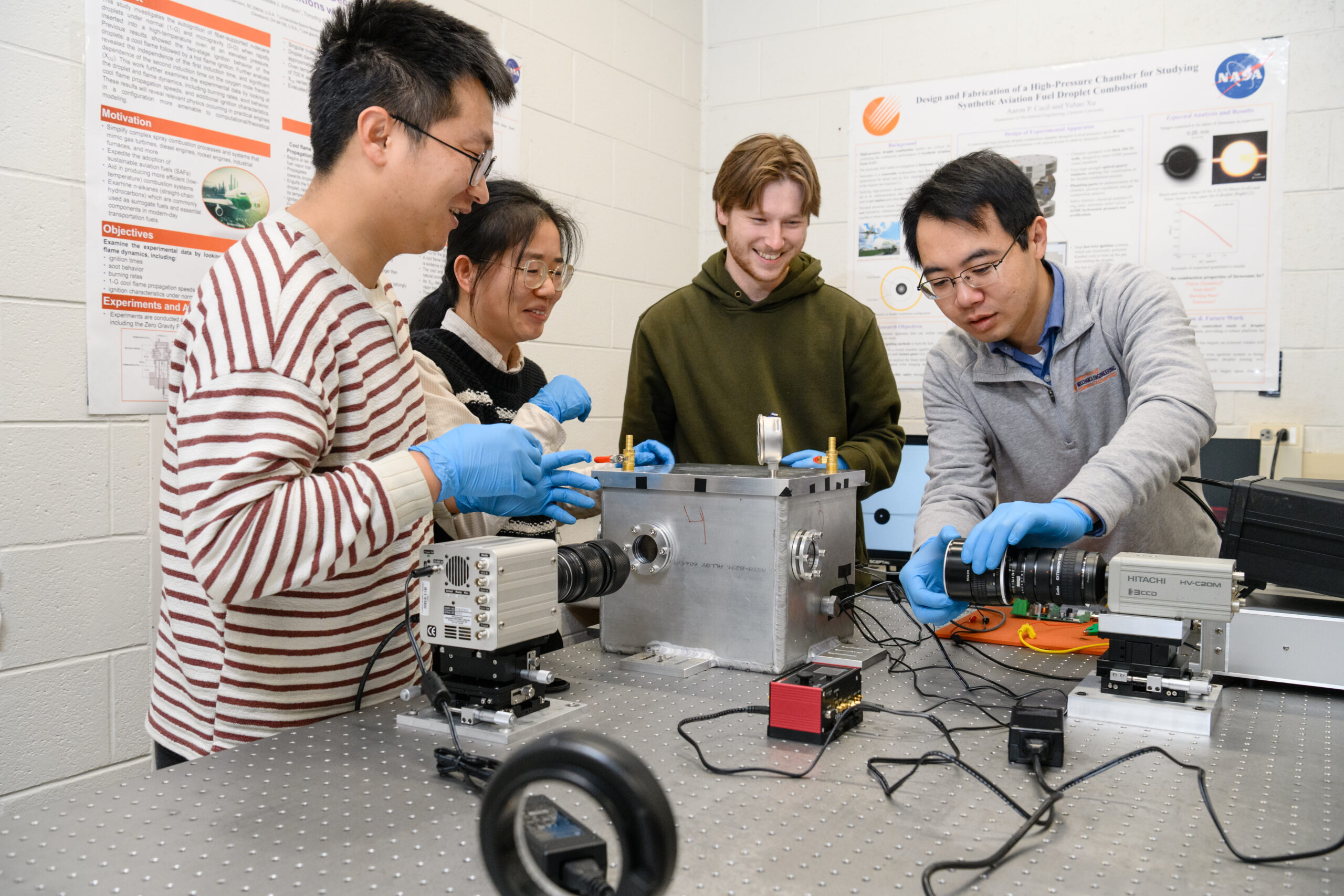
Astronauts could soon have advanced fire suppression techniques, thanks to groundbreaking research by Yuhao Xu and his team at Clemson University. As humanity prepares for extended missions to the Moon and Mars, understanding combustion in microgravity is essential for ensuring spacecraft safety.
Xu, an assistant professor of mechanical engineering, has gained national recognition for his work. He is particularly focused on developing innovative methods to suppress fire in space, a critical aspect of maintaining safety during long missions. “It’s very exciting,” Xu stated. “First, I feel like I’m pushing the boundary of scientific discovery. Second, it’s the human exploration of space. I know that my contribution is a very small part, but no matter how tiny that is, I am very excited to be part of it.”
Research and Recognition
As Xu looks toward 2026, he is set to make significant strides in fuel and combustion science. He recently received the 2025 Thora Halstead Young Investigator Award from the American Society for Gravitational and Space Research (ASGSR). Over the past three years at Clemson, Xu has built upon his twelve years of research in combustion, which began during his Ph.D. studies at Cornell University.
In 2013, Xu supervised experiments aboard the International Space Station, analyzing data and providing real-time feedback to the NASA Glenn Research Center. The findings from these experiments are still being evaluated, contributing valuable insights into combustion in space.
Innovative Techniques for Space Travel
Xu’s most ambitious project involves developing a reactor that can create fire within water, enabling astronauts to recycle wastewater effectively. This process, known as supercritical water oxidation, entails heating and pressurizing water to form a hydrothermal flame. This flame breaks down organic materials in wastewater, resulting in clean water suitable for consumption.
While still in its early stages, Xu believes this technology could revolutionize long-duration missions to the Moon and Mars. “This is a crucial step towards sustainable life-support systems in space,” he remarked.
Beyond aiding space missions, Xu’s research has implications for Earth as well. By finding cleaner ways to burn fuel and reduce soot emissions, his work could lead to more efficient engines and improved air quality.
Xu also plays a vital role in the national space research community, serving on the governing board of ASGSR. His involvement positions Clemson at the forefront of space-related research and innovation.
Alexander Leonessa, chair of the Department of Mechanical Engineering at Clemson, praised Xu’s contributions, noting, “Dr. Xu’s creativity and drive are helping elevate Clemson’s research profile. His work in space-related combustion not only advances science and technology but also inspires students by giving them access to cutting-edge projects that could have an impact on this planet—and beyond.”
As researchers like Xu continue to explore the complexities of combustion in space, the potential for safer and more sustainable space travel becomes increasingly promising.