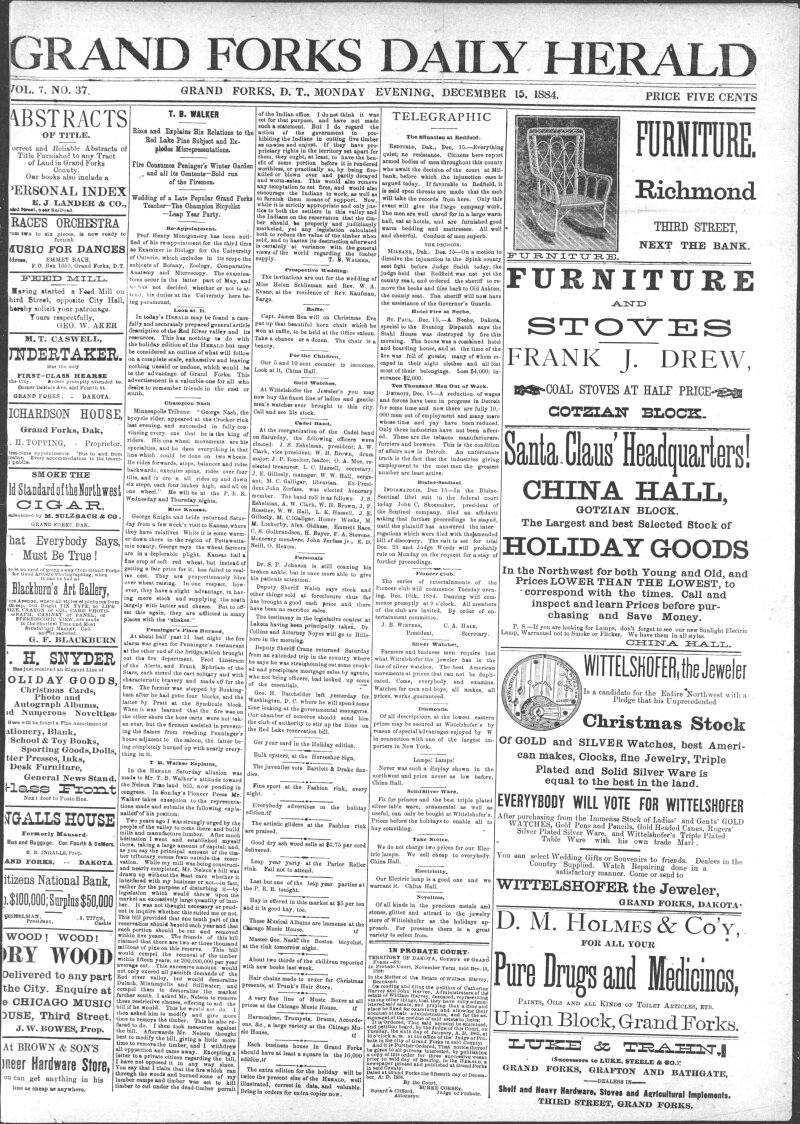
On December 15, 1884, the Grand Forks Herald issued a compelling report showcasing the promising developments in Grand Forks, North Dakota. At that time, the city, with a population of approximately 5,000, was emerging as a significant manufacturing center, driven by abundant local timber resources and enhanced railway access. The article emphasized the completion of a $250,000 roller mill, the establishment of the new University of North Dakota, and the region’s low tax rates, all of which contributed to its attractiveness for prospective residents and businesses.
The Grand Forks Herald detailed the city’s picturesque location at the convergence of the Red River, positioned about 300 miles west of St. Paul and 125 miles east of Red Lake. This strategic placement provided excellent transportation facilities through the Northern Pacific Railway, facilitating easy access to the vast forests rich in valuable timber. With the anticipated completion of the Canadian Pacific Railway and the Dakota Central Railway, competition among local towns was expected to intensify, further boosting the region’s economic potential.
A major highlight of the article was the announcement of the new roller mill, which was set to be constructed by W. H. Merritt and the Item Company. This facility would process 2,000 barrels of flour daily, operating continuously for 300 days a year. The article illustrated the scale of industrial activity in the area, mentioning several other mills, a steam beer brewery, and the production of quality bricks from local clay.
The establishment of the University of North Dakota was another focal point, with construction already underway. Once completed, the university’s main building would measure 150 feet in length, showcasing a commitment to higher education in the region. Dr. W. T. Montgomery had been appointed president, with a distinguished faculty set to provide top-notch education. The article praised the public schools in Grand Forks and the surrounding county, noting their superior quality compared to institutions in other states.
The Herald also highlighted the liberal homestead laws and low taxation, making the area particularly appealing for new settlers. The report noted that the taxable value of North Dakota had reached $70 million the previous year, with a growing population engaged primarily in agriculture. This environment fostered a thriving agricultural community, offering excellent opportunities for land acquisition at reasonable prices.
As the report concluded, the benefits of settling in Grand Forks were underscored. The climate, characterized as “mild, pleasant, healthy, and delightful,” was noted as a significant draw for potential residents. The article described the area’s dry atmosphere and abundance of clean air, presenting Grand Forks as a prime location for those seeking a new beginning.
The article from December 15, 1884, encapsulates a time of optimism and opportunity in Grand Forks, reflecting the aspirations of its citizens and the potential for future growth in the Dakota Territory.