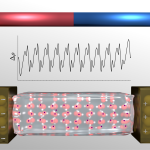
Researchers at Stony Brook University have made significant strides in understanding capacitor behavior at the nanoscale, as detailed in a recent study published in Physical Review Letters. The findings, released on January 23, 2026, challenge long-held beliefs regarding how capacitors function when miniaturized, providing a more robust scientific framework for the development of future nanoscale electronic devices.
Capacitors are fundamental components in modern electronics, storing electrical energy for various applications. Traditionally, the principles governing their operation have been well-established at larger scales. However, as electronic devices continue to shrink, understanding their behavior at the nanoscale becomes increasingly critical.
The research team, led by scientists at Stony Brook University, conducted extensive experiments and simulations to investigate the properties of capacitors at this minuscule scale. Their results indicate that conventional models do not accurately predict the performance of nanoscale capacitors. Instead, the findings suggest that these components may behave differently than previously thought, particularly in terms of energy storage capacity and efficiency.
The implications of this research extend beyond theoretical understanding. As industries strive to create smaller, more efficient electronic devices, a re-evaluation of capacitor behavior at the nanoscale could lead to innovations in various sectors, including consumer electronics, telecommunications, and renewable energy technologies.
Understanding how capacitors operate at smaller sizes will also aid in addressing challenges related to energy loss and heat generation, which can hinder device performance. By redefining the physical principles governing these components, Stony Brook’s research paves the way for the design of more efficient and powerful nanoscale electronic devices.
The study reflects a growing trend in nanotechnology research, where scientists are continuously exploring the limits of material properties and device functionality. As the demand for compact and efficient electronics rises, advancements in understanding nanoscale phenomena like those presented by the Stony Brook team will be crucial.
This groundbreaking research not only enhances scientific knowledge but also has the potential to influence the next generation of technological innovations. By providing a clearer understanding of capacitor behavior at the nanoscale, the findings from Stony Brook University could play a vital role in shaping the future of electronic design and engineering.