The enigmatic sounds known as the Seneca Drums and unexplained geological features are drawing scientific attention at Seneca Lake, New York. This summer, a collaborative team from Cornell University, the State University of New York College of Environmental Science and Forestry, and the New York State Department of Environmental Conservation embarked on a mission to uncover the lake’s secrets. Seneca Lake, the largest and deepest of New York’s Finger Lakes, serves as a drinking water source for approximately 100,000 residents, including those in Geneva, Waterloo, and Watkins Glen.
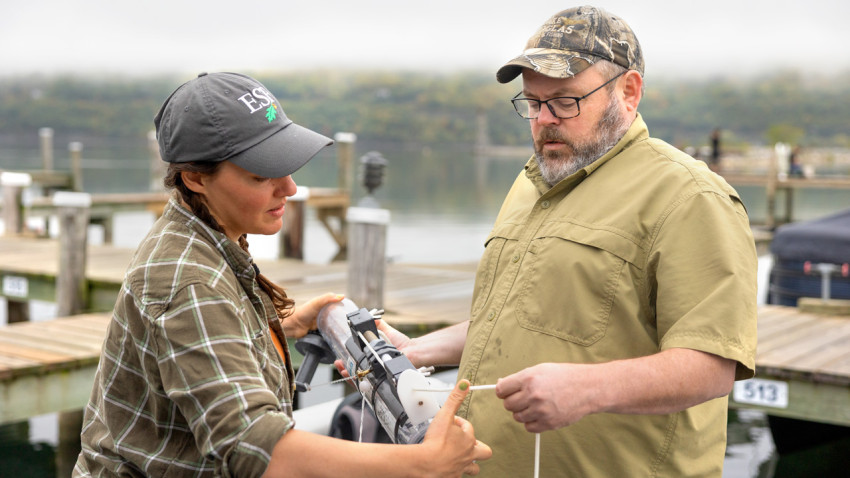
In September, researchers ventured onto the lake to collect water samples from its depths, focusing on pockmark formations believed to be connected to the mysterious sounds. The team sought to identify the presence of methane, which could provide insights into both the sounds and the geological features. Their findings revealed methane levels similar inside the pockmarks as in the surrounding lake, indicating that these formations are not continuously releasing gas.
Jed Sparks, a professor and chair in the Department of Ecology and Evolutionary Biology at Cornell University, explained, “Now we’re thinking these are episodic events where a bubble builds up in that sediment, and then it all erupts at one time.” This suggests that the booming noises might result from large bubbles reaching the surface and bursting, though the gas’s origin remains uncertain.
Sparks specializes in stable isotope analysis, allowing him to differentiate between methane produced by biological processes and that derived from fossil sources. His team found that the gas in the lake appears to originate from a mix of both biological and fossil sources. “The bottom of the lake doesn’t have any oxygen, so there are very few biogeochemical processes that make a gas,” he noted. The analysis of methane remains complex, leaving room for further inquiry.
The research team is also addressing another mystery: the high levels of chloride in Seneca Lake. Even accounting for contributions from human activities such as road salt, the lake’s chloride levels are notably higher than those found in other Finger Lakes and exceed recommended limits for drinking water. The team deployed sensors to measure chloride and conductivity levels at the lake’s bottom, intending to retrieve them in May 2024.
Sparks highlighted the ongoing investigation: “There’s always been this weird extra source of chloride that nobody knows about. We’re interested to see if there’s chloride leaking out of these pockmarks as well.” The sensors are designed to be sonically activated for retrieval, floating back up from depths of 600 feet when triggered.
In addition to studying the lake’s chemistry, Sparks and his colleague, Geoffrey Abers, the William and Katherine Snee Professor in Geological Sciences at Cornell Engineering, are considering the deployment of seismic listening equipment at the southern end of Seneca Lake. This technology could help determine the frequency and magnitude of the Seneca Drums. “We could get an idea of how often and how big they are, and then you could start to put that into models,” Sparks stated.
While the Seneca Drums capture significant attention, Sparks notes that similar phenomena likely occur in other lakes. He expressed a broader perspective on scientific exploration, saying, “We don’t just do science to make things that help us grow food faster. We also do things just because it’s really cool. I like living on this planet because it has these really interesting things in it.”
As research continues, the Seneca Lake project not only aims to unravel geological enigmas but also highlights the delicate balance between natural phenomena and human impact in one of New York’s vital freshwater resources.