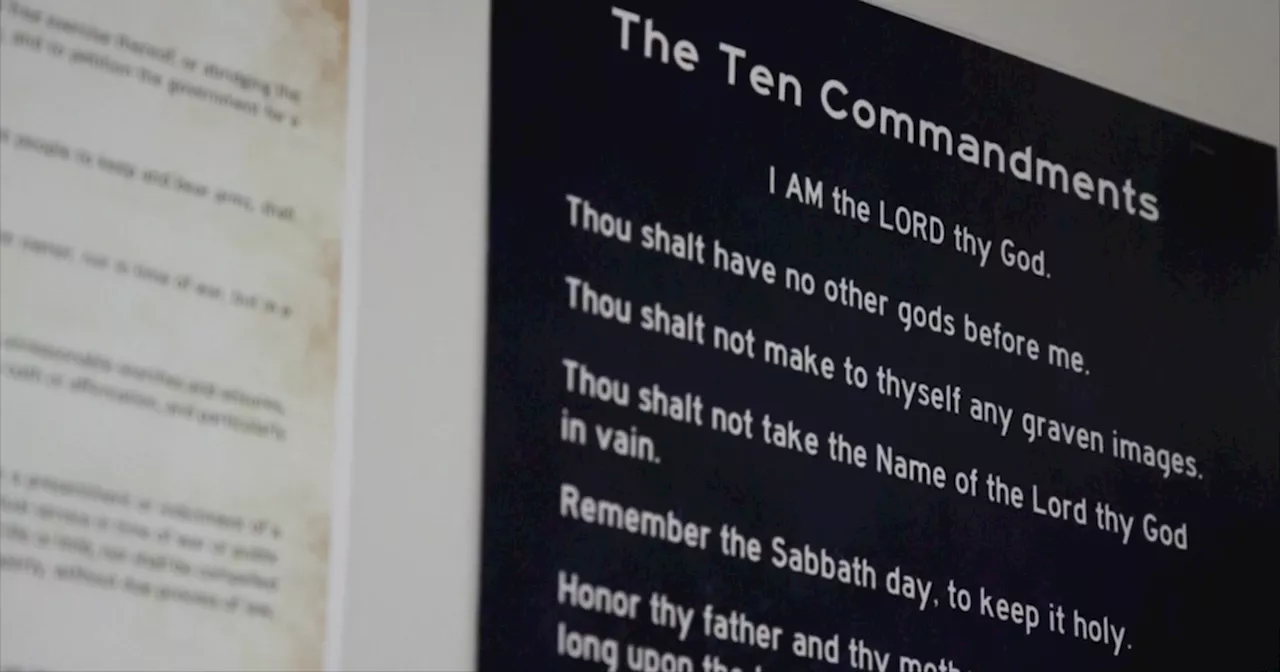
The Ohio Senate has passed a controversial bill that would permit public schools to display the Ten Commandments alongside other historic texts in classrooms. This legislation, known as S.B. 34, reflects a growing push among some lawmakers to integrate more Christian elements into the educational framework.
The bill, spearheaded by Republican senators, allows public schools to display a selection of significant documents, which includes the Declaration of Independence, the U.S. Constitution, and the Ten Commandments. According to state Senator Terry Johnson, who supports the measure, these texts are essential to understanding America’s legal and moral foundations. “This bill will expose our students to the documents which have, in America, served as the backbone of our legal and moral traditions,” he stated.
Under the proposed legislation, each school district would be required to choose at least four documents from a list that includes the Magna Carta and the Bill of Rights. Critics argue that the bill constitutes a mandate rather than an option, pointing to provisions that require schools to display donated texts. Senate Minority Leader Nickie Antonio, a former educator, condemned the bill as unconstitutional, asserting that presenting religious texts in classrooms contradicts the principle of separation of church and state.
Experts on constitutional law have expressed concerns regarding the implications of this legislation. Retired professor Jonathan Entin from Case Western Reserve University noted that the bill raises significant First Amendment issues. He referenced past Supreme Court rulings, including the 1980 case of Stone v. Graham, which determined that displaying the Ten Commandments in public schools violated the establishment clause of the First Amendment. He also pointed out that a subsequent ruling in Van Orden v. Perry allowed the Ten Commandments to be displayed in public spaces as part of a broader historical context.
In recent years, there has been a notable trend in several states advocating for the inclusion of religious doctrine in school curricula. For instance, in Texas, a court recently mandated the removal of the Ten Commandments from classrooms, citing similar constitutional concerns. However, Entin suggested that the current composition of the Supreme Court could influence how such cases are approached, as the majority appears to be more favorable towards public displays of religious symbols.
In addition to S.B. 34, the Ohio House has passed another bill, H.B. 486, titled the “Charlie Kirk American Heritage Act.” This legislation aims to allow K-12 public schools and university professors to teach about the positive impacts of religion on American history. Proponents, including state Representative Gary Click, argue that many Americans lack an understanding of the nation’s Christian roots and their significance to liberty and freedom. Click emphasized, “I think we need to be able to be free to teach that.”
The House has also advanced H.B. 485, which mandates that fifth graders and older watch a controversial animated video on fetal development created by the anti-abortion group Live Action. Representative Melanie Miller stated that the goal is to promote a culture of celebrating life. Critics of this bill, including abortion rights advocate Kellie Copeland, have raised concerns about the accuracy of the video’s content, labeling it as medically misleading and offensive.
These legislative efforts in Ohio highlight the ongoing debate over the role of religion in public education. As the bills progress through the state legislature, both supporters and opponents will continue to voice their perspectives on what they believe should be taught in schools and the extent to which religious doctrine should influence educational content.