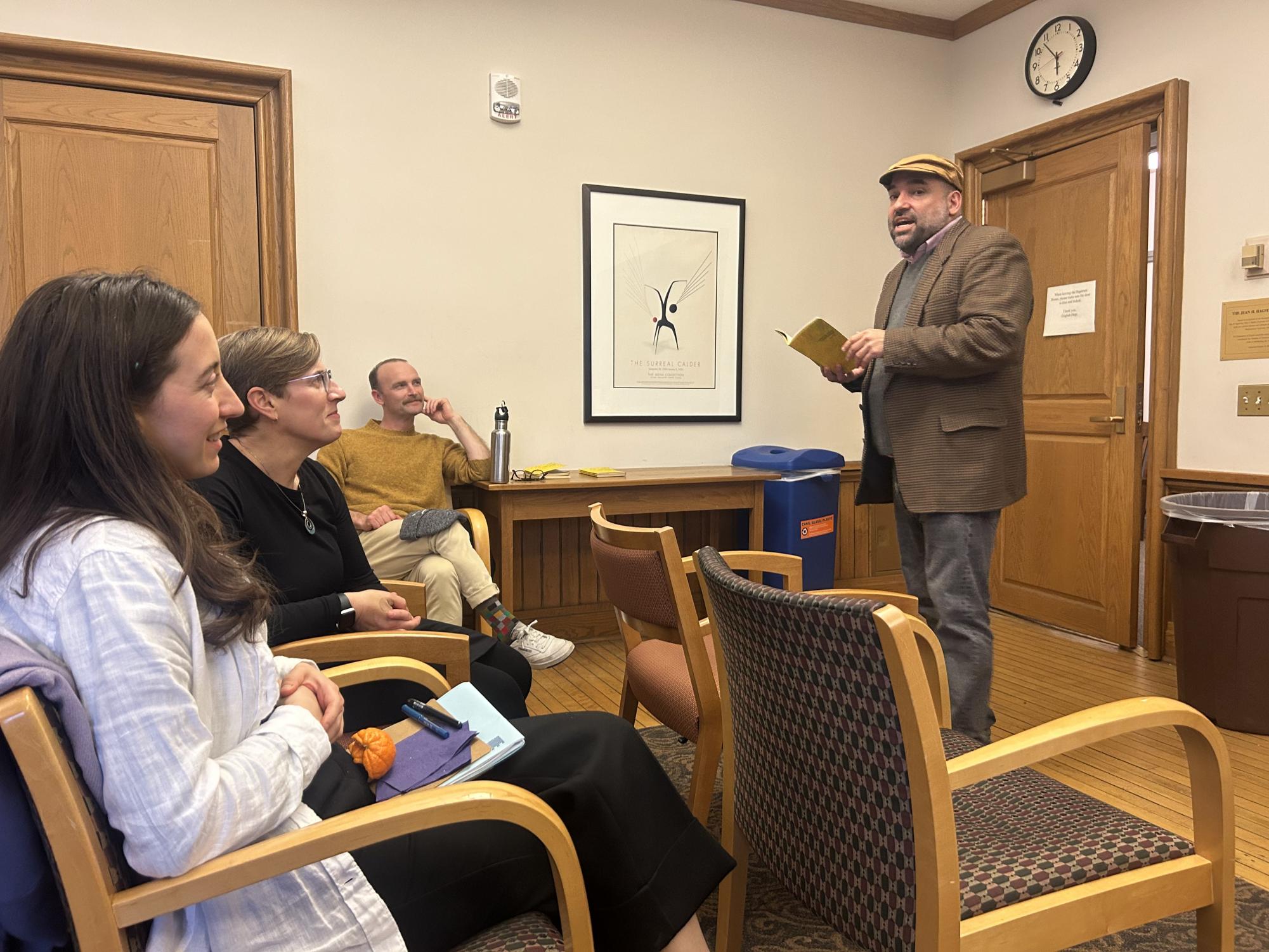
Poet and translator Urayoán Noel captivated an audience of approximately 15 attendees at Northwestern University on March 14, 2024, during a poetry reading and Q&A session. This event was part of the English department’s Unsettling Sound series, where Noel shared his literary work and insights, engaging the community in a rich dialogue about poetry and translation.
Noel, who teaches English and Spanish at New York University, began the evening by reading selections from his 2021 poetry collection, “Transversal.” Utilizing dynamic vocal techniques, he alternated between English and Spanish versions of his poems, enhancing the experience with instrumental music in the background. In one notable piece, titled “Juliécimas,” he expressed profound thoughts on the essence of poetry, stating, “Now poetry is just a name for this, our faint embodied sound, for music once it’s not around, for ash in lockstep with the flame, for streets still summoning the same old shadows.”
Transitioning to his ongoing series “Wokitokiteki,” Noel described it as a “walking poetic improvisation project.” He creates poetry while exploring neighborhoods in Puerto Rico and U.S. cities with significant Puerto Rican populations. In honor of his visit to the Chicagoland area, he presented a piece inspired by Humboldt Park, a historically Puerto Rican cultural hub, drawing from his observations during a walk in the neighborhood.
As a translator, Noel has worked extensively with the poetry of Wingston González, a Garifuna and Guatemalan poet. He recited verses from an unpublished translation of González’s 2015 book, “Translaciones.” During the discussion, Noel emphasized the collaborative nature of translation, explaining that despite cultural differences, he and González share a mutual understanding of performance and improvisation. He cited the work of Mary Louise Pratt, saying that translation involves more than mere equivalences; it is about grasping and conveying the experiences of different cultures.
Continuing the evening, Noel presented excerpts from his forthcoming autobiographical prose work, “Cuaderno de Isabela/Isabela Notebook,” and distributed copies to attendees. In one poem, he reflected on a striking image: “Tell me if there’s a city like the one with the horse staring at the sea in front of windows with iron bars and flanked by piles of car tires…” This vivid imagery resonated with the audience, highlighting his ability to evoke place through language.
The event transitioned into a Q&A session where Noel elaborated on his “Wokitokiteki” project and the significance of improvisation in poetry. He differentiated between the product and the process of writing, emphasizing the importance of focusing on the journey rather than solely on the final output. “We can always do things to become better writers, but I can’t tell you what you need to write,” he explained, adding, “What I can share with you is the process. How did my process get me from A to B?”
Attendees included Emily Maguire and Julia Oliver Rajan, professors in the Spanish and Portuguese department. Maguire, who studied alongside Noel at NYU, praised his performance skills and bilingual proficiency. “He has a tremendous facility in both Spanish and English, but he is also someone who has a tremendous gift for performing live and a real ability to capture an audience and move and entertain in surprising and creative ways,” she noted.
Rajan, who is Puerto Rican, expressed her appreciation for Noel’s portrayal of Puerto Rican culture in his poetry. “The way he described Puerto Rico, the struggles of Puerto Rico — I liked those things in his poetry,” she remarked.
During the Q&A, Noel tackled the complexities of translating works from poets of different cultures or those who have passed away. He explained the inherent challenges of this role, describing translation as “the least messed-up kind of appropriation.” He acknowledged the tension in telling the stories of others, especially when there are cultural differences. “But to me, that shouldn’t dissuade us, because there’s way more work that needs to be translated than there are translators,” he concluded.
Noel’s reading not only showcased his poetic talent but also fostered a deeper understanding of the intercultural dialogues inherent in both poetry and translation, leaving a lasting impression on the Northwestern community.