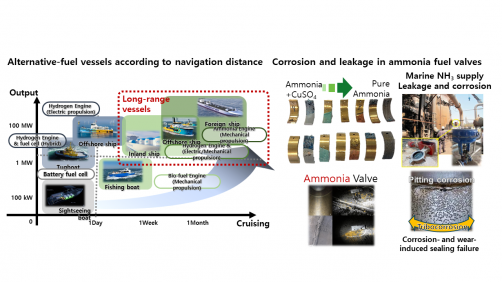
A collaborative research effort led by Dr. Young-Jun Jang and Dr. Jongkuk Kim at the Korea Institute of Materials Science (KIMS) has culminated in the development of a pioneering carbon coating technology. This innovation is designed to address the significant corrosion and wear challenges faced by metals used in ammonia-fueled marine vessels, marking a substantial advancement for eco-friendly shipping.
The newly engineered coating, referred to as ta-C:Hx, demonstrates remarkable resistance to corrosion and wear in environments characterized by ammonia fuel. This breakthrough is particularly important as conventional marine materials, such as stainless steel 440C, experience degradation due to ammonia’s strong alkalinity and chemical reactivity. Such conditions can lead to the failure of crucial components, including engines, valves, and pumps, necessitating enhanced protective measures during the design and certification of ammonia-powered ships.
The high-performance carbon coating technology effectively reduces corrosion current densities from approximately 48 μA/cm2 in traditional materials to just 4 μA/cm2, representing a remarkable 92% reduction. Moreover, it achieves a reduction in corrosive wear rates from 1.4 × 10⁻⁶ mm3/N·m for conventional SS440C to 1.3 × 10⁻⁸ mm3/N·m, reflecting a 99.1% decrease in tribocorrosion wear tests within ammonia solutions.
Significance of the Research
Conventional coatings used in marine applications primarily address seawater and atmospheric conditions, lacking proven reliability in the harsh, alkaline environments associated with ammonia. These traditional methods often suffer from defects such as pores and thickness inconsistencies, which can serve as initiation sites for corrosion. The innovative process developed by KIMS utilizes pulsed bias control in a filtered arc deposition method, effectively minimizing these vulnerabilities. The introduction of hydrogen during the coating process enhances the internal structure and stability of the coating, allowing it to withstand corrosion in aqueous ammonia conditions.
This technology is positioned as the first domestically developed surface coating solution in Korea that meets the rigorous corrosion resistance standards necessary for the certification of ammonia-powered ships. The urgency for such innovations is underscored by the 2023 IMO Greenhouse Gas Reduction Strategy, which mandates the transition to zero-carbon fuels in international shipping by 2030. Furthermore, the Maritime Safety Committee (MSC) has enacted interim guidelines requiring the verification of metallic materials’ corrosion resistance used in fuel systems.
Future Implications and Collaborations
South Korea has identified ammonia-powered vessels as a strategic sector within its shipbuilding and shipping industries under the 2050 Green Shipping National Action Plan. Despite progress, the lack of domestically developed coating technologies capable of withstanding corrosive environments has posed challenges for commercialization. The KIMS research team builds on its extensive expertise in carbon coating technologies to address these gaps, enhancing the nation’s competitive edge in the evolving maritime sector.
Dr. Young-Jun Jang, the principal investigator, emphasized the potential impact of this technology on the industry, stating, “If this technology is commercialized, it will provide a practical solution for long-distance operation by significantly improving the efficiency and reliability of key components for eco-friendly shipbuilding and marine vessels.” Co-researchers Dr. Jongkuk Kim and Dr. Sungmo Moon noted that the project exemplifies the strength of domestic research capabilities, developed through KIMS’s internal infrastructure rather than relying on external technologies.
The research has received backing from KIMS’s in-house programs and the National Research Foundation of Korea (NRF), supporting initiatives for practical tribology technologies in cryogenic environments. The findings were published on December 1, 2025, in the esteemed journal *Carbon*, which boasts an impact factor of 11.6. Currently, the research team is focusing on stabilizing the coating process and conducting reliability evaluations for ammonia fuel applications while exploring opportunities for technology transfer and collaboration with industry partners.
As the maritime industry shifts towards greener alternatives, the development of advanced corrosion-resistant technologies like this coating is crucial for enabling the safe and efficient operation of ammonia-powered vessels in the future.