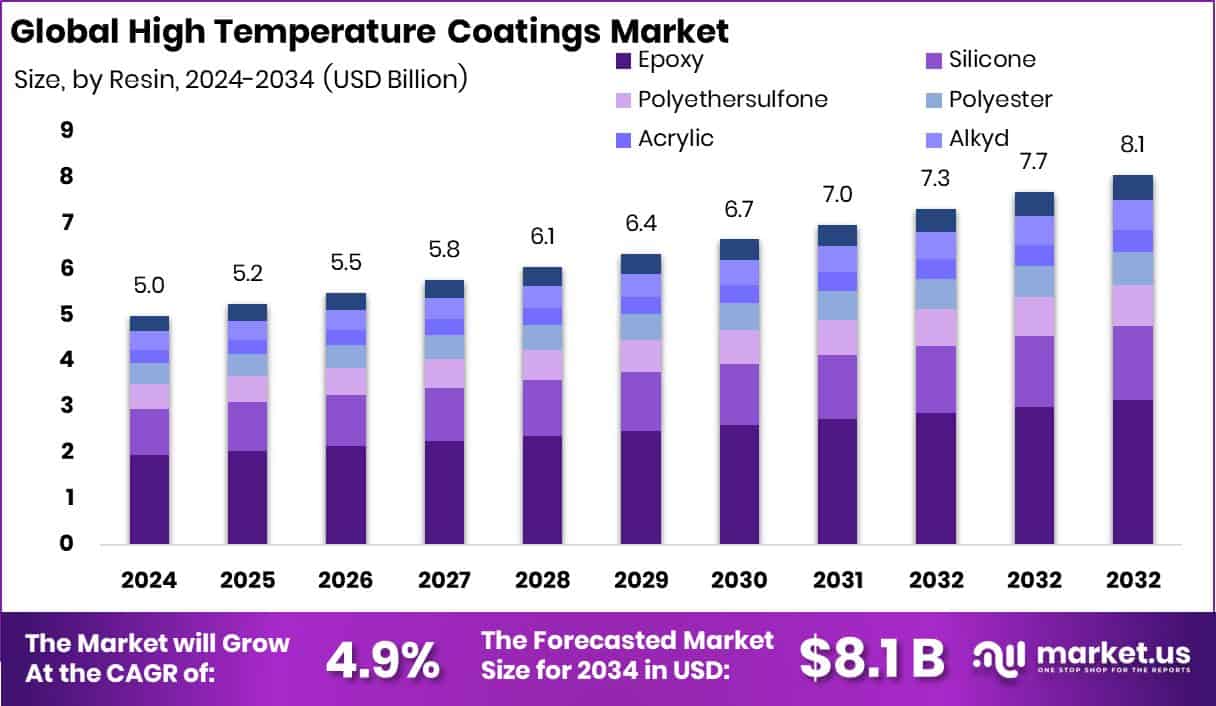
The global market for high temperature coatings is set for significant growth, projected to increase from USD 5.0 billion in 2024 to USD 8.1 billion by 2034, representing a compound annual growth rate (CAGR) of 4.9%. This expansion is largely driven by the demand for enhanced durability in equipment operating under extreme heat conditions. The Asia Pacific region currently holds a substantial market share of 48.10%, fueled by extensive manufacturing and infrastructure activities.
High temperature coatings serve a vital role across various industries by preventing oxidation, corrosion, and thermal degradation in critical components such as furnaces, exhaust systems, and heavy-duty power equipment. Innovation in materials is a key factor driving growth. For instance, a company based in Renton recently became a finalist in a USD 3 million global business competition for its bio-epoxy resins, highlighting the shift towards advanced and sustainable coating solutions.
Government initiatives also bolster the sector, exemplified by Ontario’s USD 10.4 million investment aimed at facility upgrades, which enhances the need for protective coatings in modern machinery. Additionally, emerging applications in diverse sectors, such as a camping technology startup securing USD 500,000 in pre-seed funding, indicate that heat-resistant materials are expanding beyond traditional industrial uses.
Key Players in High Temperature Coatings
Several companies are at the forefront of innovation in high temperature coatings, each contributing to the market’s evolution through advanced technologies and sustainable practices.
BASF SE is enhancing its global footprint in coatings and materials through diversified industrial solutions. The company focuses on automotive, industrial coatings, and functional materials that support heat resistance and energy efficiency. With a strong R&D network across Europe, Asia, and the Americas, BASF emphasizes low-emission technologies and high-temperature-resistant chemistries. As of 2024, BASF’s revenue is projected to reach €68.9 billion.
Akzo Nobel N.V. is renowned for its decorative paints and performance coatings. The company invests heavily in sustainable practices, including low-VOC formulations and high-durability resins. Its global brands, such as Dulux and Interpon, are integral to manufacturing and architectural applications. Expected revenue for Akzo Nobel in 2024 stands at €11.1 billion.
The Sherwin-Williams Company ranks among the largest producers of paints and performance coatings, specializing in high-temperature and protective systems for heavy equipment and energy sectors. With over 5,000 retail stores worldwide, the company’s revenue is anticipated to be USD 22.1 billion in 2024.
PPG Industries, Inc. is known for its advanced coatings and specialty materials for various sectors, including automotive and aerospace. The company’s revenue is projected at USD 20.0 billion for 2024. PPG maintains a robust network of R&D labs to support its innovative approaches to heat-resistant technologies.
Following its acquisition by Sherwin-Williams, Valspar continues to provide a wide range of industrial and protective coatings. The brand remains integral in sectors such as metal coatings and packaging, leveraging its legacy of durability in coatings.
Other notable companies in the market include Carboline Company, specializing in high-performance coatings for oil and gas applications, and Axalta Coating Systems, LLC, which offers coatings designed for automotive and industrial uses. Additionally, Jotun and Aremco focus on protective coatings for marine and aerospace applications, respectively, while Belzona International Ltd. is recognized for its repair composites used in heavy industries.
The Future of High Temperature Coatings
As industries increasingly seek better protection for equipment exposed to extreme heat, the demand for high temperature coatings is expected to rise. Innovations in eco-friendly chemistries, high-performance resins, and specialized protective technologies are creating new applications. These advancements not only enhance operational reliability but also reduce maintenance needs and extend the lifespan of critical equipment.
The ongoing development of these coatings aligns with the growing complexity of industrial systems, particularly in sectors such as manufacturing and energy. The future appears bright for high temperature coatings, which will continue to play a crucial role in ensuring efficiency and durability in a wide range of applications.
As the market evolves, stakeholders are encouraged to explore innovative solutions and stay informed on industry trends to capitalize on emerging opportunities.