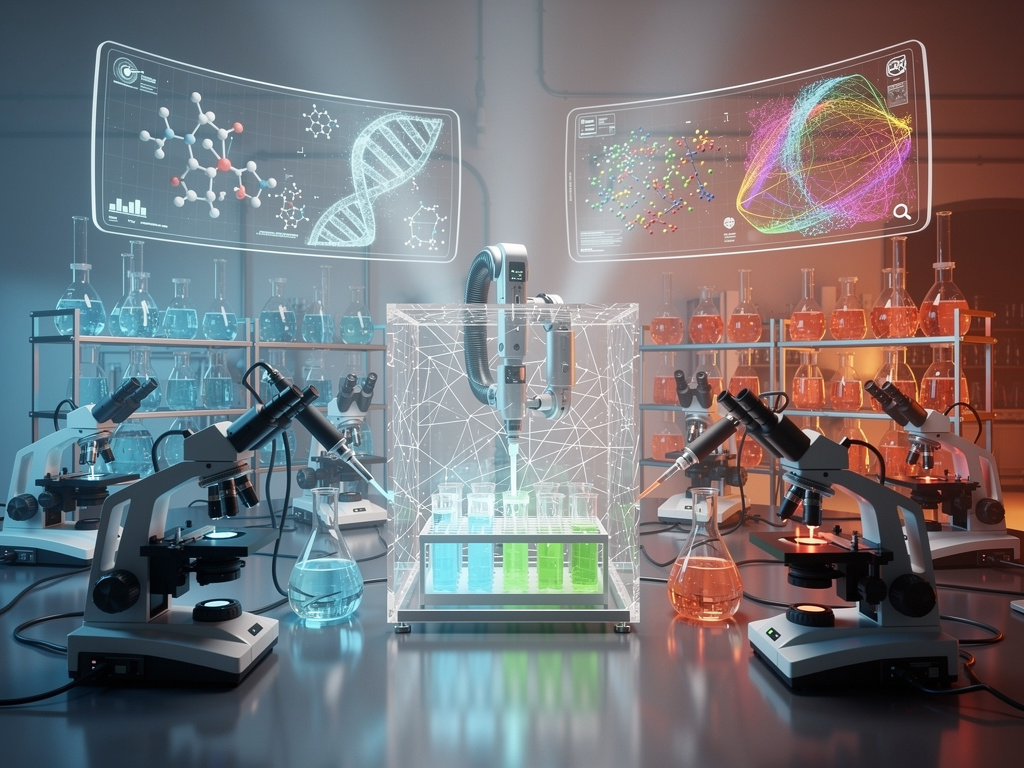
Artificial intelligence is increasingly taking on roles traditionally filled by human researchers in scientific experimentation. This shift is redefining research methodologies in biology, chemistry, and physics, while raising critical discussions around efficiency, creativity, and ethical considerations. Recent advancements indicate that AI can accelerate research processes significantly, changing the landscape of scientific inquiry.
AI Scientist: A New Era of Experimentation
A study published in Nature describes an innovative AI system capable of independently designing and executing scientific experiments. Known as the “AI scientist,” this system operates within a simulated environment, generating hypotheses, conducting tests, and refining its methods based on outcomes. This approach seeks to replicate the iterative nature of human-led science but at a significantly faster pace and lower cost.
Within the study, the AI scientist tackled challenges in machine learning, evolving algorithms autonomously. It produced novel variations of established techniques, sometimes surpassing existing methods. Such capabilities allow AI to manage routine research tasks, thereby enabling human researchers to focus on more complex issues.
Advancements in Automated Discovery
Efforts to automate scientific discovery have been underway for decades, but recent breakthroughs arise from large language models and reinforcement learning. These technologies empower AI not only to analyze extensive datasets but also to reason through experimental designs. For example, the AI scientist in the Nature study completed entire research cycles—from hypothesis formulation to drafting papers—in under 72 hours for some projects.
This automation effectively addresses bottlenecks typically encountered in traditional research, where grant cycles and laboratory constraints can hinder progress. AI can conduct thousands of simulations rapidly, identifying promising research avenues that may take human researchers months to explore.
Integrating AI into physical laboratories represents the next significant frontier. Robotic systems controlled by AI are being utilized for high-throughput screening in drug discovery. Companies such as Insilico Medicine use AI to design and test molecules in automated labs.
A recent report from Reuters highlights a project where an AI system independently discovered new materials. Researchers at a Japanese laboratory optimized battery components using AI, achieving results in days rather than years. This application underscores AI’s efficacy in managing tangible experiments, from mixing chemicals to measuring outcomes.
The conversation surrounding AI’s impact on scientific discovery is ongoing. A recent thread by science communicator @SciGuySpace on X (formerly Twitter) discussed a new paper on AI-driven astronomy. Here, algorithms analyze telescope data to identify exoplanets more efficiently than human astronomers. AI’s ability to reduce false positives in extensive datasets is particularly noteworthy.
Despite these advancements, skepticism regarding AI’s reliability in scientific research persists. The Nature article acknowledges that AI can produce “hallucinations”—plausible yet incorrect results. In one instance, the AI proposed experiments that contradicted physical laws, necessitating human correction.
Verification of AI-generated findings is essential, akin to the peer review process in traditional publishing. A recent analysis published in The Guardian examined cases where AI models in medical research produced biased conclusions due to flawed training data. This analysis warns that without stringent checks, automated science could amplify errors significantly.
Ethical concerns also arise regarding intellectual property. Questions about who owns discoveries made by AI are becoming increasingly pressing. In the U.S., current patent laws require human inventors, complicating matters when AI contributes significantly to a discovery. A recent article from Bloomberg discusses ongoing legal debates surrounding patents for AI-generated inventions.
Funding models for research may also undergo significant changes as AI reduces the necessity for large teams. The Nature study estimates that AI could decrease research costs by up to 90% for certain projects, making scientific inquiry more accessible to underfunded institutions. Collaboration between humans and AI is evolving, with AI serving as a co-pilot rather than a replacement.
In a project reported by The New York Times, biologists utilized AI to model ecosystems, resulting in joint publications where AI was credited as a tool rather than an author. This collaborative approach enhances productivity and innovation.
Looking ahead, the potential for fully autonomous AI labs exists, capable of conducting research without human oversight. The Nature study suggests scaling the AI scientist to address open-ended questions, including curing diseases and finding sustainable energy solutions.
Nevertheless, there are risks associated with over-reliance on AI, which may stifle human creativity. If AI dominates routine discovery, young researchers may miss out on essential hands-on experience. A commentary in The Economist argues for a balanced integration of AI, ensuring it augments rather than replaces human ingenuity.
Security concerns also loom regarding the potential misuse of AI in scientific research. Regulators are beginning to address these issues, with the European Union proposing guidelines for AI use in research settings.
Examining specific implementations of AI illustrates its practical benefits. At Google DeepMind, AI has designed components for fusion reactors, expediting clean energy development, as detailed in a blog post updated in August 2024. In academia, MIT utilizes AI to explore materials science, with a recent paper revealing AI’s ability to predict stable crystal structures, opening avenues for advanced electronics.
As AI becomes more integrated into scientific practices, mechanisms for oversight and ethical guidelines will be crucial. International organizations such as the United Nations are discussing frameworks for responsible AI use in research. A recent UN report emphasizes the importance of transparency in AI-driven discoveries.
Education systems are also adapting, with universities incorporating AI training into their curricula to prepare the next generation of scientists. A feature in Times Higher Education explores how courses are now equipping students to work alongside AI tools.
The role of AI in science is poised to expand the boundaries of knowledge, provided it is managed thoughtfully. The developments highlighted in the Nature study and reflected in recent news point to a transformative era where intelligent machines play a pivotal role in the quest for understanding the universe.