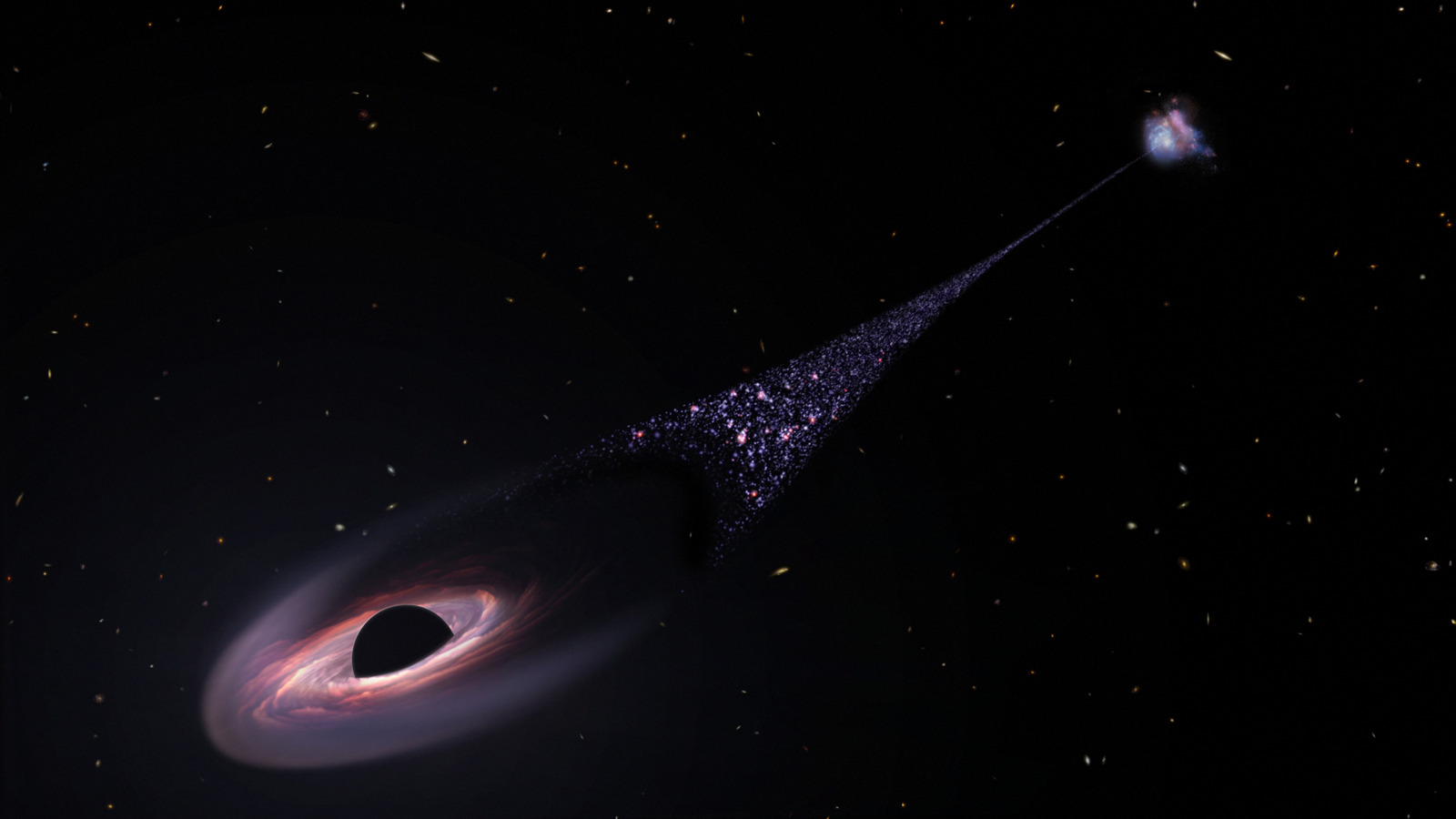
Researchers have confirmed the existence of a “runaway” supermassive black hole (SMBH) that is accelerating away from its original galaxy at an astonishing speed of 2.2 million mph. This groundbreaking discovery, which reveals a black hole with a mass equivalent to 20 million suns, was announced in a paper titled “JWST Confirmation of a Runaway Supermassive Black Hole via its Supersonic Bow Shock.” The paper was authored by Pieter van Dokkum of Yale University and his team, and was uploaded to arXiv in December 2025.
The researchers first detected the potential runaway black hole in 2023 while analyzing an image captured by the Hubble Space Telescope. They noted a thin line linked to the center of a galaxy, which prompted them to investigate further. Van Dokkum explained to Live Science that this observation indicated the presence of a massive black hole that had been ejected from its host galaxy, leaving behind a trail of gas and newly formed stars.
To confirm their findings, the team utilized the advanced capabilities of the James Webb Space Telescope (JWST). The JWST’s imaging technology revealed a bow shock at the front of the SMBH, solidifying evidence that the black hole is indeed escaping its galaxy at a rapid pace.
The Mystery of Supermassive Black Holes
Supermassive black holes remain a significant enigma in astrophysics. Although they are thought to exist at the center of most galaxies, the mechanisms behind their formation and rapid growth are still not fully understood. Various theories exist, but definitive answers remain elusive.
The paper suggests that this particular runaway SMBH was propelled into its escape trajectory by a “velocity kick,” likely caused by gravitational-wave recoil or a three-body interaction. Van Dokkum elaborated that such velocity kicks can occur when two or more supermassive black holes come into close proximity, leading to one being ejected due to the gravitational influence of the others.
In addition to this confirmed runaway black hole, the research also identifies several other potential candidates. Among them is a massive black hole located in the dwarf galaxy MaNGA 12772-12704, which is situated approximately 1 kiloparsec from the galaxy’s center. This candidate was first reported in a brief communication published in Volume 70, Issue 21 of Science Bulletin.
While Van Dokkum’s team stands out as the first to confirm a runaway SMBH, their findings are still subject to peer review. The implications of such discoveries could reshape our understanding of black holes and their behavior within the cosmos, shedding light on the dynamic processes that govern the universe.
As research continues, the universe still holds many mysteries, particularly regarding the formation and evolution of supermassive black holes. This remarkable finding is a significant step toward unraveling those mysteries and understanding the complex interactions that occur in the depths of space.