UPDATE: A significant eruption at Kilauea has captivated observers as it nears the one-year mark, with the latest episode raising urgent safety concerns. Since December 23, 2024, the volcano has exhibited a rare style of high lava-fountaining, and new forecasts predict that the next fountaining episode could commence between December 22 and 27, 2025.
The ongoing eruption, which began before dawn nearly a year ago, stands out for its intense fountaining episodes, reaching heights of up to 460 meters (1,500 feet). Visitors to Hawaii Volcanoes National Park have been rewarded with breathtaking views, but officials warn that the dynamic nature of this volcanic activity brings life-threatening hazards that can escalate rapidly.
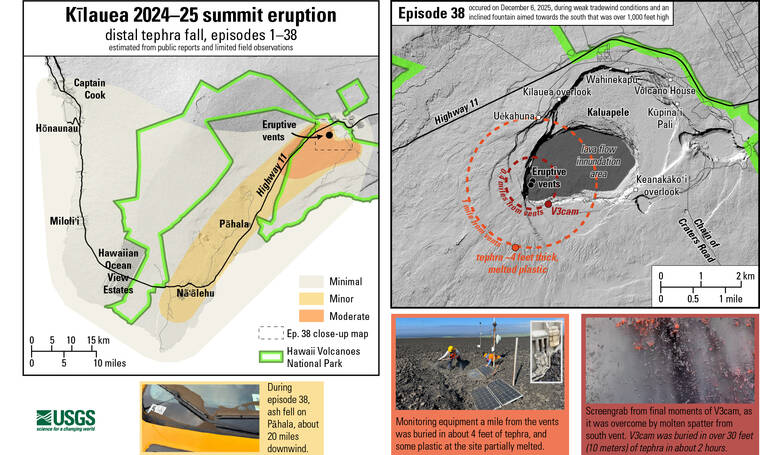
On December 6, 2025, the recent Episode 38 showcased the volcano’s volatility, featuring a 12-hour fountaining event that surged as high as 300 meters (1,000 feet). The eruption’s rapid intensity prompted significant changes in the landscape, with tephra covering pre-existing cracks and creating a new 42-meter (140 ft) tall hill on the crater rim. The caldera floor itself has risen by 68 meters (223 feet) due to ongoing activity.
Officials from the US Geological Survey (USGS) are closely monitoring Kilauea’s activity, emphasizing the critical advancements in technology that have enabled them to provide timely forecasts and detailed observations. The current eruption represents a unique opportunity for scientists and the public alike to witness the power of Hawaiian volcanoes, but caution is paramount.
“During high fountaining events, life-threatening hazards exist within the closed areas of the park,”
warned USGS officials. The areas of highest risk can change dramatically, particularly if fountaining becomes inclined, as it did during Episode 38.
Volcanic air pollution, known as vog, can also extend its reach to neighboring islands, further complicating public safety measures. As Kilauea continues to erupt, the USGS has recorded no unusual activity along the East Rift Zone or Southwest Rift Zone, and Mauna Loa remains at a NORMAL alert level.
Behind the scenes, dedicated staff at the Hawaiian Volcano Observatory (HVO) are working tirelessly to track the volcano’s behavior. Engineers are navigating thick deposits of tephra to maintain monitoring stations, while geologists gather crucial data on tephra thickness and composition to understand the eruption’s evolution.
As of December 15, 2025, the eruption is currently paused, but intermittent glow at the south vent signals that activity is far from over. With the potential for a new episode on the horizon, experts urge the public to heed park safety guidelines and respect closed areas.
This historic eruption offers a once-in-a-lifetime chance to witness the beauty and fury of Kilauea. Stay tuned for further updates from the USGS as this developing story unfolds. For the latest information, please visit HVO’s website, where you can find updates on Kilauea and Mauna Loa, as well as volcano photos, maps, and earthquake data.
Follow safety protocols to ensure your well-being while experiencing the remarkable power of nature.