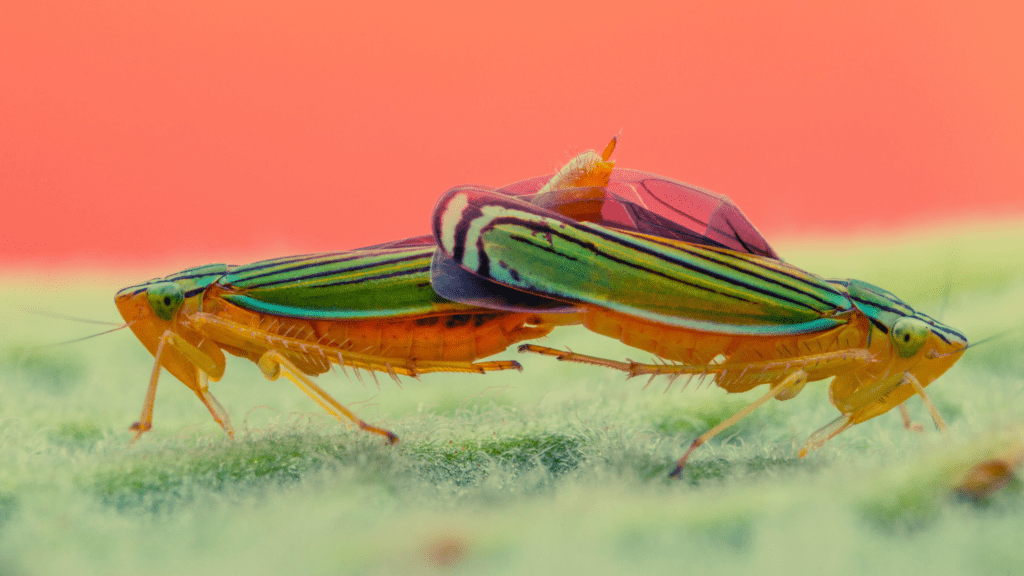
UPDATE: Scientists at Penn State have achieved a remarkable breakthrough by replicating the leafhopper’s extraordinary ability to become nearly invisible. This urgent development, published in ACS Nano, reveals how these common insects use microscopic particles to evade predators.
Leafhoppers, often unnoticed due to their small size and green color, employ a unique method to blend into their surroundings. Their bodies produce tiny hollow particles known as brochosomes, which significantly reduce glare, making them difficult to detect by animals relying on reflected light. Researchers confirm that the replicated particles can reduce reflected glare by an astonishing 80 to 96 percent across visible and ultraviolet light wavelengths.
The Penn State team utilized an innovative chemical approach rather than traditional nanofabrication methods. They developed a microfluidic system capable of generating microscopic droplets containing dissolved polymers suspended in water. As the solvent evaporates, these polymers are drawn into hollow spheres with patterned pores, mirroring the natural brochosomes found on leafhoppers.
The speed of production is notable, with the system capable of generating over 100,000 particles per second. This efficiency could lead to applications beyond the laboratory. The team successfully recreated five distinct brochosome designs observed in various leafhopper species, with sizes ranging from a few hundred nanometers to about two micrometers.
The implications of this research are vast. Potential applications span multiple industries, including energy devices that could benefit from surfaces reflecting less light, improved optical materials for better glare control, and even military camouflage. Although practical uses are still in the testing phase, the researchers suggest the technology could also have biomedical applications, such as drug delivery, due to the unique shape and surface properties of the particles.
This study stands out not only for its scientific advancements but also for its connection to an ordinary backyard insect. A creature that many might overlook has evolved a sophisticated method to manage light, and now scientists are learning to replicate that ability at scale.
As this research continues to develop, the scientific community is eager to explore the full range of possibilities that these findings may unlock. The implications for technology and industry could be transformative, making this an exciting area to watch in the coming months.
Stay tuned for more updates as the team at Penn State continues to explore the potential applications of this groundbreaking study.