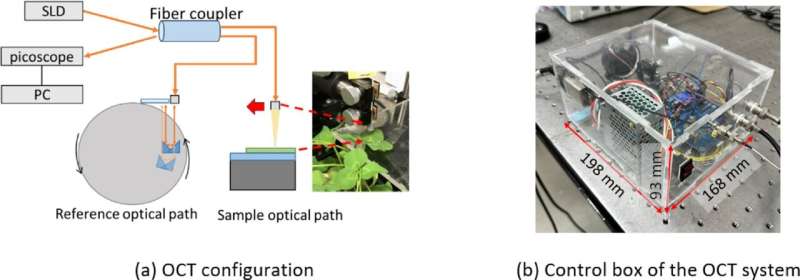
Researchers from an international team have developed a portable optical coherence tomography (OCT) scanner that can detect hidden ozone damage in plant leaves. This innovative device enables non-invasive assessments of plant health, addressing increasing concerns over the damaging effects of environmental pollutants, particularly ozone, on plant growth.
Significance of the Research
Published in the journal Scientific Reports on December 15, 2025, the research was led by Associate Professor Tatsuo Shiina and Dr. Hayate Goto from the Graduate School of Science and Engineering at Chiba University in Japan, in collaboration with other experts from the University of the Philippines, Visayas, and De La Salle University in Manila. The team identified that conventional methods for assessing plant health often rely on visual inspections and invasive techniques, which do not provide accurate quantitative measurements or allow for long-term monitoring.
According to Dr. Shiina, “By using OCT, the internal structure can be non-destructively quantified layer by layer to identify areas affected by the external environment. Since stress responses in plants appear first in the interior, OCT has the potential to elucidate environmental stresses that cause internal changes in plants.”
Innovative Testing on Indicator Plants
To validate the effectiveness of the OCT scanner, researchers conducted tests on the leaves of white clover (Trifolium repens), recognized as an indicator plant due to its sensitivity to environmental pollutants. The team exposed potted white clover plants to high concentrations of ozone, allowing them to monitor changes over a period of 14 days. They observed that ozone enters the leaves through stomata and damages the palisade tissue, altering its optical properties.
Through OCT measurements, the researchers found that ozone exposure reduced light scattering within the palisade layer, indicating structural damage to the cell walls and intercellular boundaries. They also noted a gradual increase in palisade tissue thickness, aligning with the observed decrease in OCT signal intensity.
In subsequent field studies, the team sampled indicator plants from four different regions in the Chiba Prefecture, Japan, where ozone concentrations varied between 0.04 and 0.16 ppm. The results indicated that the internal structural characteristics of the leaves were reflective of their ozone exposure levels, demonstrating the scanner’s potential for real-time assessments.
Broader Implications and Future Research
The findings highlight the portable OCT scanner’s capability to provide timely evaluations of environmental stress in plants prior to visible symptoms, offering a significant advantage over traditional methods that often require chemical fixation and staining. This non-invasive technology could facilitate early detection of deficiencies or stress-induced changes, which is crucial for improving agricultural productivity.
Dr. Shiina emphasized the importance of ongoing research, stating, “Continued research in this direction could expand OCT’s utility in optimizing crop environments and improving agricultural productivity. The ability to estimate atmospheric and soil conditions from a single OCT measurement presents a promising approach to advancing crop management and environmental monitoring.”
The potential applications of this technology extend beyond immediate assessments, as further studies could explore its effectiveness across diverse environmental conditions, including variations in humidity, temperature, and light intensity. The development of this portable OCT scanner marks a significant step forward in the field of plant health monitoring, providing a vital tool for researchers and agricultural professionals alike.