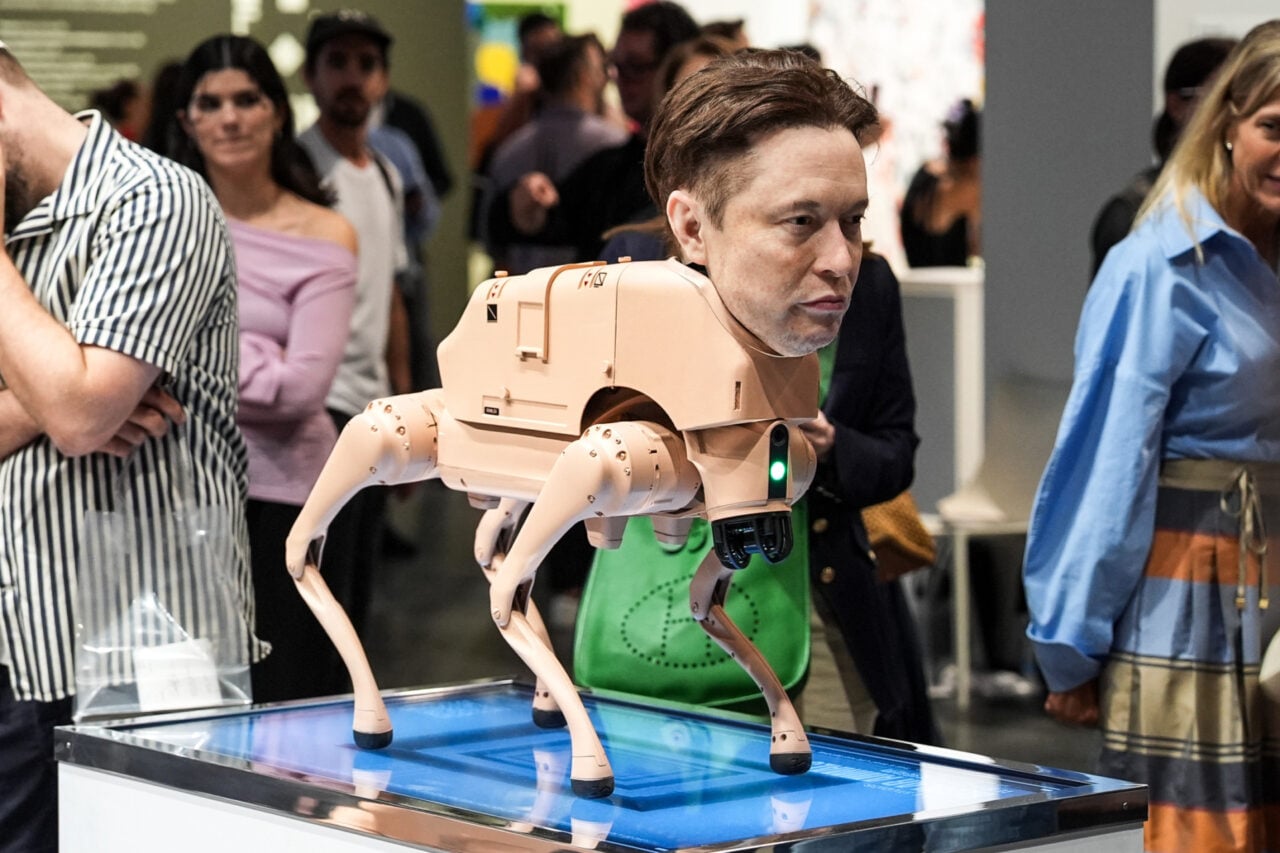
At the recent Art Basel Miami Beach, a provocative installation by artist Beeple featured robotic dogs that highlight the influence of major tech figures like Elon Musk, Mark Zuckerberg, and Jeff Bezos. The artwork, which challenges viewers to consider the power dynamics of modern technology, showcases the faces of these billionaires attached to the bodies of robotic canines that roam the exhibition space.
The installation draws attention with robotic dogs designed by renowned mask creator Landon Meier. These machines, inspired by the technology of Boston Dynamics, are equipped with cameras that capture images from a unique perspective. As part of the performance, the robots “poop” out stylized photographs. Each billionaire’s robot displays a different artistic style, reflecting their public personas: Zuckerberg’s images are imbued with a “metaverse” aesthetic, Musk’s are stark black and white, while Pablo Picasso and Andy Warhol are represented through cubist and pop art styles, respectively.
Curiously, the robot representing Bezos does not produce any images, leaving viewers to ponder the reasoning behind this artistic choice. Beeple commented, “He’s another person who shapes how we see the world, so he needed to be in the piece,” highlighting Bezos’ significant influence in the tech landscape.
Commentary on Power and Perception
The piece serves as a commentary on how contemporary figures in technology shape societal perceptions. Beeple articulated that “it used to be that we saw the world interpreted through the eyes of artists, but now Mark Zuckerberg and Elon, in particular, control a huge amount of how we see the world.” His statement underscores the shift in cultural paradigms where algorithms dictate the narratives presented to the public.
In addition to the prominent billionaires, the installation features other notable figures, including Sergey Brin, Barry Sternlicht, and David Solomon. While the relevance of these additional characters may be ambiguous, their inclusion suggests a broader commentary on the interconnectedness of wealth and influence in shaping public discourse.
The performance pieces not only provoke thought but also engage collectors. Beeple has reportedly sold individual robotic dogs for $100,000 each, with ownership including a stipulation that the robots can go “on tour.” Additionally, for those who wish to take a piece of the installation home, there are 1,028 prints generated by the robots. These prints come packaged in an “Excrement Sample” bag, complete with a warning that the artwork may be “disgusting to most patrons of the arts.”
NFTs and the Value of Art
The exhibition also touches on the evolving landscape of digital art. Of the total prints available, 256 will feature barcodes that allow collectors to claim them as NFTs. This aspect reflects Beeple’s previous success, particularly his monumental NFT sale for $69 million in March 2021. The artist’s comments imply a blurring of lines between traditional and digital art forms, suggesting that both may carry a similar value, regardless of their nature.
While viewers may be left questioning the depth of the commentary, Beeple’s installation undeniably sparks conversation about the role of technology in art and society. The provocative nature of the piece encourages audiences to reflect on the influence of tech moguls in shaping cultural narratives and the implications of viewing the world through the lens of artificial intelligence and robotics.
Art Basel Miami Beach continues to be a platform where traditional and modern art collide, and Beeple’s work is a testament to the evolving conversation around the nature of art in today’s digital age.