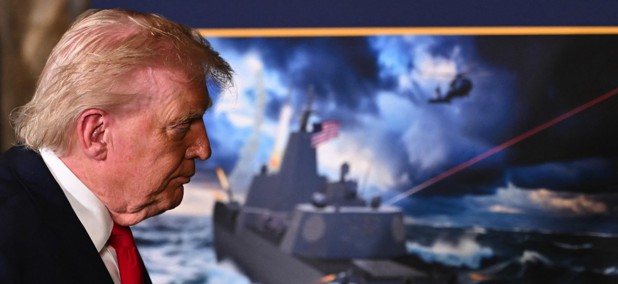
Plans for a new class of warships, proposed by former President Donald Trump, have raised significant concerns regarding their potential nuclear capabilities. The proposed vessels, referred to as “battleships,” are slated to be armed with a new type of nuclear-armed cruise missile, known as SLCM-N (Submarine-Launched Cruise Missile-Nuclear). This development contradicts Trump’s earlier stance in February 2023, when he asserted, “There’s no reason for us to be building brand-new nuclear weapons. We already have so many.”
Historically, the United States has approached nuclear weapons with caution, particularly regarding sea-launched cruise missiles. In 1991, former President George H.W. Bush ordered the removal of all nuclear-armed Tomahawk missiles from Navy surface ships and submarines. He viewed the deployment of these tactical nuclear weapons as destabilizing and opted to store them instead. This decision represented a strategic shift that recognized the U.S. Navy’s conventional advantages while mitigating risks associated with tactical nuclear armaments.
Two decades later, in 2010, President Barack Obama followed this precedent by dismantling the remaining nuclear-armed Tomahawk missiles. This approach reinforced a nuclear strategy that emphasized stability, relying primarily on strategic missiles located on select submarines.
However, in a surprising turn of events, the 2018 Nuclear Posture Review, approved by Trump’s then-Defense Secretary James Mattis and the Chairman of the Joint Chiefs of Staff, General Mark Milley, called for the development of a new SLCM-N. President Joe Biden attempted to cancel this program in 2021, but Congress ultimately overruled his decision and continued funding for the project. This marks a rare instance in U.S. history where Congress has compelled the executive branch to initiate a new nuclear weapons program.
As a former Assistant Secretary of Defense for Nuclear, Chemical, and Biological Defense Programs, I advocate for the modernization of the U.S. strategic nuclear arsenal. Nonetheless, the case for tactical SLCM-N is less compelling.
There are three primary concerns regarding the development of this weapon. First, allowing adversaries to believe that the U.S. would respond to a small, tactical nuclear strike with a similar response could be dangerous. Russian President Vladimir Putin has made threats regarding the use of tactical nuclear weapons, and it is crucial that the U.S. maintains a posture that deters such actions through overwhelming retaliation rather than proportional responses.
Second, tactical nuclear weapons heighten the risk of their actual use in conflicts. The potential for a limited nuclear exchange is alarming, as crossing the nuclear threshold could lead to full-scale nuclear war.
Lastly, the existence of both nuclear and conventional variants of these weapons could lead to miscalculations. In a conflict scenario with compromised intelligence, adversaries may misinterpret incoming threats, prompting them to resort to their own nuclear arsenals in a bid to defend themselves.
In light of these considerations, it is essential that the U.S. refrains from undermining its strategic nuclear capabilities by pursuing tactical nuclear weapons. Donald Trump has an opportunity to align his new battleship initiative with a commitment to enhancing national security without introducing the complexities and dangers associated with tactical nuclear arms. By focusing on capabilities that bolster the U.S. military’s strengths, he can contribute to a more secure future.
As discussions unfold, the implications of these nuclear arms decisions will resonate far beyond the battlefield, affecting global security dynamics and the strategic posture of the United States.