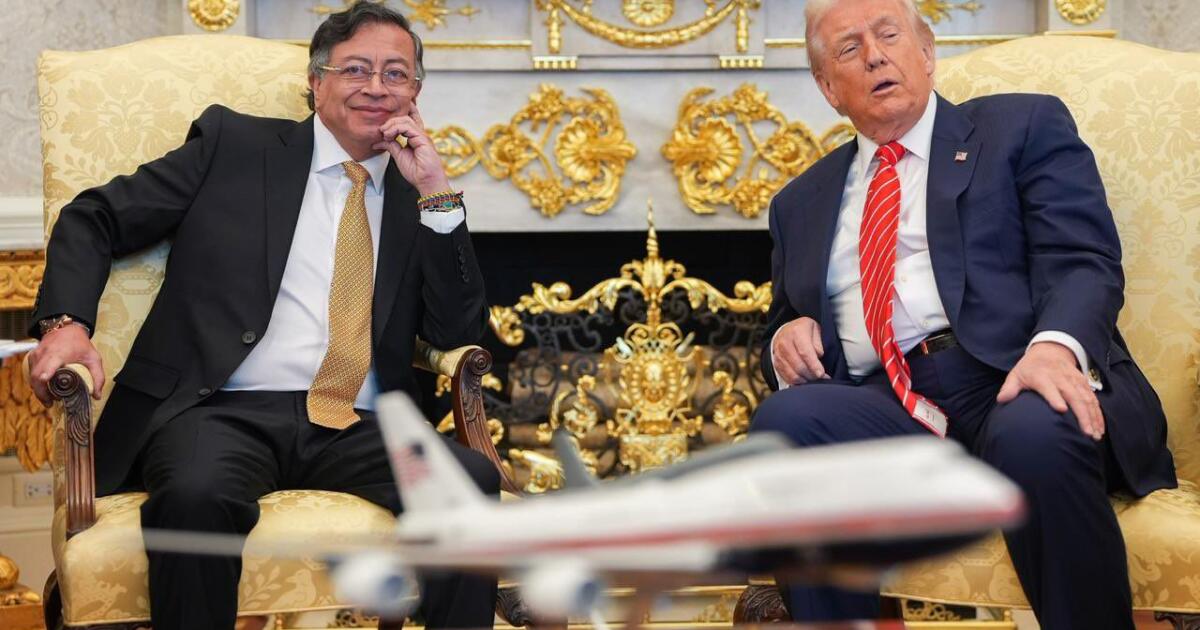
In a significant turn of events, U.S. President Donald Trump and Colombian President Gustavo Petro met at the White House on January 7, 2024, aiming to mend their strained relationship after a year marked by sharp public confrontations. The two leaders described their closed-door discussion as productive, with topics including energy, Venezuela, and joint efforts to combat drug trafficking.
The two-hour meeting came after a series of escalating tensions. Notably, Trump previously criticized Petro by calling him a “sick man who likes making cocaine and selling it to the United States.” Petro, in response, labeled Trump a murderer and drew comparisons to Adolf Hitler. Despite these harsh exchanges, both leaders indicated a willingness to find common ground.
Details of the Meeting
During the meeting, Trump referred to their conversation as “fantastic,” while Petro characterized it as “very positive,” emphasizing its “optimistic and constructive tone.” In a gesture of goodwill, Petro presented Trump with Colombian coffee and a gown made by indigenous artisans for First Lady Melania Trump. Trump reciprocated with a framed portrait of the two men shaking hands, inscribed with the message: “I love Colombia.”
Despite the cordial interactions, the meeting did not erase the significant political differences between the two leaders. Trump advocates for U.S. dominance in the Western Hemisphere, while Petro, a former left-wing guerrilla, opposes U.S. military interventions, such as the recent operation to capture Venezuelan President Nicolás Maduro.
Background of Tensions
The relationship between Colombia and the United States soured following Trump’s return to the White House for a second term. Tensions escalated when Petro refused to accept U.S. military flights transporting deported migrants, a stance he only changed after Trump threatened heavy tariffs on Colombian imports.
The situation deteriorated further after Petro delivered a speech at the United Nations General Assembly, criticizing U.S. support for Israel and urging American soldiers to disobey Trump’s orders. In retaliation, the U.S. State Department revoked visas for Petro and several family members. Last fall, Trump accused Petro of failing to curb cocaine production, labeling him a drug trafficker, which resulted in Washington suspending aid to Colombia, amounting to over $740 million in 2023.
As tensions peaked following a U.S. military operation in Caracas that resulted in Maduro’s capture, Petro described the action as a “kidnapping” and challenged Trump, saying, “Come get me. I’m waiting for you here.” Trump did not rule out a similar military operation in Colombia, stating, “It sounds good to me.”
Relations began to thaw following the January 7 phone call, which led to the in-person meeting. Colombian officials noted that Petro intended to highlight his administration’s efforts in combating drug trafficking, even as cocaine production continues to rise in Colombia. Notably, Acting Minister of Justice Andrés Idárraga Franco stated that Petro’s government has extradited more criminals to the U.S. than any of his conservative predecessors.
Typically, reporters have access to ask questions in the Oval Office prior to meetings, but this was not the case during Trump and Petro’s encounter. Trump, while praising the meeting, acknowledged their complicated history, saying, “You know, he and I weren’t exactly the best of friends.”
After the meeting, Petro spoke to journalists at the Colombian Embassy in Washington, where he highlighted issues such as climate change and criticized U.S. actions in Venezuela, as well as what he described as the “genocide” in Gaza. He also mentioned receiving one of Trump’s signature red baseball caps, which he humorously altered to read: “Make Americas Great Again.”
The recent meeting marks a potential turning point in U.S.-Colombia relations, as both leaders appear committed to addressing their differences while working towards more cooperative policies.