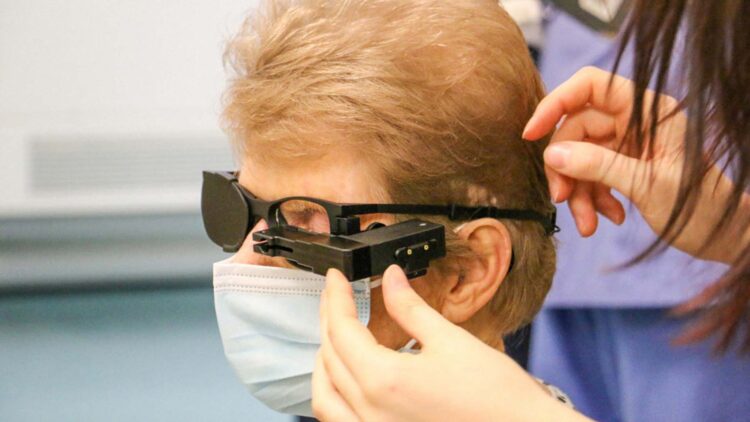
A groundbreaking study published in the New England Journal of Medicine reveals that a new wireless eye implant called the PRIMA device has enabled some older patients with partial blindness to regain a degree of vision. The research focused on individuals suffering from geographic atrophy, a severe form of dry age-related macular degeneration (AMD), which leads to the progressive loss of vital retinal cells.
Under the leadership of Dr. Frank Holz, the study involved 38 patients, with an average age of 79, who underwent surgical implantation of a tiny chip beneath the retina in one eye. Following the procedure, participants wore augmented reality glasses linked to a portable image processor that captures visual information. The camera in the glasses translates what the wearer sees into infrared light, which is then converted into electrical signals by the chip. These signals stimulate the remaining healthy cells in the macula, allowing the brain to perceive visual information.
Approximately 80% of the 32 patients who returned for follow-up after one year reported significant improvements in vision when the PRIMA system was activated. Sheila Irvine, a 70-year-old participant, described her previous visual experience as “having two black discs in my eyes, with the outside distorted.” With the implantation, she has regained the ability to read her prescriptions and enjoy crossword puzzles, activities she once cherished.
Challenges and Limitations
While the results are promising, the procedure is not without risks. The surgery requires delicate manipulation of the retina, leading some patients to experience complications such as bleeding or elevated intraocular pressure. Although most adverse effects resolved within two months, experts caution that not everyone is a suitable candidate for the implant.
Despite the optimism surrounding the PRIMA device, some eye specialists are urging caution. Dr. Sunir Garg, a retina surgeon, noted that while new therapies represent progress, they do not offer a cure. “Even with new medical therapies, the best that we can do is slow it down. We can’t stop it, and we can’t do anything to bring back lost vision,” he explained. Patients still face challenges, such as viewing only in black and white and needing guidance to operate the device effectively.
Potential for Improvement
The study’s findings indicate that while the quality of life improvements may not be dramatic, certain visual tasks were notably enhanced for patients. Dr. Demetrios Vavvas, another specialist, expressed a desire for further advancements. “Is it something that is good enough for patients to say, ‘Well, I’ve regained my independence because I can now do my credit card bills myself, stamp and address my envelopes myself, and look at grocery store labels’?” he asked.
Looking ahead, Daniel Palanker, the inventor of the PRIMA device and a professor at Stanford University, shared that his team is working on a more advanced chip that will offer a resolution of 10,000 pixels, compared to the current 400. Future developments also aim to enable patients to perceive grayscale images, enhancing their visual experience further.
The PRIMA device represents a significant step forward in the treatment of AMD, providing hope for many patients struggling with vision loss. While it does not cure the disease, advancements in technology may lead to even more effective solutions in the future. As the research continues, the medical community remains focused on understanding the long-term implications and efficacy of this innovative approach.