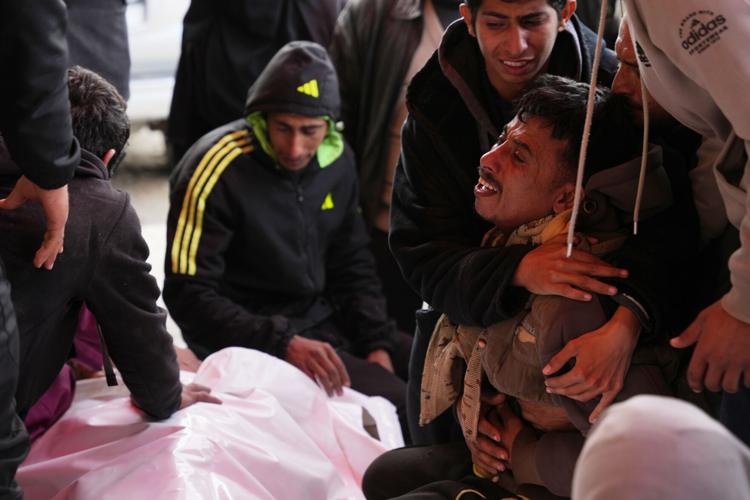
Israeli forces conducted airstrikes on Wednesday, resulting in the deaths of at least 11 Palestinians in Gaza, including two 13-year-old boys, three journalists, and a woman. This incident marks one of the deadliest days in the region since the ceasefire between Hamas and Israel was established on October 10, 2023. The attacks have drawn international attention as the United States seeks to further advance the peace process.
Among those killed were three Palestinian journalists who were documenting conditions in a displacement camp in central Gaza. According to Mohammed Mansour, a spokesperson for the Egyptian government committee managing the camp, the journalists were approximately five kilometers (three miles) from the Israeli-controlled area when they were struck. The Israeli military claimed that they targeted individuals operating a drone perceived as a threat to its troops.
The two 13-year-old boys were killed in separate incidents. One boy, Moatsem al-Sharafy, was reported to have been collecting firewood for his family when he was hit by Israeli drone fire near the Bureij refugee camp. His mother, Safaa al-Sharafy, expressed her grief, stating, “He went out in the morning, hungry. He told me he’d go quickly and come back.” The second boy was shot by Israeli troops in the eastern town of Bani Suheila, as confirmed by Nasser Hospital.
In a tragic development, the vehicle carrying the three journalists, including Abdul Raouf Shaat, was hit while they were filming the displacement camp. Shaat was a regular contributor to Agence France-Presse but was not officially on assignment. The agency released a statement mourning his loss, describing him as “much loved” by colleagues in Gaza.
Since the onset of the conflict in 2023, the Committee to Protect Journalists has reported that over 200 Palestinian journalists and media workers have lost their lives in Gaza. This figure includes visual journalist Mariam Dagga, who was killed in a previous strike. Despite ongoing investigations by the Israeli military, the international community continues to call for accountability.
Nasser Hospital also reported receiving the body of a woman shot by Israeli troops in the Muwasi area of Khan Younis. Additionally, three brothers were killed due to tank shelling in the Bureij camp, highlighting the ongoing violence in the region.
According to Gaza’s health ministry, more than 470 Palestinians have lost their lives due to Israeli fire since the ceasefire began. This includes at least 77 fatalities near the ceasefire line that divides Israeli-controlled areas from much of Gaza’s Palestinian population. The health ministry, associated with the Hamas-led government, maintains casualty records deemed reliable by UN agencies.
The ceasefire’s initial phase focused on the return of hostages held by Hamas in exchange for the release of Palestinian detainees and a partial withdrawal of Israeli forces. While most hostages have been returned, one remains unaccounted for. Ran Gvili, a 24-year-old police officer, was killed during the October 7 attack that initiated the conflict. His family continues to advocate for the recovery of his remains, urging both the Israeli government and international leaders to take action.
On the same day, Israeli airstrikes targeted locations in southern Lebanon, claiming to target Hezbollah’s weapon storage sites. The military reported striking four border crossings in the northeastern region of Hermel, with Lebanese health officials indicating that 19 individuals, including journalists, were injured during the strikes in the village of Qennarit. President Joseph Aoun condemned the strikes as “systematic aggression,” further escalating tensions in the region.
The recurring violence in both Gaza and Lebanon underscores the fragile nature of the ceasefire and the complicated political landscape in the area. As international efforts continue to seek a resolution, the human toll of the ongoing conflict remains stark and painful.