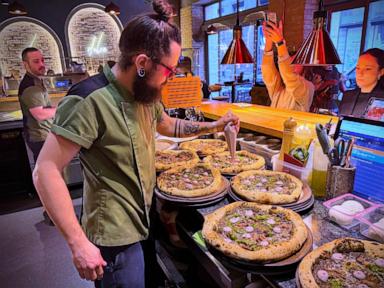
In the heart of Budapest, a unique culinary venture is inviting diners to experience a taste of ancient Rome. At Neverland Pizzeria, founder Josep Zara has crafted a limited-edition pizza using only ingredients that would have been available over two millennia ago. This innovative dish challenges modern notions of pizza by excluding staples such as tomatoes and mozzarella, which were unknown in Europe at the time.
Zara’s inspiration stems from a recent archaeological discovery in March 2023, where archaeologists uncovered a fresco in Pompeii depicting a focaccia-like flatbread topped with pomegranate seeds, dates, and spices. “Seeing that fresco sparked my curiosity about the flavors of ancient Roman food,” Zara explained. The discovery led him to question whether pizza, as we know it today, could have existed during the time of the Roman Empire.
While traditional pizza did not originate in ancient Rome, Romans enjoyed oven-baked flatbreads topped with various herbs, cheeses, and sauces. These dishes can be considered the early ancestors of modern pizza, often sold in snack bars known as thermopolia. Zara delved into culinary history, consulting a historian in Germany and studying the ancient cookbook De re coquinaria, believed to be authored around the 5th century.
The challenge was to create a pizza that adhered strictly to ingredients that were historically documented. “We had to exclude anything that came from the Americas,” Zara noted, reflecting on the extensive research process. The pizzeria’s head chef, László Bárdossy, emphasized the complexity of this task. “The lack of infrastructure, like a water system, made it difficult,” he said. With pizza dough relying heavily on water, the team had to innovate.
Their solution involved using fermented spinach juice to help the dough rise. They opted for ancient grains such as einkorn and spelt, commonly cultivated in Roman times. The resulting dough is denser than contemporary pizza crusts, setting the stage for a truly distinctive dish.
Topped with ingredients associated with Roman aristocratic cuisine, the pizza features epityrum (an olive paste), garum (a fermented fish sauce), confit duck leg, toasted pine nuts, ricotta, and a grape reduction. “We aimed to create a modern interpretation of a Roman pizza that is still accessible,” Bárdossy explained. He acknowledged that while the dish is special, it might not cater to everyone’s palate. “Most people prefer conventional pizza, but this offers a unique culinary experience.”
For Zara, this project aligns with Neverland Pizzeria’s broader philosophy of balance between tradition and innovation. “We love creating new and interesting dishes, but we also value tradition,” he stated. Despite their adventurous spirit, Zara made it clear that certain modern toppings, like pineapple, are off-limits. “We do a lot of experimentation, but we definitely do not use pineapple,” he remarked with a hint of humor.
As diners in Budapest embark on this time-traveling culinary journey, Neverland Pizzeria not only offers a taste of history but also highlights the rich tapestry of flavors that have evolved over centuries. This limited-edition pizza is a testament to the creativity and dedication of Zara and his team, inviting guests to savor a slice of the past.