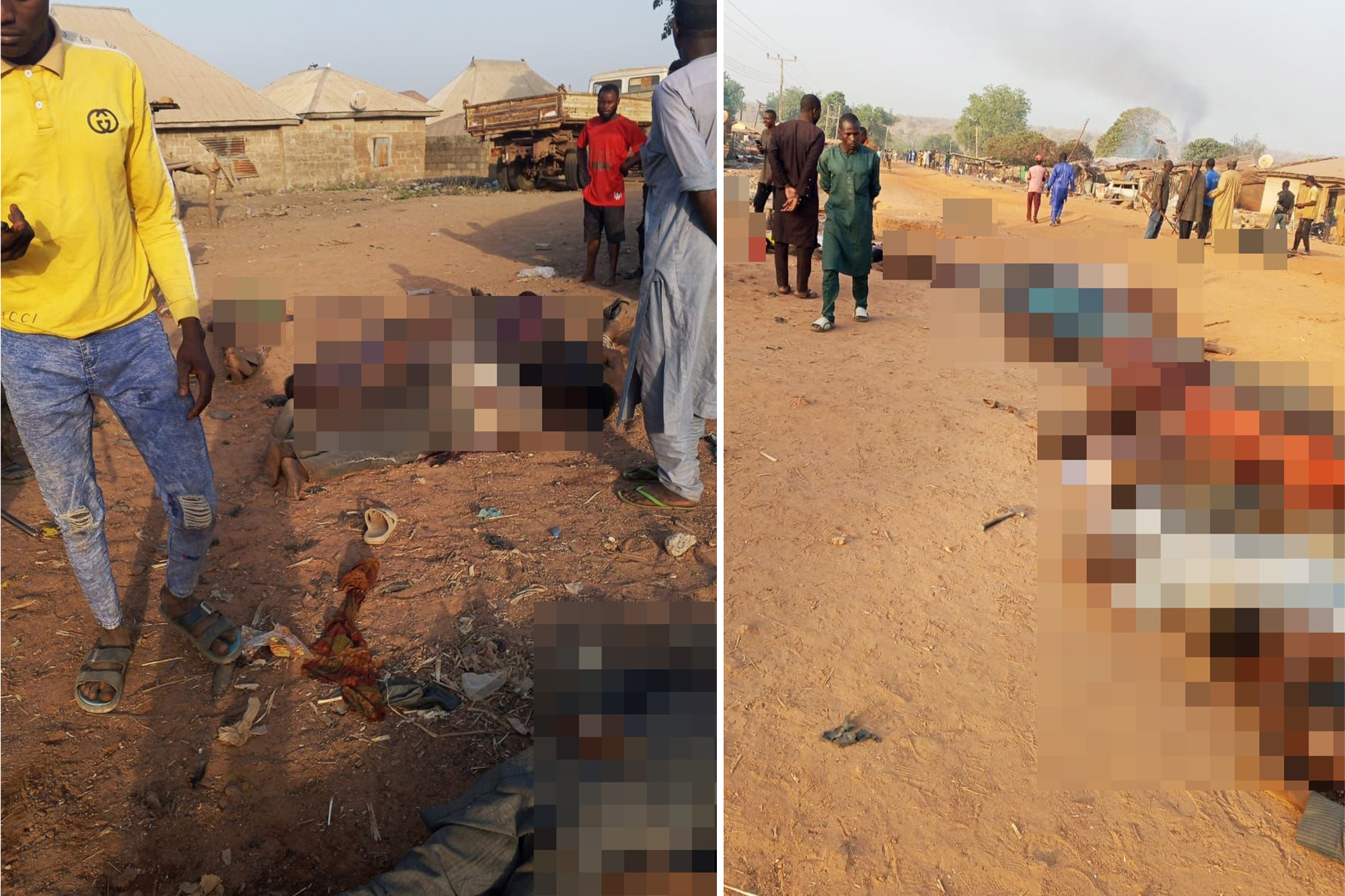
Armed extremists killed at least 162 people during a series of attacks on two villages in western Nigeria on Tuesday evening, according to Mohammed Omar Bio, a member of parliament representing the area. The violence occurred in the villages of Woro and Nuku, located in Kwara State, marking one of the deadliest assaults in recent months. The attacks were reportedly carried out by the Lakurawa, an armed group linked to the Islamic State, although no group has officially claimed responsibility.
Eyewitness accounts describe scenes of devastation. Ayodeji Emmanuel Babaomo, the Red Cross secretary in Kwara State, stated that the organization has been unable to access the affected communities due to their remoteness, approximately eight hours from the state capital and close to Nigeria’s border with Benin. Local television footage revealed bodies lying in blood, some with their hands tied, alongside charred remains of homes.
In a statement, AbdulRahman AbdulRazaq, the governor of Kwara State, condemned the attack as a “cowardly expression of frustration by terrorist cells,” suggesting it was a reaction to ongoing military operations against armed groups in the region.
The violence in Nigeria is part of a complex security crisis that includes an ongoing insurgency by Islamic militants in the northeast and a rise in kidnappings for ransom across northwestern and north-central regions. On the same day as the attacks in Kwara, unknown gunmen killed at least 13 people in the village of Doma, located in the northwestern state of Katsina.
The situation has escalated recently, with Boko Haram militants reportedly killing at least 36 people in separate attacks on a construction site and an army base last week. The Nigerian military has identified various armed groups, including at least two affiliated with the Islamic State: the Islamic State West Africa Province and the lesser-known Lakurawa, which has gained prominence in the northwest.
Researcher James Barnett from the Washington-based Hudson Institute indicated that the Kwara State attack was likely perpetrated by the Jama’atu Ahlis Sunna Lidda’awati wal-Jihad (JAS), a faction of Boko Haram responsible for other recent massacres in the region.
In response to the ongoing security situation, the U.S. Africa Command announced the deployment of a small team of military officers to Nigeria, signifying a renewed commitment to addressing the security crisis. This move follows airstrikes conducted by U.S. forces against IS-affiliated militants in December 2022.
The violence has drawn international attention, particularly from the United States, which has expressed concerns over Nigeria’s ability to protect its citizens, especially Christians. President Donald Trump had previously threatened action against Nigeria, emphasizing the need for stronger security measures.
With the situation deteriorating, the humanitarian impact is expected to deepen as communities grapple with the aftermath of such brutal violence.