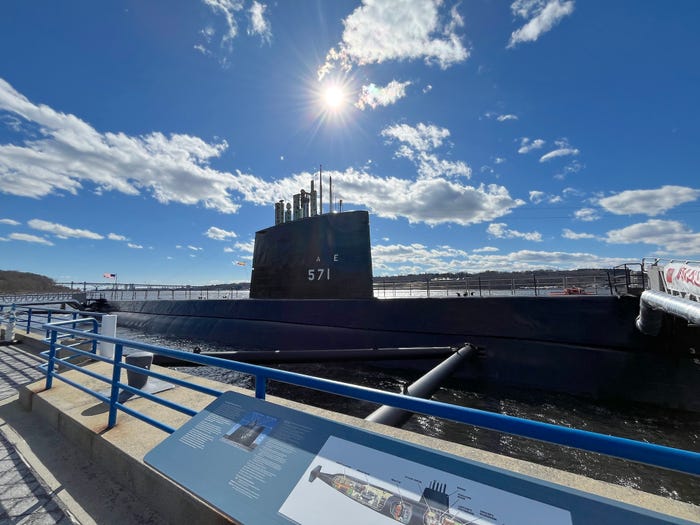
UPDATE: The historic USS Nautilus, the world’s first nuclear-powered submarine, has reopened to the public after extensive preservation efforts costing $36 million. Located at the Submarine Force Museum in Groton, Connecticut, this emblematic vessel is now welcoming visitors to explore its groundbreaking design and storied past.
Commissioned in 1954, the USS Nautilus made history with its groundbreaking nuclear power capabilities, enabling it to remain submerged for up to two weeks and travel at speeds exceeding 20 knots (approximately 23 miles per hour). This development marked a significant shift from World War II submarines, which were limited by diesel engines and could only remain underwater for 12 to 48 hours.
The Nautilus first gained international attention on January 17, 1955, when it famously transmitted the message: “Underway on nuclear power.” It became the first ship to navigate the North Pole in 1958 during Operation Sunshine and played a vital role in the Cuban Missile Crisis blockade in 1962.
Today, guests can walk through the submarine’s compartments to witness how crew members lived and operated while submerged. The museum features life-size mannequins depicting daily routines, from loading torpedoes to navigating the depths of the ocean.
The tour begins in the forward torpedo room, showcasing the submarine’s two torpedo tubes. Visitors can observe how crew members would load and fire torpedoes, a crucial function during its operational years.
The Nautilus also hosted the first-ever underwater legislative meeting in 1955, with 13 members of Congress aboard. The submarine’s journey and contributions demonstrate the rapid advancement of maritime technology over the decades.
Following its decommissioning in 1980, Nautilus was designated a National Historic Landmark in 1982 and opened to the public in 1986. After a recent closure for preservation work, it reopened its doors in 2022, offering a glimpse into naval history and the evolution of submarine technology.
The Submarine Force Museum, operational from Wednesday to Monday, provides free admission, making it accessible for all interested in naval history. Visitors can explore not only the Nautilus but also exhibits featuring operational periscopes and other artifacts from submarine history.
As you step aboard, the sheer size of the Nautilus is impressive, measuring 319 feet long—longer than a football field—and weighing 3,400 tons. The upper deck offers stunning views of the Thames River, enhancing the experience.
The tour continues through the officers’ quarters, revealing the living conditions that defined life aboard one of the most advanced submarines of its time. Displays showcase the commanding officer’s stateroom, complete with personal workspace and living quarters.
The attack center, equipped with periscopes and firing controls for torpedoes, reflects the operational mindset of the crew. Alarms for various emergencies and sonar detection equipment illustrate the complexities and dangers of undersea warfare.
The control room showcases the submarine’s navigational controls, where crew members managed depth and speed while submerged. Each compartment tells a story of innovation and resilience in maritime operations.
The Nautilus embodies a legacy of exploration and technological advancement, reminding us of the rapid progress in naval capabilities since its commissioning. As all of the US Navy’s submarines are now nuclear-powered, the Nautilus stands as a testament to the pioneering spirit that pushed the boundaries of maritime engineering.
VISIT NOW: Experience history firsthand at the Submarine Force Museum, where the USS Nautilus invites you to explore a pivotal chapter in naval history. Don’t miss this unique opportunity to step inside a piece of military innovation that changed the course of naval warfare.