BREAKING: Thanksgiving isn’t just a time for family feasts; it’s also a season with a dark history of turkey theft that dates back over a century. Farmers in the Midwest, particularly in Fargo, North Dakota, faced a unique threat each holiday season: turkey bandits.
For decades, local families braced themselves against the annual assaults on their poultry, transforming holiday preparation into a battle against thieves. Reports from as early as 1911 warned farmers to “guard your poultry,” as thefts were rampant. In fact, the People’s Press of Geneva, Minnesota, reported, “Turkey thieves are abroad in the land,” heightening the urgency for farmers to protect their stock.
During the Great Depression, turkey thefts surged, with police urging farmers to report every incident to connect the dots. Farmers often found themselves in desperate situations, having purchased live turkeys only to discover they had been stolen before the Thanksgiving feast. The stakes were high; turkeys were crucial to family finances, often serving as a primary cash crop.
In 1927, the Fargo Forum reported a notable heist where prized breeding stock was taken from the Murphy flock, causing financial distress for the family. Farmers resorted to desperate measures, including setting up elaborate burglar alarms and fortifying their properties. One farmer even lost 123 turkeys in 1932 due to a “neglected” security system.
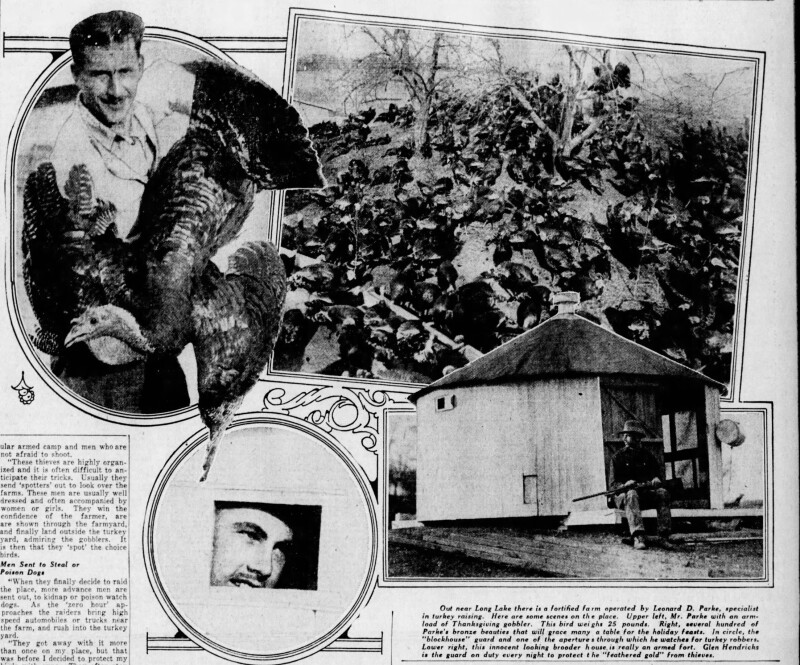
The lengths to which farmers went to protect their turkeys were often dramatic. In 1930, a farmer transformed his property into a fortress, employing armed men and wire entanglements to prevent theft. Another innovative farmer, Arthur Neumeyer of Dassell, Minnesota, resorted to marking his flock to deter thieves.
The threat was so severe that some farmers armed themselves. A 1911 report noted, “farmers are taking the precaution to be ready for the thieves” with guns and ammunition. A farmer named Nels Malm even accidentally shot his prized sow, mistaking it for a thief.
In the courtroom, turkey thieves faced harsh repercussions. A notorious case in South Dakota saw a thief sentenced to eight years in prison, with one local paper praising the judge for delivering “old west justice.” A 1929 editorial from the Grand Forks Herald emphasized the community’s disdain for turkey thieves, stating, “The turkey thief has no friends, and he ought to have none.”
Despite the overwhelming contempt for thieves, there were moments of unexpected compassion. In 1933, a local sheriff in Sisseton, South Dakota, paid for stolen turkeys out of his own pocket, reasoning that it was better for the county to help the thieves than to imprison them.
As Thanksgiving approaches this year, the legacy of turkey theft lingers in the Midwest’s folklore. Local farmers like Charles Pollock from Duluth reflect on these tales with a mix of humor and resignation. After losing 30 gobblers, Pollock remarked, “I hope the person who stole them is at least thankful.”
As families prepare for this year’s Thanksgiving, they can breathe easier knowing that while turkey thefts may have faded with the rise of large-scale poultry farms, the stories of those past struggles remain a compelling part of the region’s history.
Stay tuned for more updates on Thanksgiving traditions and the evolving culinary landscape as the holiday approaches.