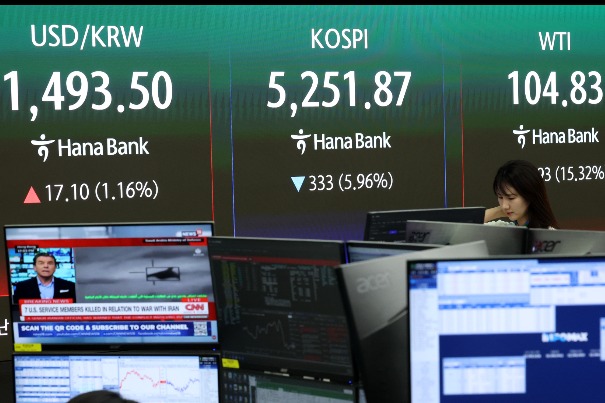
URGENT UPDATE: South Korean equities are in freefall as the benchmark Kospi has plummeted more than 8% during trading, hitting a drastic low amid escalating tensions in the Middle East. Investors are fleeing risk assets as oil prices surge, triggered by the ongoing conflict involving the U.S., Israel, and Iran. The Kospi closed down 6% at 5,251.87, while the tech-heavy Kosdaq fell 4.5% to 1,102.28.
The crisis has intensified fears in the market, prompting the Korea Exchange to impose a 20-minute trading halt after the Kospi dropped more than 8%. The selloff, which began early Monday morning, was exacerbated by a nearly 26% spike in West Texas Intermediate crude prices, now sitting at $114.49 per barrel, marking its highest point since July 2022.
Investors are particularly anxious as military exchanges in the Middle East show no signs of abating, raising concerns about potential disruptions in oil supply. This is critical for South Korea, which heavily relies on energy imports from the Middle East. “Given South Korea’s heavy dependence on energy imports from the Middle East, a spike in oil prices amid a closure of the Strait of Hormuz could intensify risk-averse sentiment toward the country’s manufacturing-heavy, oil-intensive stock market,” warned Lee Sung-hoon, an analyst at Kiwoom Securities Co.
As of 9 a.m. on March 9, 2023, average gasoline prices in South Korea surged to 1,897.7 won per liter, up 2.3 won from the previous day. The Korean won also weakened significantly, trading at 1,495.50 per U.S. dollar, nearing the psychologically critical 1,500 mark, a level not seen since the global financial crisis in 2009.
Foreign investors were the driving force behind the selloff, dumping 3.2 trillion won (approximately $2.1 billion) of shares on the main board, while institutions sold off 1.5 trillion won. In contrast, individual investors purchased a net 4.6 trillion won, absorbing some of the loss.
The downturn is widespread, with significant losses in major corporations. SK Hynix Inc. dropped 9.5%, Hyundai Motor Co. lost 8.3%, and Samsung Electronics Co. slid 7.8%. The Kosdaq also suffered, with Rainbow Robotics Co. tumbling 11.2%.
This market volatility reflects broader global concerns, as the Dow Jones Industrial Average recently fell nearly 1% due to similar fears surrounding oil price surges and weak U.S. labor data. Experts are divided on the outlook; while some assert that the market has entered a deep-value zone, others warn that continued macroeconomic pressures could lead to further volatility rather than a quick rebound.
Stay tuned for further developments as the situation evolves and analysts assess the long-term impact of these escalating oil prices on South Korea’s economy and stock market.