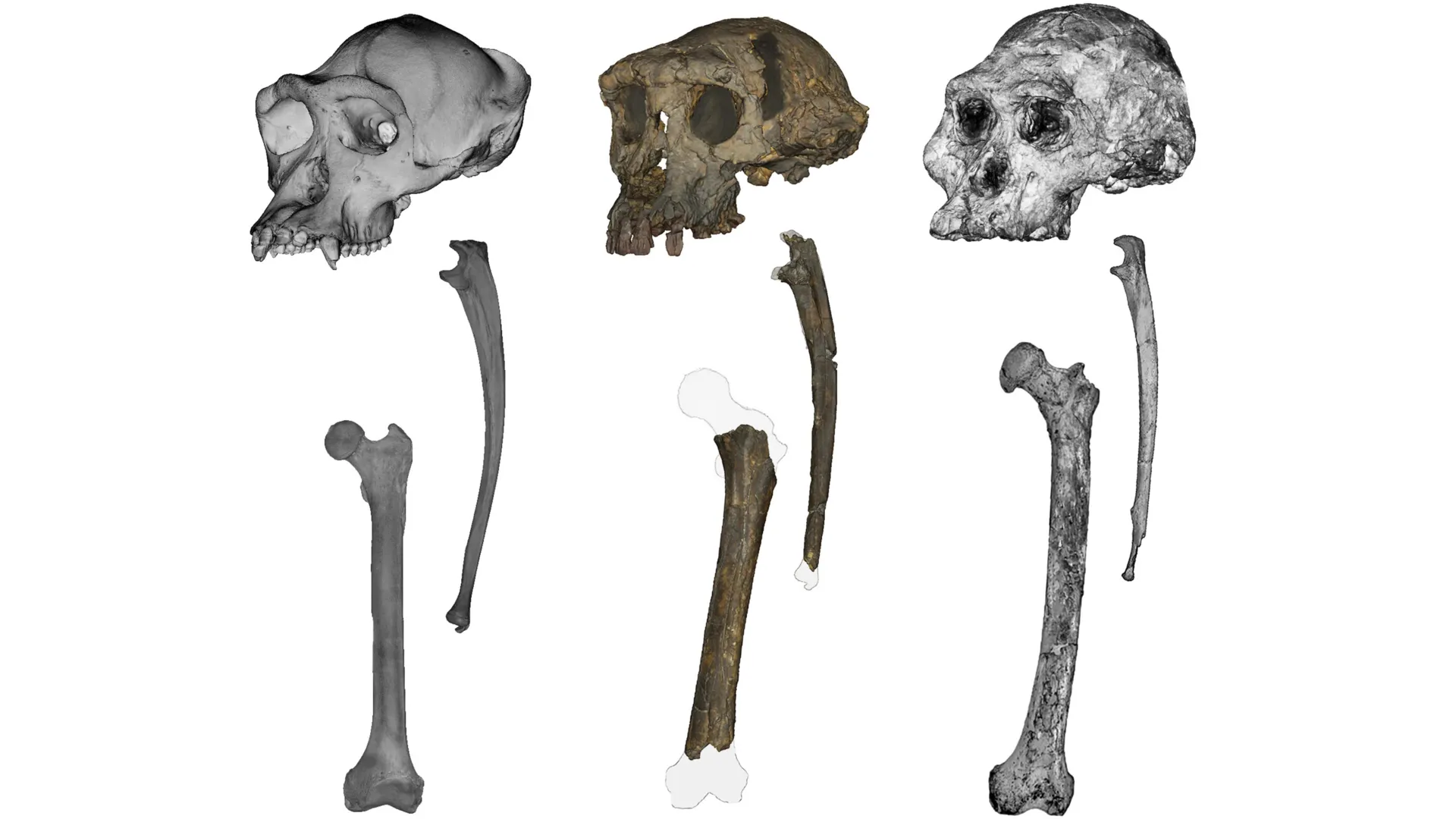
UPDATE: Groundbreaking research just released confirms that the ancient fossil Sahelanthropus tchadensis, dating back seven million years, was capable of walking upright. This significant finding could fundamentally alter our understanding of human evolution and the origins of bipedalism.
Scientists from New York University and their collaborators from the University of Washington, Chaffey College, and the University of Chicago have presented compelling evidence that Sahelanthropus, despite its ape-like features and small brain, was adapted for bipedal movement. The study, published in the journal Science Advances, reveals critical anatomical traits suggesting that this early ancestor of humans walked confidently on two legs.
The key discovery lies in the identification of a femoral tubercle—an essential attachment point for the iliofemoral ligament, which is crucial for upright walking. Scott Williams, the study’s lead author, emphasized the importance of this finding: “Sahelanthropus tchadensis was essentially a bipedal ape that possessed a chimpanzee-sized brain and likely spent a significant portion of its time in trees, foraging and seeking safety.”
The research team utilized advanced 3D imaging and analytical techniques to examine the skeletal remains, which provided fresh insights into the species’ locomotion. This marks a pivotal moment in anthropological studies that have long debated whether this fossil could truly be classified as a human ancestor.
For decades, the question of Sahelanthropus’s ability to walk upright has fueled controversy within the scientific community. Early discoveries focused largely on the fossil’s skull, leaving its locomotion unclear. However, renewed investigations have revealed that Sahelanthropus possesses anatomical features consistent with bipedalism, including femoral antetorsion and a developed gluteal complex.
The implications of this research are vast. If Sahelanthropus was indeed bipedal, it could redefine the timeline of our evolutionary history, placing the origins of upright walking much earlier than previously thought. The findings suggest that bipedalism evolved from an ancestor resembling modern-day chimpanzees and bonobos.
The study also compared the bones of Sahelanthropus to modern and fossil species, including the famous Australopithecus, which is known for the discovery of the “Lucy” skeleton. The researchers found that Sahelanthropus exhibited an intermediate limb proportion, with a relatively long femur compared to its ulna, suggesting a significant evolutionary step toward upright walking.
As anthropologists digest these findings, the broader implications for our understanding of human evolution are monumental. “Our analysis of these fossils offers direct evidence that Sahelanthropus tchadensis could walk on two legs, demonstrating that bipedalism evolved early in our lineage,” Williams concluded.
With the continuous exploration of human origins, this research signals a new chapter in our understanding of where we come from. As studies like these unfold, they not only pique scientific interest but also resonate deeply with the human experience, reminding us of our shared ancestry and the complex journey of evolution.
Stay tuned for more updates as scientists continue to explore the implications of these findings and what they mean for the future of anthropological research.
This urgent development is expected to generate significant discussion and research within the community, making it a vital topic for those interested in human evolution and anthropology.