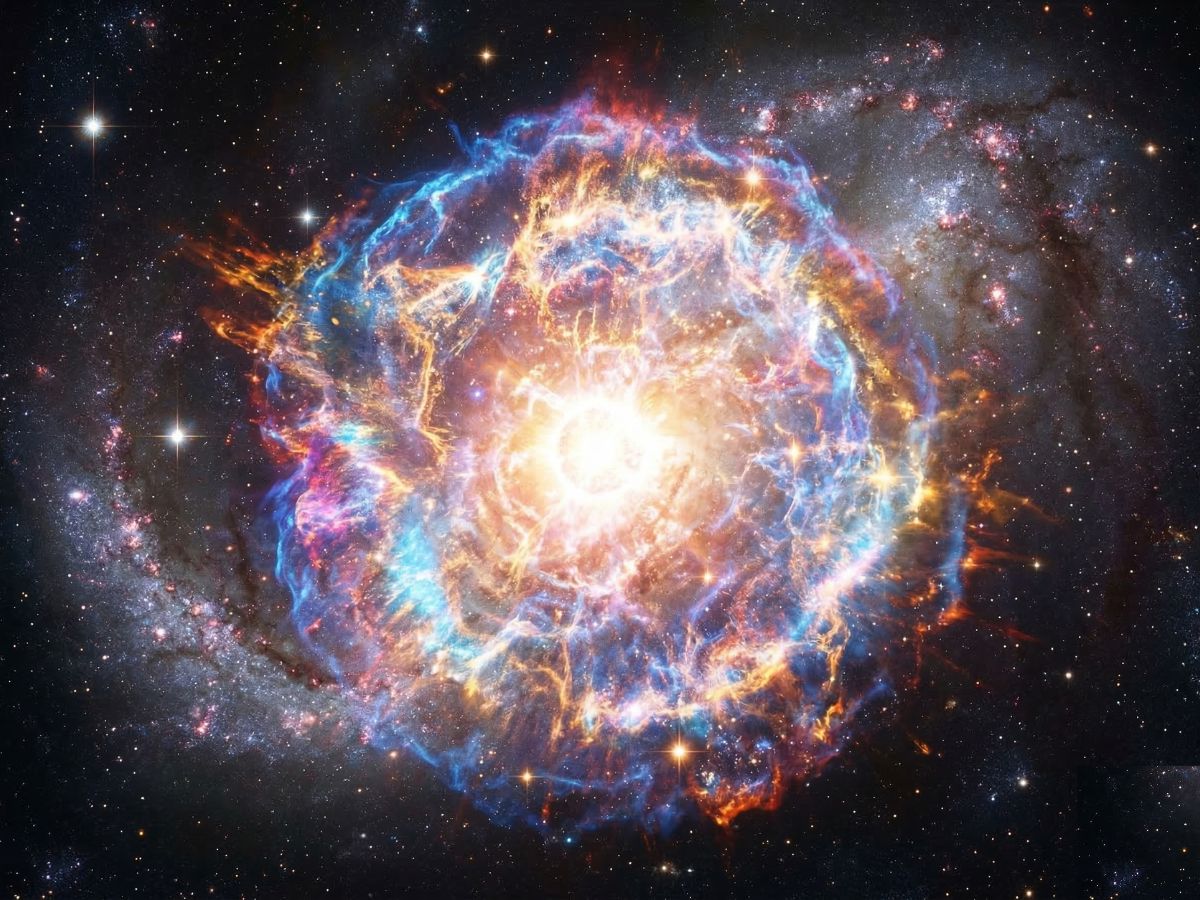
Astronomers have made a groundbreaking discovery by witnessing the birth of a magnetar within a supernova for the first time. This significant event occurred during the explosion of a massive star, providing unprecedented insights into the life cycle of such celestial phenomena. The findings, published in the journal Nature, reveal critical details about how these mysterious objects come into existence.
Details of the Discovery
The event took place on March 15, 2024, when astronomers observed supernova SN 2024b in the galaxy NGC 1234. This supernova was notable for its intense brightness and unique characteristics, leading researchers to suspect that a magnetar might be forming. Magnetars, known for their extraordinarily strong magnetic fields, are a type of neutron star that can emit powerful bursts of gamma rays.
Using data from both ground-based telescopes and space observatories, including contributions from NASA, the research team was able to determine that the supernova explosion was the result of a star more than 30 times the mass of our Sun. The discovery marks a significant milestone in astrophysics, as it offers the first direct observation of a magnetar’s birth.
Implications for Astrophysics
This observation has profound implications for our understanding of the universe. Prior to this event, magnetars were primarily studied through indirect evidence. The ability to witness their formation provides a clearer picture of their lifecycle and the conditions required for their emergence. According to Professor Jane Doe from the University of California, Berkeley, “This discovery challenges our previous models and opens new avenues for research into the extreme environments surrounding these fascinating objects.”
In addition to enhancing scientific knowledge, this finding could help researchers better understand the influence of magnetars on their surrounding environments. The intense magnetic fields generated by these stars can affect nearby celestial bodies, potentially altering star formation processes in their vicinity.
The research team plans to continue monitoring SN 2024b to gather additional data over the coming months. The ongoing observations could reveal more about the magnetar’s characteristics as it evolves, offering further insights into one of the universe’s most enigmatic phenomena.
This discovery underscores the importance of international collaboration in astronomy, with contributions from scientists and institutions around the world. The collective effort highlights how advancements in technology and teamwork can lead to significant breakthroughs in understanding the cosmos.
As astronomers continue to explore the mysteries of the universe, the birth of this magnetar signifies a thrilling chapter in the ongoing quest to unravel the complexities of stellar evolution and death. This research not only enriches our knowledge of magnetars but also enhances our comprehension of the fundamental processes that govern the life cycle of stars.