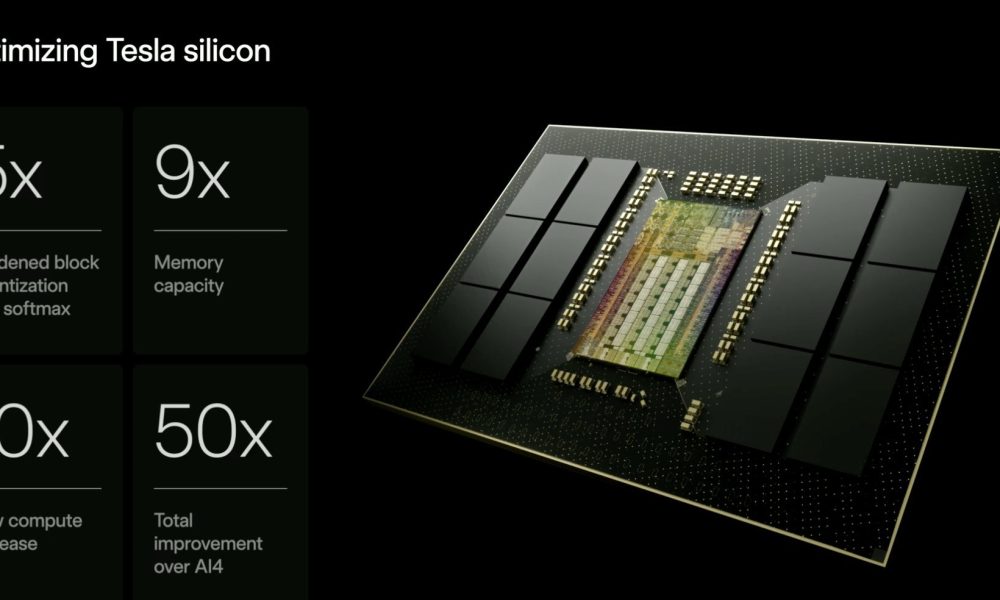
Tesla is on the verge of completing its next-generation AI5 chip, with CEO Elon Musk also revealing that work on the AI6 chip has commenced. Musk shared these updates during a recent post on the social media platform X, expressing his vision for a rapid development cycle that could lead to successive generations of AI chips being designed in just nine months.
Musk’s Vision for Rapid Development
In his post, Musk indicated that the design for the AI5 chip is “almost done,” while early development for the AI6 chip is already in progress. He emphasized Tesla’s commitment to a quick iteration process, mentioning plans for AI7, AI8, and AI9, all aiming for that ambitious nine-month design timeline. This rapid pace is expected to position Tesla’s in-house chips as the highest-volume AI processors globally, a claim that Musk framed as a recruitment message to attract engineers to join Tesla’s AI and chip development teams.
Tesla community member Herbert Ong underscored the strategic importance of this timeline. He pointed out that quicker chip cycles facilitate faster learning and iteration, creating a significant advantage in the fields of AI and autonomy that could be challenging for competitors to overcome.
Manufacturing Plans and Collaborations
Musk’s statements align with earlier reports regarding the production of the AI5 chip. In December, it was disclosed that Samsung is set to manufacture Tesla’s AI5 chip and is actively hiring experienced engineers to support production efforts in the U.S. This initiative aims to tackle complex challenges associated with semiconductor manufacturing.
Samsung, along with TSMC, has been selected as one of the two suppliers for the AI5 chip. Each company is expected to produce different versions of the chip, with TSMC utilizing a 3nm process and Samsung opting for a more advanced 2nm process. Musk has previously noted that despite the differing manufacturing processes, both versions of the AI5 chip are designed to operate identically.
The AI5 chip will replace Tesla’s current AI4 hardware, previously known as Hardware 4, and is anticipated to enhance the company’s self-driving system and support other AI-driven initiatives, including the development of its humanoid robot, Optimus. As Tesla continues to innovate in chip technology, the implications for the automotive and AI industries could be significant, setting new benchmarks for performance and efficiency.