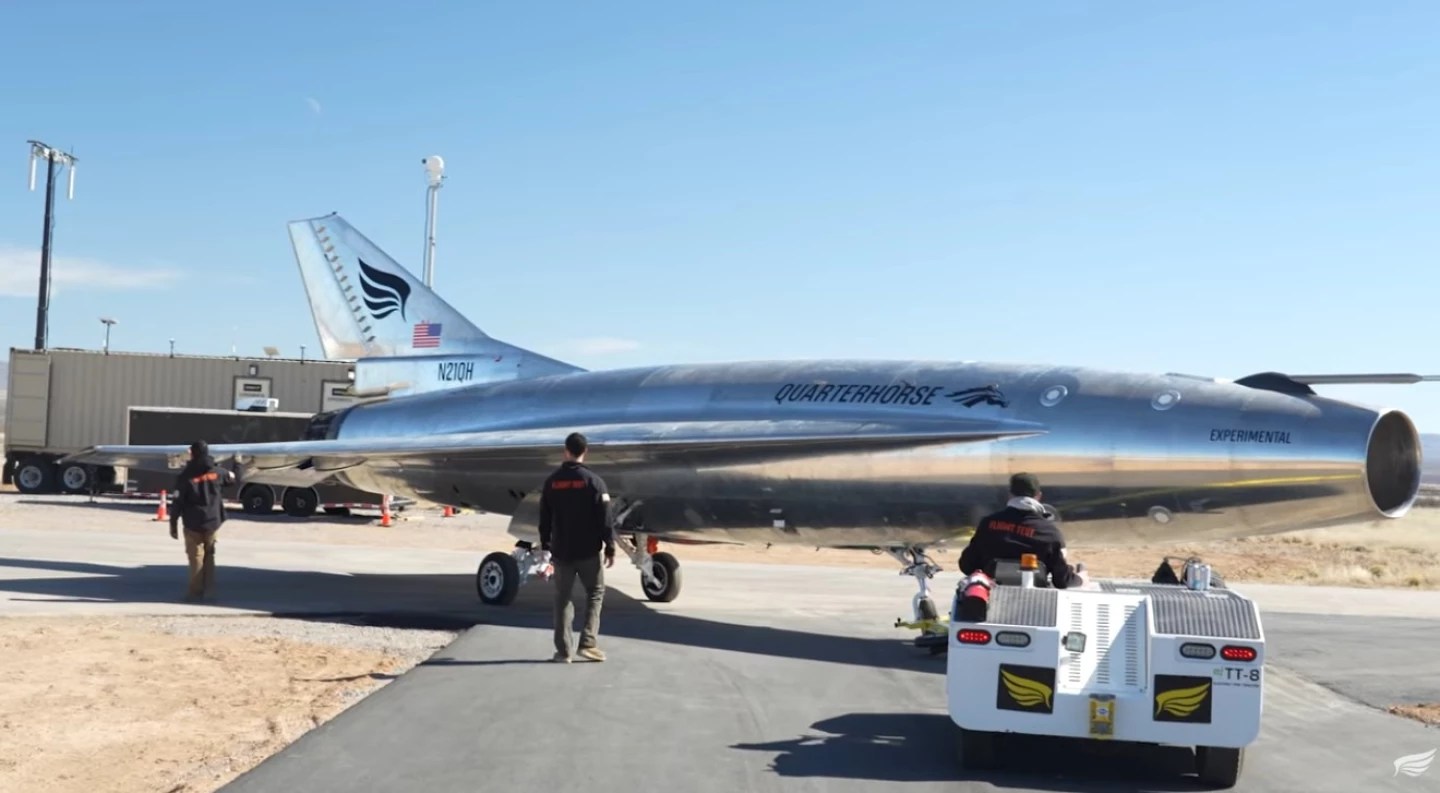
Hermeus Aerospace has taken a significant step forward in its mission to surpass the legendary speed record of the SR-71 Blackbird. On March 15, 2026, the company successfully launched its Quarterhorse 2.1 unmanned aerial vehicle (UAV) from Spaceport America. This flight marks the second successful first flight for Hermeus within a year, following the initial launch of Quarterhorse 1 in May 2025.
The new prototype, comparable in size to an F-16, is designed to play a crucial role in developing the engine for the upcoming version 2.2. Hermeus aims for this future model to achieve a remarkable speed of Mach 5, significantly exceeding the SR-71’s record of Mach 3.3, set in 1976. Although Quarterhorse 2.1 has not yet broken the sound barrier, its design and engineering suggest that it is on a promising trajectory.
Innovative Engine Design
At the heart of the Quarterhorse’s capabilities is the advanced Chimera engine, which incorporates the F100 engine used in F-15 and F-16 fighter jets. This engine is modified to enhance performance at high speeds. The Chimera combines the F100 with a pre-chiller to cool incoming supersonic air, preventing the engine from overheating during flight. This innovative approach includes a ramjet stage that bypasses the turbine entirely at high speeds, a significant departure from traditional engine designs.
The engineering behind the Chimera aims to address the limitations of the SR-71’s J-57 engine, which was restricted by the need to protect its turbine stage from damage. Hermeus’ design allows for more efficient operation at extreme velocities, potentially redefining what is possible in commercial and military aviation.
Despite the ambitious goal of breaking a 50-year-old speed record, Hermeus’ objectives remain focused and methodical. The current prototype’s performance will inform the timeline for the next phase of development. Observers are keen to see how well Quarterhorse 2.1 performs in its upcoming test flights.
Looking Ahead
The absence of a shock cone on the prototype’s inlet at its unveiling raises questions about its design and intended operational parameters. It is possible that Quarterhorse 2.1 will initially be limited to lower Mach numbers, where such features are not necessary, or that they will be integrated in future iterations.
Hermeus has positioned itself at the forefront of cutting-edge aerospace technology, and the company’s progress is being closely monitored by industry experts and aviation enthusiasts alike. As the test program unfolds, the results will be pivotal in determining the feasibility of achieving Mach 5 and establishing new benchmarks in flight speed.
The developments at Hermeus reflect a broader trend in aerospace innovation, where companies are increasingly pushing the boundaries of speed and efficiency. With each successful flight, Hermeus moves closer to realizing its ambitious vision, contributing to the evolving landscape of air travel and aerospace engineering.