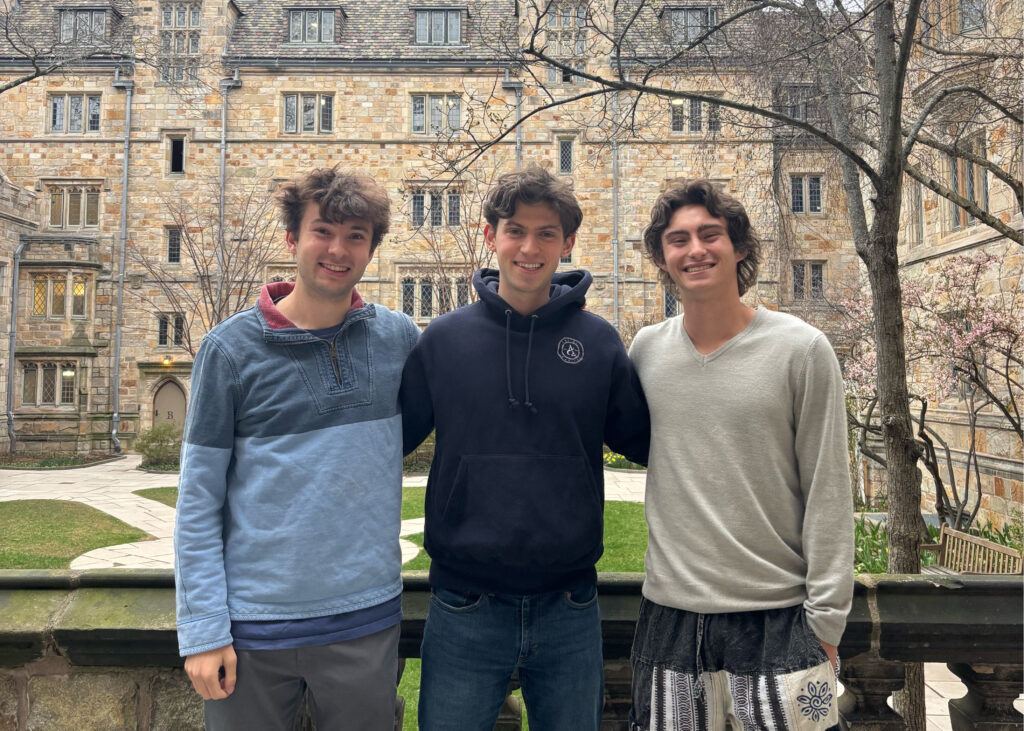
Three students at Yale University have developed an innovative application named Scroll Toll, designed to help users reduce their screen time while promoting charitable contributions. Launched in November 2023 by Asher Barondes (class of 2026), Benjamin Siegel (class of 2029), and Chase Reynders (class of 2026), the app allows individuals to set limits on their app usage. Exceeding these limits prompts users to donate to a charity selected by the app.
The founders aimed to create a system that not only discourages excessive phone use but also encourages users to contribute to social causes. “We wanted to add more friction to really get people off their phones,” Barondes stated. He emphasized that linking financial donations to screen time could effectively motivate users to engage less with their devices while supporting charitable organizations.
Upon downloading the app, users can establish time limits for specific applications and designate an amount to donate for each instance they surpass these limits. For example, a user might opt to donate $0.25 for every additional five minutes spent on Instagram. The app offers the option to enable scheduled donations, allowing users to decide whether to donate automatically or manually.
Siegel articulated the app’s strategy, comparing its impact to congestion pricing in urban areas. He believes that creating a financial balance between time spent on devices and monetary contributions can effectively alter user behavior. The trio’s collaboration emerged when Siegel, during a gap year prior to Yale, connected with Barondes through mutual acquaintances.
Siegel’s gap year experience fueled his perspective on screen time. He previously documented various adventures on social media platforms, amassing two million followers on Instagram. This exposure helped him recognize the time lost to excessive social media engagement. “I would look at the stats on the phone after I posted something and realize I just wasted years of people’s lives in a matter of seconds,” Siegel reflected.
Although the app was initially introduced to a limited audience, the early results have been promising. Barondes reported that among the initial 65 users, there was an average reduction of screen time by 20 to 30 percent. As of January 2024, Scroll Toll has attracted 130 users, and the team has incorporated feedback to enhance user experience.
Current users, including Evan Daneker (class of 2026), have expressed appreciation for the app’s flexible approach. Daneker noted that unlike other screen time management applications that impose strict limits, Scroll Toll allows users to set their own parameters. This permissiveness makes the app more approachable, encouraging gradual reductions in usage rather than abrupt restrictions.
Another user, Sofia Jacobson (class of 2026), shared her experience with Scroll Toll, stating it helped her learn to establish realistic screen time limits. She noted that the app prompted her to reflect on her usage patterns, particularly during mindless scrolling sessions.
Looking ahead, the development team is focused on refining their project further. They aim to strengthen partnerships with their affiliated charities and introduce monthly challenges, such as highlighting charities related to breast cancer during Breast Cancer Awareness Month in October.
The founders acknowledge that not all users may be inclined to create a financial incentive linked to their phone usage, even if it amounts to a modest donation of $6 or $7 per month. Nonetheless, they believe there is a dedicated audience for their concept. “At the end of the day, you can always delete the app, and while we would love them to stick with it, we’re really trying to be intentional about our audience,” Reynders concluded. This thoughtful approach aims to ensure that Scroll Toll meets the needs of its users while fostering a healthier relationship with technology.