Researchers at the Technical University of Munich (TUM) have identified a rare supernova that may help clarify the ongoing debate about the rate at which the universe is expanding. The supernova, designated SN 2025wny, is located approximately 10 billion light-years from Earth and is classified as a superluminous stellar explosion, significantly brighter than typical supernovae. This discovery, detailed in studies on the arXiv preprint server, could provide a new, independent method for measuring the universe’s expansion rate.
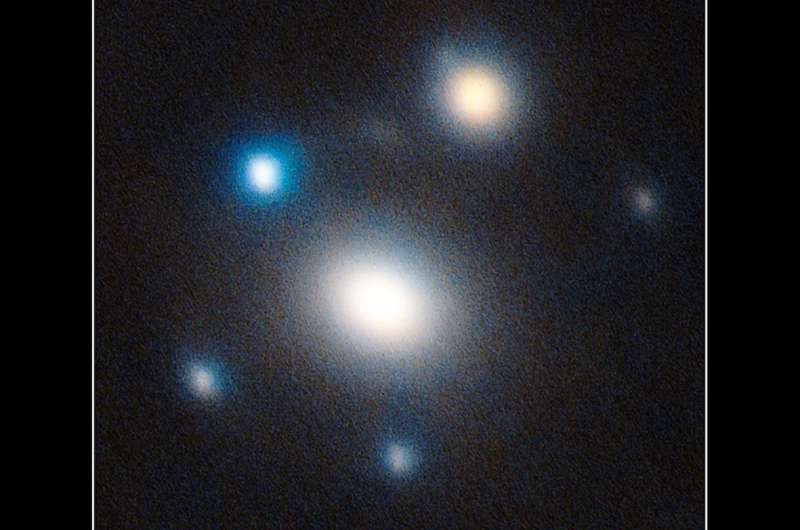
The uniqueness of SN 2025wny is enhanced by its appearance in the night sky as five distinct images, a phenomenon caused by gravitational lensing. This occurs when two foreground galaxies bend the light of the supernova, creating multiple paths for the light to travel to Earth, resulting in variations in arrival times. By calculating these time delays, researchers can derive the universe’s present-day expansion rate, known as the Hubble constant.
Sherry Suyu, Associate Professor of Observational Cosmology at TUM, emphasized the significance of this discovery. “The chance of finding a superluminous supernova perfectly aligned with a suitable gravitational lens is lower than one in a million,” she stated. The team searched for six years to identify the ideal conditions that led to this extraordinary event, with their breakthrough occurring in August 2025.
Measuring the Cosmic Scale
The analysis of gravitationally lensed supernovae is rare, with only a few attempts made to date. The accuracy of these measurements hinges on determining the masses of the lensing galaxies, which affects how the supernova’s light is bent. To achieve this, researchers utilized the Large Binocular Telescope in Arizona, USA, which features two 8.4-meter mirrors and an adaptive optics system to counteract atmospheric distortion.
This collaboration resulted in the first high-resolution color image of SN 2025wny, revealing the lensing galaxies and the five bluish copies of the supernova. “SN Winny, however, is lensed by just two individual galaxies,” said Allan Schweinfurth, a junior researcher at TUM. The simplicity of the lensing system presents a promising opportunity for precise measurements of the universe’s expansion.
Addressing the Hubble Tension
For years, scientists have struggled with conflicting measurements of the Hubble constant, a discrepancy known as the Hubble tension. Current methods primarily include the local approach, which involves measuring distances to galaxies via a process akin to climbing a ladder, and the cosmic microwave background study, which examines the afterglow of the Big Bang. The former is susceptible to cumulative errors, while the latter relies heavily on assumptions about the early universe’s development, which remain contentious.
The method involving SN 2025wny introduces a novel approach by leveraging gravitational lensing. Stefan Taubenberger, a key member of the TUM team, highlighted the advantages of this technique: “Unlike the cosmic distance ladder, this is a one-step method, with fewer and completely different sources of systematic uncertainties.”
Current observations of SN 2025wny are ongoing, utilizing both ground-based and space telescopes. The results from these observations promise to provide critical insights and potentially resolve the persistent Hubble tension, advancing our understanding of the cosmos.
This remarkable discovery not only sheds light on the universe’s expansion but also exemplifies the intricate connections between celestial phenomena and our quest to comprehend the fundamental nature of reality.