Recent research suggests that cosmic rays generated by nearby supernovae could play a significant role in the formation of Earth-like planets. A team led by astrophysicist Ryo Sawada from the University of Tokyo explored this concept in their study published in Science Advances on December 21, 2025. Their findings indicate that the conditions for creating water-depleted rocky planets like Earth may be more common than previously thought.
For years, scientists believed that the early solar system was enriched with short-lived radioactive elements—such as aluminum-26—from a supernova explosion. This radioactive material was thought to heat up young planetesimals, resulting in the loss of water and volatile compounds essential for life. However, this explanation hinged on the occurrence of a rare and precise event: a supernova exploding at just the right distance to provide these elements without destroying the protoplanetary disk.
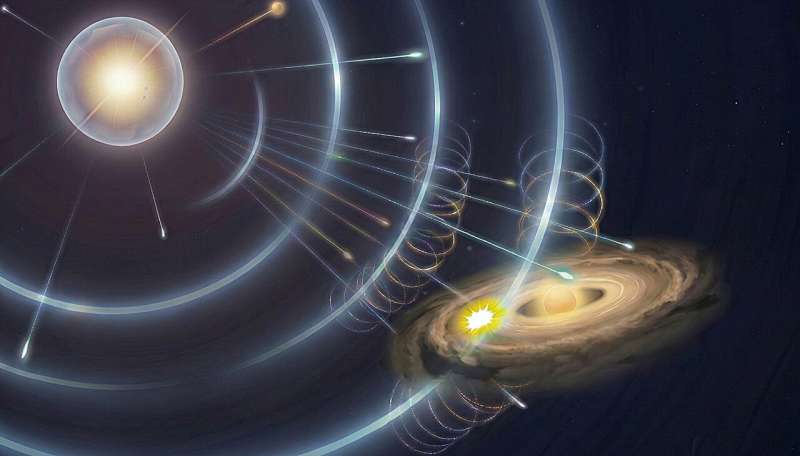
In examining the influence of supernovae, Sawada questioned whether the traditional view might be incomplete. Supernovae do not merely eject material; they also act as powerful particle accelerators, generating vast quantities of high-energy particles known as cosmic rays. In many models of solar system formation, these cosmic rays had been largely overlooked.
The research team proposed that instead of relying solely on supernova ejecta, the young solar system might have been enveloped in a “cosmic-ray bath.” Their numerical simulations demonstrated that when cosmic rays interact with the protosolar disk, they can induce nuclear reactions that produce radioactive elements, including aluminum-26. Remarkably, the simulations showed that these elements could be generated from distances of about one parsec from a supernova—a distance commonly found in star clusters.
This finding challenges the notion that Earth’s formation depended on a rare cosmic occurrence. Instead, it suggests that the young solar system merely needed to exist within the same stellar nursery as a massive star that would eventually explode. The implications of this discovery are significant; if cosmic-ray baths are typical in environments with sun-like stars, then the processes that influenced Earth’s development could be prevalent across the galaxy.
The researchers caution that while their findings provide a broader understanding of planetary formation, they do not imply that every habitable planet is guaranteed to form under similar conditions. Factors such as disk lifetime, cluster structure, and stellar dynamics remain crucial in determining the habitability of a planet.
Sawada emphasized the interconnectedness of astrophysical processes, noting that cosmic-ray acceleration, typically studied in high-energy astrophysics, is vital to understanding planetary science and the conditions necessary for habitability. He remarked, “Sometimes, the key to understanding where we come from lies not in adding more complexity but in noticing what we have been overlooking.”
This research contributes to the ongoing dialogue about the origins of Earth-like planets, providing a fresh perspective on how cosmic events shape the conditions necessary for life to emerge. The findings underscore the importance of interdisciplinary studies that bridge astrophysics and planetary science, highlighting the potential for new discoveries in the quest to understand our place in the universe.