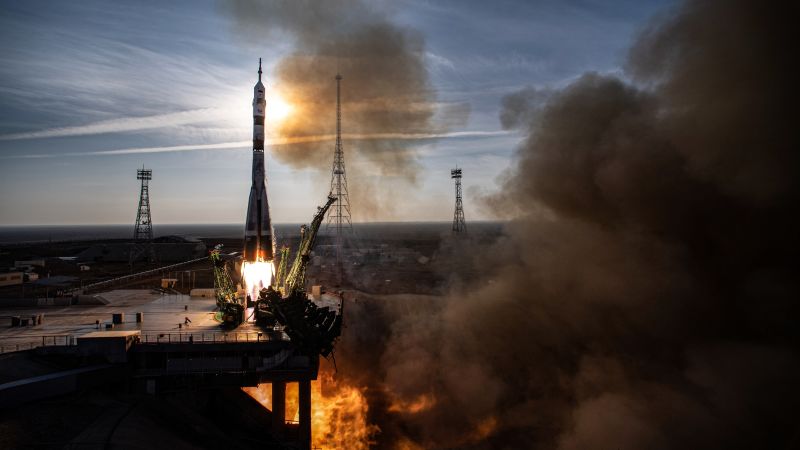
A launch pad at Russia’s primary space facility was damaged during the launch of a mission that successfully transported two Russian cosmonauts and one American astronaut to the International Space Station (ISS). The launch occurred on November 30, 2023, and the crew aboard the Soyuz MS-28 spacecraft successfully docked with the ISS shortly thereafter, according to a statement from Roscosmos, Russia’s space agency.
Following the launch, a post-launch inspection at the Baikonur Cosmodrome in Kazakhstan revealed damage to several elements of the launch pad. Roscosmos confirmed that an assessment of the launch complex’s condition is currently underway and noted that all necessary parts for repairs are available. The agency stated, “The damage will be repaired in the near future.”
Impact on Future Launches
The launch pad is crucial as it houses support systems for the rocket and provides a structure for cosmonauts to access their capsule. These facilities must endure extreme heat, air pressure, and vibrations during liftoff. Russian analysts have speculated that repairs could take a week or longer, which may hinder Russia’s ability to launch future missions to the ISS.
Analyst and blogger Georgy Trishkin expressed concerns on Telegram, stating, “In the worst case this could seriously affect the rotation of crewed missions and cargo flights to the ISS.” Typically, crewed missions are launched from Baikonur approximately every six months.
Commentator Vitaliy Egorov highlighted the broader implications of the damage, noting, “This is the only launch pad Roscosmos uses for the ISS program, and in the future it was supposed to be used for launches to the Russian Orbital Station.” He emphasized that this incident effectively means Russia has lost the capability to launch humans into space, marking a significant historical shift since the inception of its human spaceflight program in 1961.
Current Status of ISS Crew
Currently, the three crew members from the latest mission join seven other astronauts already aboard the ISS. According to NASA, three of these crew members are scheduled to return to Earth by December 8, 2023. Besides the Russian Soyuz spacecraft, NASA utilizes SpaceX’s Dragon spacecraft for crew transport to the ISS, ensuring that human presence in space continues despite the recent setback for Roscosmos.
As the situation develops, the focus remains on the swift repair of the launch pad to restore Russia’s capability for human spaceflight.