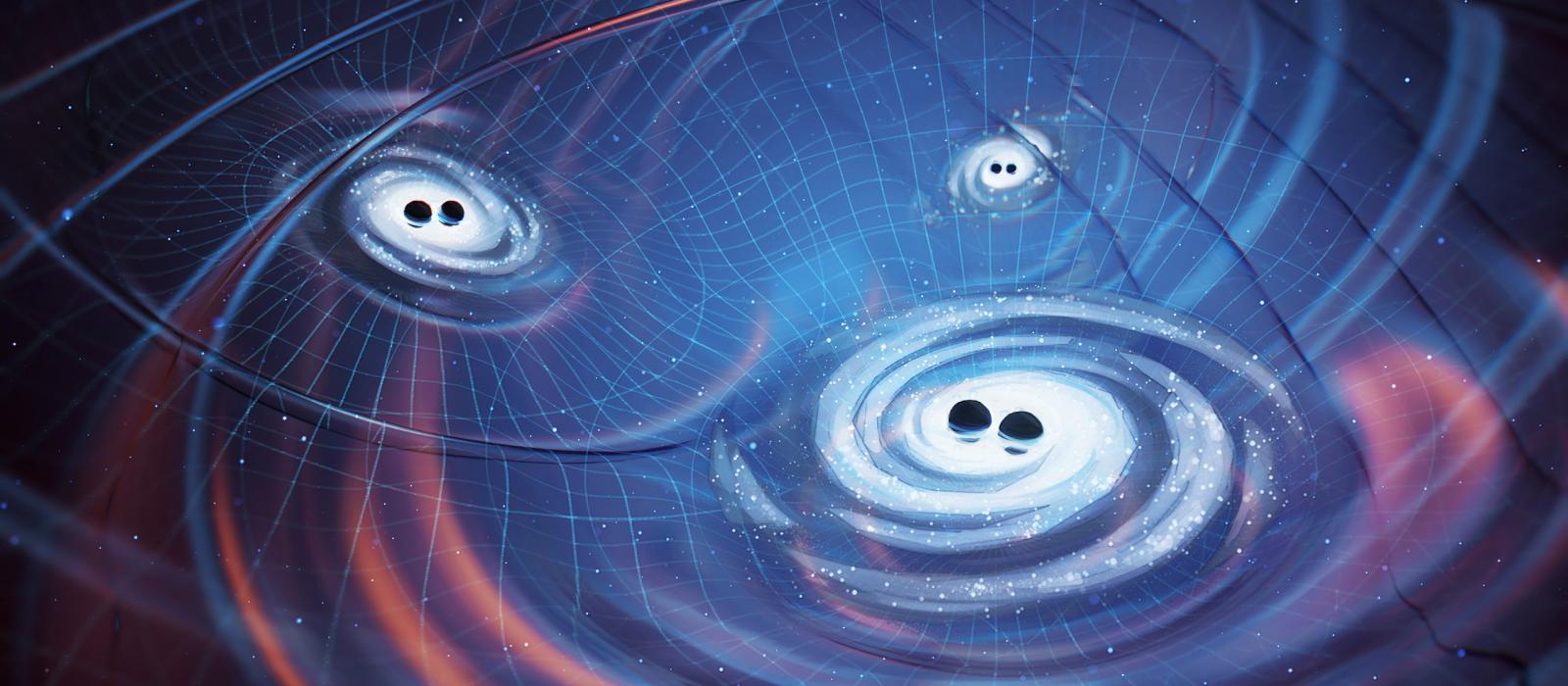
The discovery of gravitational waves (GWs) has opened new avenues in astrophysics, particularly in understanding dark matter. Researchers from the University of Amsterdam (UvA) have proposed a novel method to utilize GWs produced by black hole mergers to investigate the elusive nature of dark matter. This groundbreaking research is documented in a paper published in the journal Physical Review Letters.
The 2015 detection of GWs confirmed a fundamental prediction of Albert Einstein’s Theory of General Relativity, marking a significant milestone in astronomy. These waves arise when massive objects, such as black holes and neutron stars, collide, sending ripples through spacetime that can be detected across vast cosmic distances.
New Insights into Dark Matter
The UvA research team, led by Rodrigo Vicente, Theophanes K. Karydas, and Gianfranco Bertone, focused on how black hole binaries and other compact objects spiral inward to form larger black holes, a phenomenon termed Extreme Mass-Ratio Inspirals (EMRIs). Their study enhances the understanding of how dark matter interacts with these black holes, particularly in dense environments where dark matter may accumulate.
The authors explain that their research offers a more comprehensive model for how dark matter affects the orbits of EMRIs. By employing General Relativity instead of a simplified Newtonian framework, the team provides a groundbreaking perspective on the gravitational interactions at play. This new approach enables scientists to predict the effects of dark matter “spikes” or “mounds” on GW signals.
Future Observations and Implications
The implications of this research are significant as it aligns with plans by the European Space Agency (ESA) to launch the Laser Interferometer Space Antenna (LISA) within the next decade. LISA will be the first space-based observatory dedicated to studying GWs, utilizing three spacecraft and six lasers to measure spacetime ripples. It is expected to detect over 10,000 GW signals throughout its mission, providing critical data on the nature of dark matter.
This work not only suggests what astronomers might discover with LISA and other detectors, including the Laser Interferometer Gravitational Wave Observatory (LIGO) and the Virgo Collaboration, but also contributes to a burgeoning field that aims to map dark matter’s distribution across the universe. Dark matter is believed to account for approximately 65% of the universe’s mass, and understanding its properties could yield insights into its composition and role in cosmic evolution.
In conclusion, the UvA team’s research presents a significant advancement in the intersection of gravitational wave astronomy and cosmology. As scientists prepare for future observations, the potential to decode the mysteries of dark matter through gravitational waves becomes increasingly tangible. Further studies will undoubtedly enhance our understanding of the universe’s fundamental components.