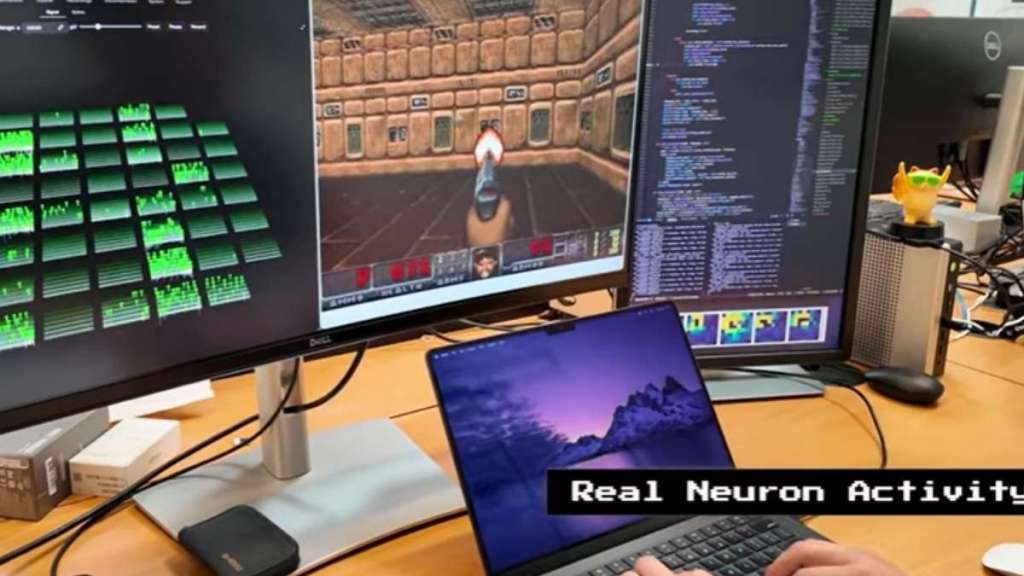
In a pioneering experiment, researchers at Cortical Labs have cultivated 800,000 brain cells in a petri dish, successfully utilizing their neural activity to play the classic video game Doom. This innovative development represents a significant advancement in the field of biological computing, captivating both the scientific community and the public.
The experiment, which builds on previous work where the same team taught the brain cells to play Pong in 2021, marks a leap in complexity. According to the researchers, “Pong was much simpler. There was a direct relationship: The ball went up, the paddle went up. It was a direct input-output relationship.” In contrast, Doom presents a far more intricate digital environment that required translating the game’s mechanics into a format comprehensible to neurons.
Breakthrough in Biological Computing
Using microelectrode arrays, the team was able to stimulate and read the electrical activity of the neurons, effectively creating an interface that allows real-time interaction with the brain cells. “While there’s still a lot of work left to do on this, the exciting thing is we’ve solved the interface problem,” the team stated. “We have a way to interact with these cells in real time and train them and shape their behavior to do things even like Doom.”
The announcement has garnered widespread attention, particularly following the release of a video on X (formerly Twitter) by Curiosity, showcasing the brain cells engaging with the game. This visual representation of biological computing has sparked a flurry of reactions online. One user humorously suggested, “We need a competition between the Petri dish and DSP on who can beat Doom first. My money is on the Petri dish.” Another remarked, “Crazy what a ‘clump of cells’ can do,” while a science enthusiast jokingly noted, “That’s the beginning of a Terminator-like plot.”
Despite the excitement surrounding this achievement, Cortical Labs clarified that these brain cells are not poised to defeat human players anytime soon. The complexities of the game and the limitations of the biological system mean that while the cells can interact with the game, they are far from mastering it at a competitive level.
This research opens up new possibilities for understanding neural networks and their potential applications in computing. As scientists continue to explore the interface between biological systems and technology, the implications of such breakthroughs are likely to extend beyond gaming, potentially influencing fields such as artificial intelligence and neural prosthetics.
As the scientific community delves deeper into these intersections, the developments at Cortical Labs invite further inquiry and exploration, marking a noteworthy chapter in the evolution of both biology and technology.