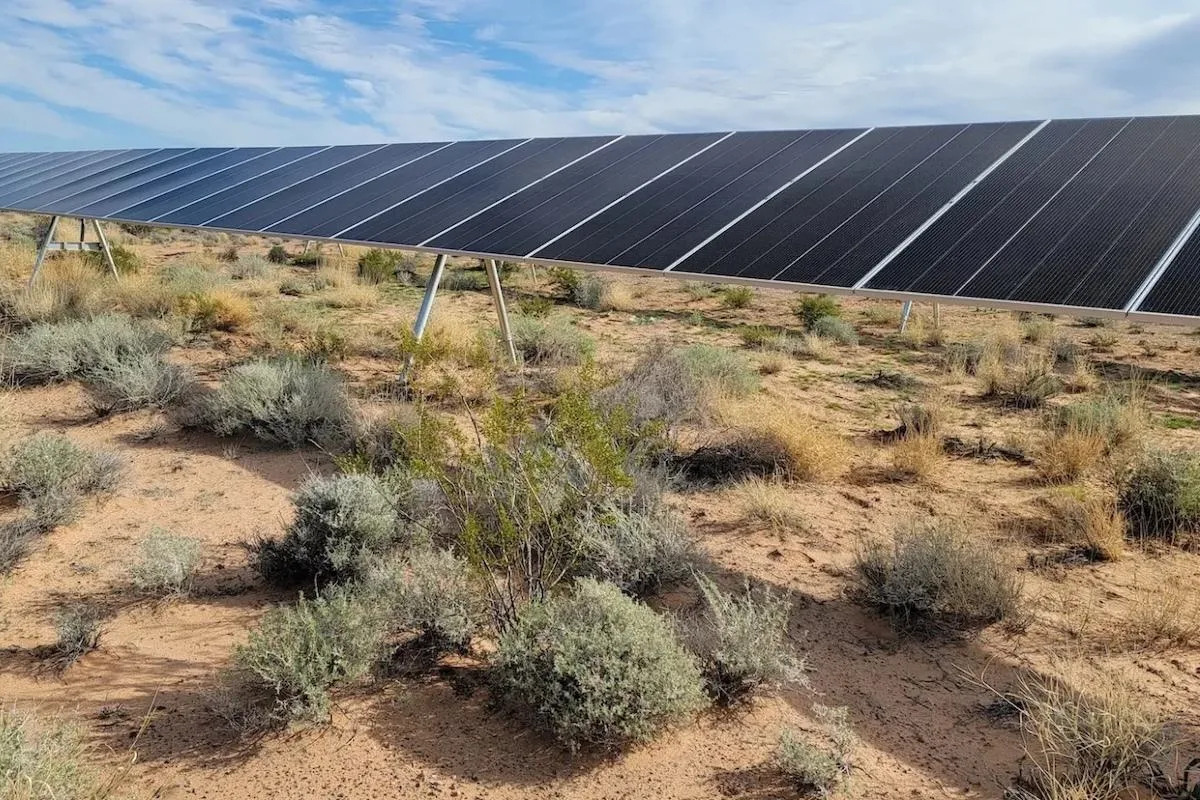
A new study highlights the flourishing of a rare desert plant, the threecorner milkvetch, at the Gemini Solar Project located near Las Vegas. Researchers found that the Mojave Desert, often perceived as barren, is rich in biodiversity, including this unique member of the pea family. The threecorner milkvetch typically lies close to the ground, waiting for rain to trigger its growth and reproduction.
Despite its resilience, this species, which is currently under consideration for protection under the Endangered Species Act, remains vulnerable to disturbances caused by construction. Traditional methods employed by energy companies often involve “blading and grading” — a practice that disrupts existing vegetation and seed banks in the soil. In contrast, the Gemini Solar Project adopted a more ecologically sensitive approach, aiming to preserve the local ecosystem during construction.
According to the study led by ecologist Tiffany Pereira from the Desert Research Institute, the impact of this approach is evident. Before the development, only 12 threecorner milkvetch plants were documented on the site. By 2024, following the project’s completion, 93 plants were found, indicating a successful survival of seeds through the construction process. The plants at Gemini not only increased in number but also grew bigger and produced more flowers and fruits compared to those in a nearby area.
One contributing factor could be the shade provided by solar panels, which helps retain soil moisture and reduces evaporation. Pereira remarked, “So you just have the potential for a lot more plants,” noting that the survival of the seed bank is a significant achievement. This study provides further evidence that solar farms can be developed in ways that benefit local ecosystems.
The concept used at Gemini is known as ecovoltaics, which focuses on designing solar facilities with the preservation of native species in mind. For instance, crews can introduce native grasses and flowers to enhance the local ecosystem. Lee Walston, an ecologist at Argonne National Laboratory who was not involved in the research, explained that “some of those seed mixes do quite well at solar facilities,” attracting a variety of wildlife.
Evidence of positive ecological outcomes is seen in other regions as well. In Minnesota, Walston’s research on solar sites converted from cropland revealed a sevenfold increase in unique flowering plant species and a tripling of insect pollinators over five years. Notably, native bee populations surged by 20 times. The increase in biodiversity, including grassland birds and bats, showcases the potential of well-planned solar facilities to support wildlife.
While the benefits are clear, achieving significant biodiversity is not guaranteed. Different plant species have varying needs regarding sunlight; for example, Pereira noted that only one threecorner milkvetch was found growing directly under a solar panel, while others thrived in sunnier areas. The height of the solar panels plays a crucial role as well. Taller panels may allow larger plant species to flourish, but they also increase construction costs. Additionally, height adjustments can accommodate livestock used in “conservation grazing,” which helps control invasive weeds and reduces fire hazards.
The pursuit of ecovoltaics extends beyond solar energy; it also aims to restore former agricultural fields to a more natural state. Johanna Neumann, senior director of the Campaign for 100% Renewable Energy at Environment America, highlighted the potential of solar farms to benefit biodiversity, especially in prairie ecosystems that traditionally require disturbances for health.
In contrast, conventional clearing methods lead to habitat disruption and the loss of native plant structures that stabilize soil. This opens the door for fast-growing invasive species to dominate, which can be less appealing to local pollinators.
Innovatively, solar installations can also facilitate the practice of agrivoltaics, where crops are grown alongside solar panels. Research suggests that crops like cucumbers can thrive in these setups, benefiting from the unique microclimate created by the panels. This method not only conserves water but can also yield profitable crops, a critical factor for farmers considering solar adoption.
As scientists explore which crops will thrive under solar panels, there is growing interest in the economic viability of such approaches. Horticulturist Jennifer Bousselot from Colorado State University noted, “If you’re going to grow something, you want to grow something that a potential farmer could sell for decent profit.”
In summary, the emergence of ecovoltaics and agrivoltaics presents promising opportunities for enhancing biodiversity and agricultural productivity while generating clean energy. Pereira aptly stated, “Rather than a moonscape of invasive species and dust blowing into cities, why not strive for something better?” As the solar industry continues to expand, the integration of ecological principles could lead to healthier ecosystems and sustainable energy solutions.