The universe is expanding, but scientists face a puzzling contradiction regarding its rate. Researchers at the University of Tokyo have introduced an independent method that supports the idea that discrepancies in measurements of the universe’s expansion are significant and not simply due to errors. This finding sheds light on the long-standing mystery surrounding the Hubble constant, which represents the speed at which galaxies move away from Earth.
For decades, astronomers have used distance markers such as supernovae to establish the expansion rate, calculating the Hubble constant at approximately 73 kilometres per second per megaparsec. This means that for every 3.3 million light years from Earth, objects appear to recede at a speed of 73 kilometres per second faster. Yet, a conflicting measurement comes from analyzing the cosmic microwave background, the radiation leftover from the Big Bang, which suggests a lower rate of 67 kilometres per second per megaparsec. This difference, known as the Hubble tension, poses profound implications for our understanding of the universe.
Innovative Approach to Measuring Expansion
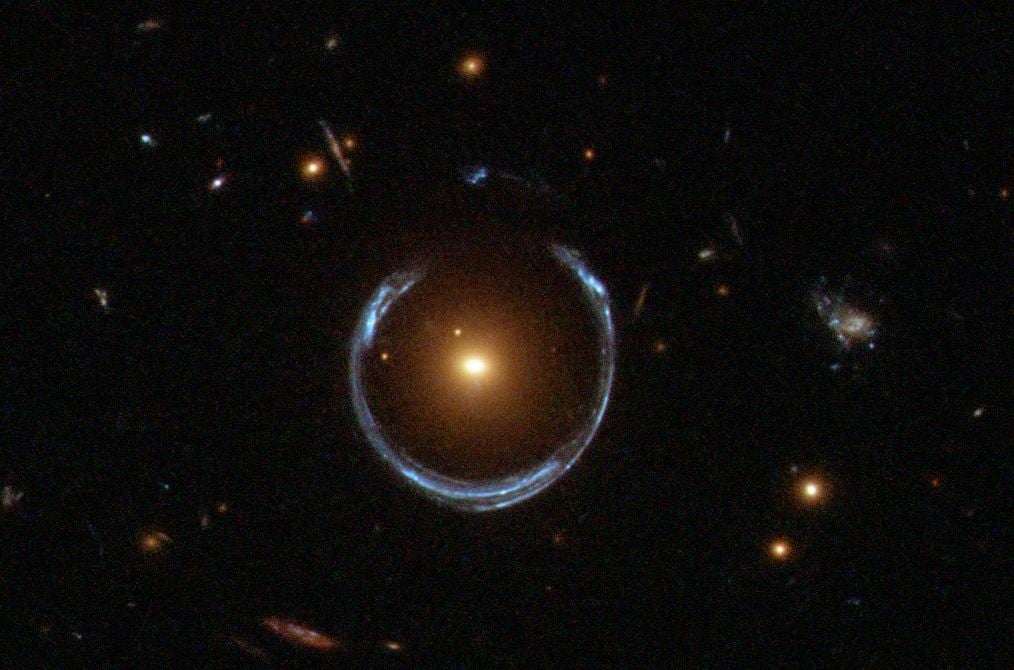
The research team, led by Project Assistant Professor Kenneth Wong at the University of Tokyo’s Research Centre for the Early Universe, has employed a technique called time delay cosmography. This method bypasses traditional distance ladders and utilizes gravitational lensing—where massive galaxies bend light from objects behind them. When conditions are optimal, a distant quasar can appear as multiple distorted images surrounding the lensing galaxy.
By observing these images, which travel different paths to reach Earth, scientists can measure the time it takes for each image to arrive. Variations in timing provide insights into the expansion rate of the universe. The team analyzed eight gravitational lens systems, employing data from state-of-the-art telescopes, including the James Webb Space Telescope. Their findings produced a Hubble constant that aligns with the higher figure of 73 kilometres per second per megaparsec, rather than the lower estimate derived from early universe predictions.
This new technique is significant because it is less likely to be affected by systematic errors that could compromise traditional measurements. The alignment with current observations strengthens the hypothesis that the Hubble tension may reflect real physical phenomena rather than mere inaccuracies in measurement methods.
Future Research and Implications
The current precision of this new measurement stands at approximately 4.5 percent, but to conclusively confirm the existence of the Hubble tension, researchers aim to enhance this precision to between 1-2 percent. Achieving this goal will involve analyzing additional gravitational lens systems and refining models of how mass is distributed within the lensing galaxies. The largest uncertainty lies in the arrangement of mass within these galaxies, although researchers base their assumptions on established observations.
The work is the culmination of decades of international collaboration among various observatories and research teams. If the Hubble tension is validated as a genuine discrepancy, it could signal a new chapter in cosmology, fundamentally altering our understanding of the universe’s evolution. The implications of this research are profound, potentially leading to breakthroughs in physics that we have yet to comprehend.