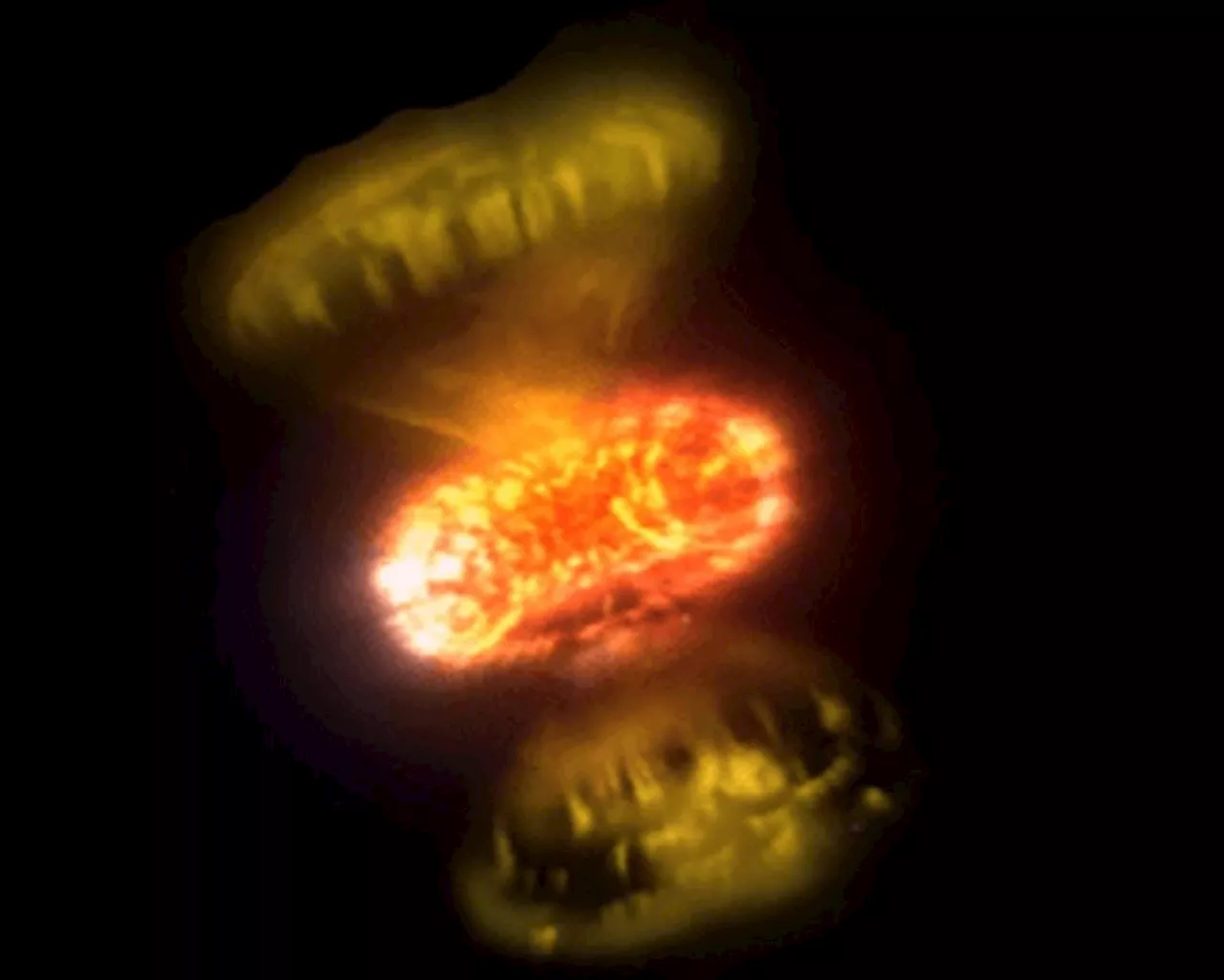
Astronomers have unveiled new images of nova explosions, revealing a complexity that challenges previous understanding. These thermonuclear eruptions occur on the surfaces of white dwarfs in binary star systems, showcasing intricate ejections and shock physics. The findings, recently published in a study in Nature Astronomy, provide critical insights into the mechanisms behind these stellar events.
Nova explosions happen when a white dwarf accumulates matter from its companion star, leading to a sudden thermonuclear reaction. This process not only results in the ejection of material but also generates high-energy gamma-ray emissions. The research team, led by Elias Aydi from Texas Tech University, captured detailed images of two distinct novae, V1674 Her and V1405 Cas, which illustrate unexpected features of these phenomena.
Revealing the Dynamics of Nova Explosions
The study highlights that novae are more than simple explosive events; they are complex occurrences involving multiple outflows and interactions. Aydi noted, “These observations allow us to watch a stellar explosion in real time, something that is very complicated and has long been thought to be extremely challenging.” This advancement provides a clearer view of how material is ejected during these explosions, akin to transitioning from a grainy black-and-white photograph to a high-definition video.
V1674 Her is classified as a fast nova, with images taken just two to three days after the explosion showing material being expelled in two perpendicular outflows. This evidence suggests multiple interacting ejections, showcasing the dynamic nature of these events. In contrast, V1405 Cas, identified as a slow nova, exhibited delayed material ejection, with significant activity occurring around 50 days post-explosion. This delay is the first documented evidence of such behavior in nova explosions.
The research team employed two observational methods: interferometry and spectrometry. Utilizing the CHARA Array at Georgia State University for interferometry, they were able to uncover fine details of the explosions. Coupled with spectrometric data from various observatories, the team identified new chemical signatures in the ejected material, confirming the structure of the material as it collided during the explosive events.
Implications for Astrophysics and Understanding Stellar Life Cycles
The findings have significant implications for astrophysics, as they reveal the underlying processes of shock physics and particle acceleration in extreme environments. The authors assert that novae serve as natural laboratories, allowing scientists to study the energetic shocks that lead to gamma-ray emissions. “Novae are more than fireworks in our galaxy — they are laboratories for extreme physics,” remarked Professor Laura Chomiuk from Michigan State University.
The research team emphasizes that understanding nova explosions is crucial for grasping the broader mechanisms of stellar evolution and death. The results challenge the notion that these eruptions are simple events, revealing a rich tapestry of interactions and complexities. Aydi expressed optimism for future studies, stating, “With more observations like these, we can finally start answering big questions about how stars live, die, and affect their surroundings.”
As astronomers continue to gather data, they aim to determine whether the delayed ejections observed in V1405 Cas are common among other novae. This ongoing research could establish a framework for understanding the physics of common-envelope interactions in binary star systems.
The discoveries surrounding nova explosions mark a significant advancement in our understanding of stellar dynamics, paving the way for further exploration of the universe’s most dramatic events.