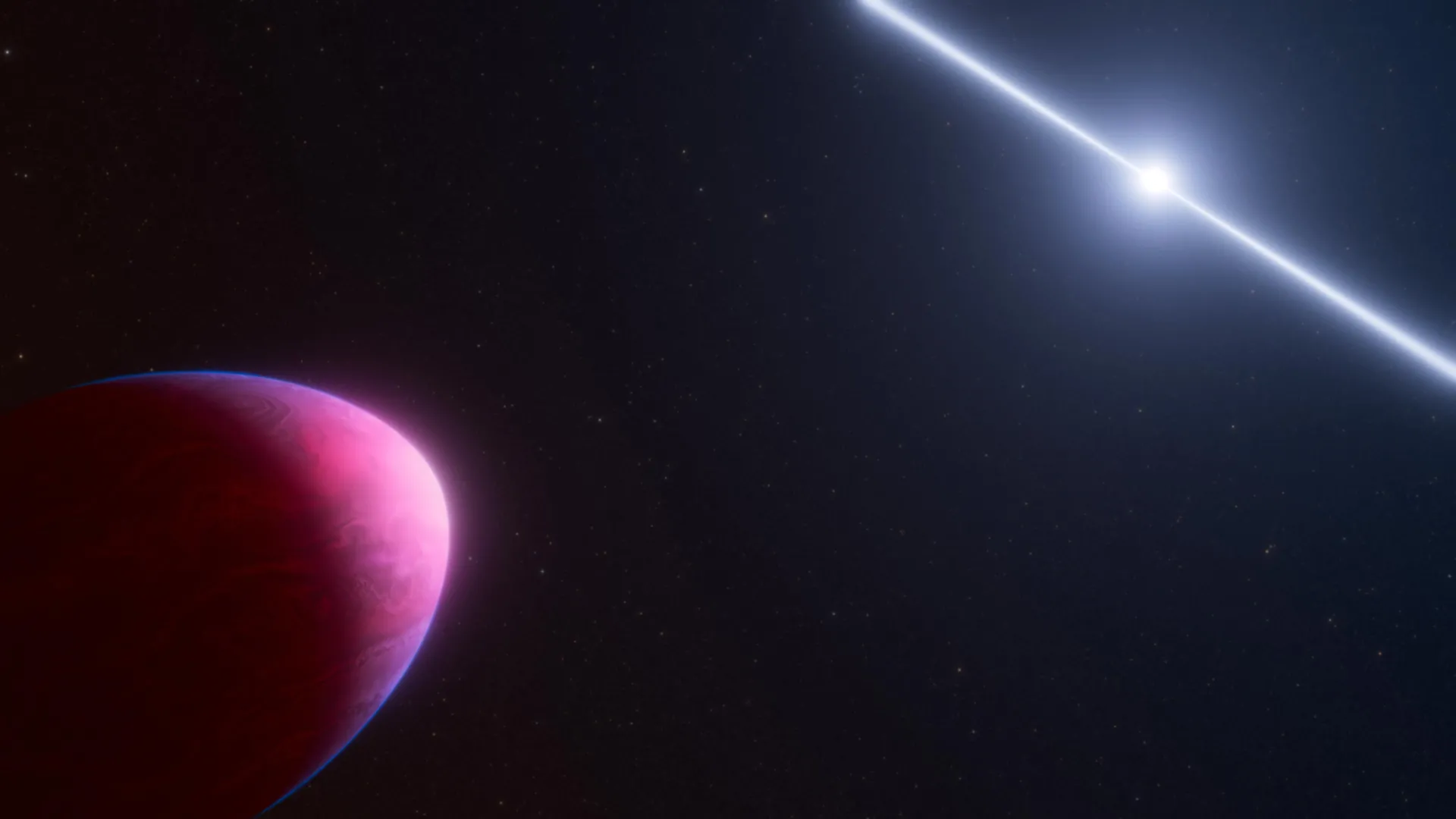
NASA’s James Webb Space Telescope has made a groundbreaking discovery of an exoplanet that challenges existing theories of planetary formation. This newly identified world, named PSR J2322-2650b, orbits a neutron star and possesses a unique atmosphere that is rich in carbon, featuring dark soot-like clouds and the potential for diamonds deep within.
A Planet Like No Other
The characteristics of PSR J2322-2650b are astonishing. With a mass similar to that of Jupiter, this planet exhibits a stretched, lemon-like shape due to the intense gravitational forces exerted by the neutron star it orbits. Completing a full orbit in just 7.8 hours, this planet exists in an environment that defies conventional understanding. Researchers have noted that the atmosphere is predominantly composed of helium and carbon, a stark departure from the more typical gaseous compositions of known exoplanets.
According to Michael Zhang, an astrophysicist at the University of Chicago and the principal investigator of the study, “This is a new type of planet atmosphere that nobody has ever seen before.” The research findings have been accepted for publication in The Astrophysical Journal Letters.
Unraveling a Cosmic Mystery
PSR J2322-2650b orbits a pulsar, a neutron star that rotates at rapid speeds and emits beams of electromagnetic radiation. This unique setup allows researchers to study the planet’s atmospheric composition without the overwhelming brightness typically associated with stars. Maya Beleznay, a graduate student at Stanford University, highlighted the benefits of this observational strategy, stating, “This system is unique because we are able to view the planet illuminated by its host star, but not see the host star at all.”
When scientists examined the planet’s atmospheric signature, they found unexpected molecular forms of carbon, specifically C3 and C2. Zhang noted, “Instead of finding the normal molecules we expect to see on an exoplanet — like water, methane, and carbon dioxide — we saw molecular carbon.” The extreme pressures inside the planet could lead to crystallization, potentially forming diamonds beneath the surface.
The formation process of this unusual exoplanet remains a mystery. Zhang remarked, “It seems to rule out every known formation mechanism.” The planet orbits its neutron star at an astonishing distance of just 1 million miles—compared to Earth’s distance of about 100 million miles from the Sun—contributing to its extreme conditions.
Additionally, the system is categorized as a black widow, where a fast-spinning pulsar is paired with a lower-mass companion. This relationship results in material from the companion being stripped away, and in this case, the companion is classified as an exoplanet rather than a star.
Leading expert on black widow systems, Roger Romani from Stanford University, has proposed a theory regarding the planet’s unusual atmosphere. He suggests that as the companion cools, carbon and oxygen in the interior begin to crystallize, allowing pure carbon crystals to rise and mix with helium. However, he acknowledges there are unresolved issues: “Something has to happen to keep the oxygen and nitrogen away. And that’s where there’s controversy.”
Ultimately, the discoveries made possible by the James Webb Space Telescope offer an exciting glimpse into the universe’s complexities. Its advanced infrared sensitivity and unique observational capabilities are critical for studying distant celestial bodies, as Zhang pointed out: “It’s absolutely not feasible from the ground.”
Funding for this remarkable research was provided by NASA and the Heising-Simons Foundation, with additional contributions from several University of Chicago scholars.