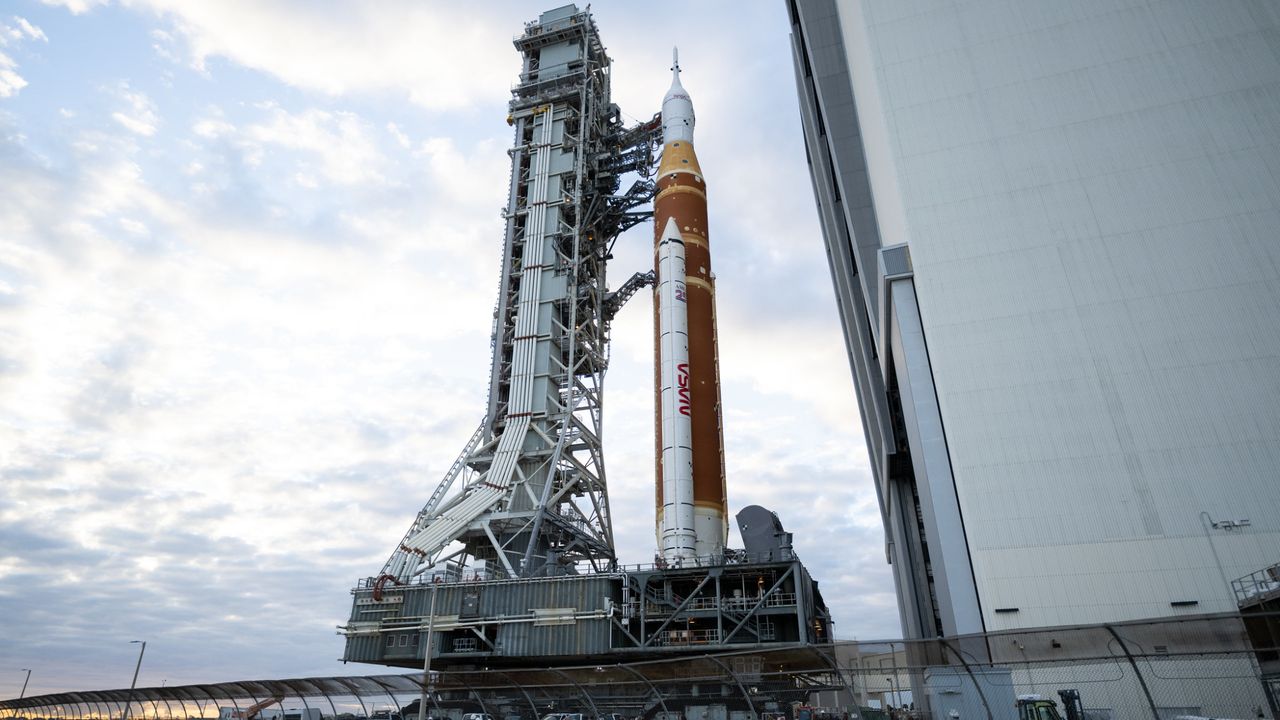
NASA’s Space Launch System (SLS) rocket has officially begun its journey to the launch pad, marking a significant step toward the upcoming Artemis 2 mission, which aims to send astronauts back to the moon. The rocket departed from the Vehicle Assembly Building (VAB) at Kennedy Space Center (KSC) in Cape Canaveral, Florida, on January 17, 2024, setting the stage for a historic launch expected in early February.
This morning, at 07:04 EST (12:04 GMT), the fully assembled SLS rolled out for the first time, embarking on a four-mile (6.4 kilometers) trek to Launch Complex-39B (LC-39B). Engineers have dedicated the past 18 months to preparing the Artemis 2 SLS, which stands 322 feet (98 meters) tall and weighs approximately 2,870 tons (2,600 metric tons) when fully fueled. The rocket’s impressive power comes from two solid rocket boosters and four RS-25 engines, generating a total of 8.8 million pounds of thrust at liftoff.
The enormous vehicle is moving at a speed of less than 1 mph (1.6 kph), and the journey from the VAB to LC-39B is anticipated to take between eight to ten hours. Once at the launch pad, NASA will conduct a series of systems integrations and vehicle checkouts. A critical milestone, known as the wet dress rehearsal, is scheduled for February 2, 2024. The actual launch could occur as early as February 6, 2024, depending on the outcomes of these checks.
NASA’s Artemis 2 mission will carry a crew of four astronauts: NASA’s Reid Wiseman, Victor Glover, and Christina Koch, along with Canadian Space Agency astronaut Jeremy Hansen. The mission involves a ten-day journey around the moon, though the crew will not enter lunar orbit. Instead, they will follow a “free-return trajectory,” which allows the spacecraft to loop around the moon and return safely to Earth, mitigating risks of stranding in lunar orbit.
This mission builds on the success of Artemis 1, which launched in November 2022 following extensive preparations. Unlike its predecessor, Artemis 2 will carry astronauts, making it a crucial test of the Orion spacecraft’s life support systems and overall functionality. NASA officials are optimistic about avoiding the technical challenges that delayed Artemis 1, stating confidence in the readiness of the SLS.
The Artemis program aims to establish a sustainable human presence on the moon, with future missions designed to land astronauts on the lunar surface. Artemis 3 is planned as the first mission intended for a lunar landing, contingent on the success of Artemis 2. As preparations continue, the Artemis 2 crew has been actively training at KSC, participating in launch-day rehearsals to ensure they are ready for their upcoming mission.
With the SLS now on its way to the launch pad, the focus shifts to the final preparations and testing necessary to ensure a successful mission. The Artemis 2 launch represents a critical step forward in NASA’s goal of returning humans to the moon and establishing a foundation for future exploration.