The recent findings from China’s Chang’e-6 mission have unveiled significant characteristics of lunar soil collected from the far side of the Moon. On June 25, 2024, the mission successfully returned 1,935.3 grams of lunar soil from the South Pole–Aitken Basin, the largest and oldest impact structure on the Moon. This marks a pivotal advancement in the study of the Moon’s geological history, particularly as prior missions had primarily focused on near-side samples.
Previous lunar exploration efforts, including the Apollo and Luna missions, have delivered approximately 383 kilograms of lunar soil and rock. These samples have contributed greatly to our understanding of the Moon’s geological evolution. However, the absence of materials from the far side has posed limitations in exploring its unique composition and geological background.
According to Hu Hao, the chief designer of the Chang’e-6 mission, the collected samples exhibited a more viscous and clumpy texture compared to the finer materials obtained by the Chang’e-5 mission. To investigate this observation further, a research team led by Prof. Qi Shengwen from the Institute of Geology and Geophysics of the Chinese Academy of Sciences (IGGCAS) conducted experiments that measured the angle of repose, a key indicator of the flowability of granular materials. Their findings were published in the esteemed journal Nature Astronomy.
The results indicated that the lunar soil from Chang’e-6 has a significantly higher angle of repose than samples from the near side, displaying flow behaviors typical of cohesive soils. The analysis eliminated magnetic and cementation effects as potential contributors, as the samples contained only trace amounts of magnetic minerals and no clay minerals. Instead, the elevated angle of repose can be attributed to three interparticle forces: friction, van der Waals forces, and electrostatic forces.
Friction is directly related to the roughness of particle surfaces, while van der Waals and electrostatic forces become more significant as particle size diminishes. Using the D 60 metric, which indicates the particle diameter at which 60% of the sample is finer, researchers identified a critical size threshold of approximately 100 micrometers. Below this threshold, fine non-clay mineral particles begin to show cohesive behavior.
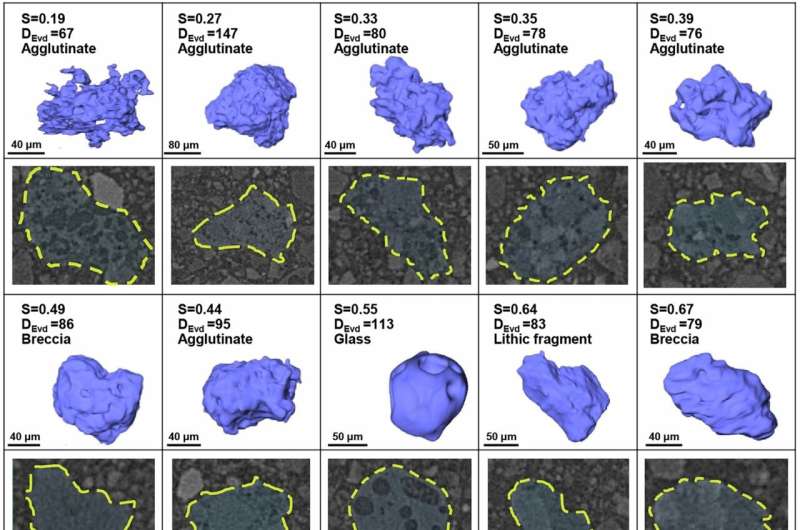
High-resolution CT imaging of the Chang’e-6 samples revealed a D 60 of only 48.4 micrometers, indicating that these particles are markedly finer and more irregularly shaped than those from the near side. With a lower particle sphericity, the findings suggest that despite their fine texture, the soil samples present more complicated particle morphologies than typically expected.
Prof. Qi remarked on this unusual characteristic, noting that finer particles generally exhibit more spherical shapes. The findings suggest that the high feldspar content of approximately 32.6% in the samples, a mineral prone to fragmentation, coupled with more intense space weathering on the far side, may contribute to the complex behaviors observed.
This research not only provides the first systematic explanation of the cohesive properties of lunar soil from a granular mechanics perspective but also offers new insights into the physical properties of regolith on the far side of the Moon. The implications of this study may extend beyond lunar geology, enhancing our understanding of granular materials in various contexts.
In conclusion, the Chang’e-6 mission has not only expanded our knowledge of the Moon’s far side but also opened new avenues for future research into the unique characteristics of its surface materials, laying the groundwork for further exploration and understanding of our closest celestial neighbor.