On July 2, 2025, astronomers detected an extraordinary event in the universe—a gamma-ray burst designated as GRB 250702B. Unlike typical gamma-ray bursts, which last mere seconds, this one persisted for an unprecedented seven hours, emitting three distinct bursts throughout the day. Following the initial detection by NASA’s Fermi Gamma-ray Space Telescope, a team of researchers began investigating this unusual phenomenon, which has become the longest gamma-ray burst ever recorded.
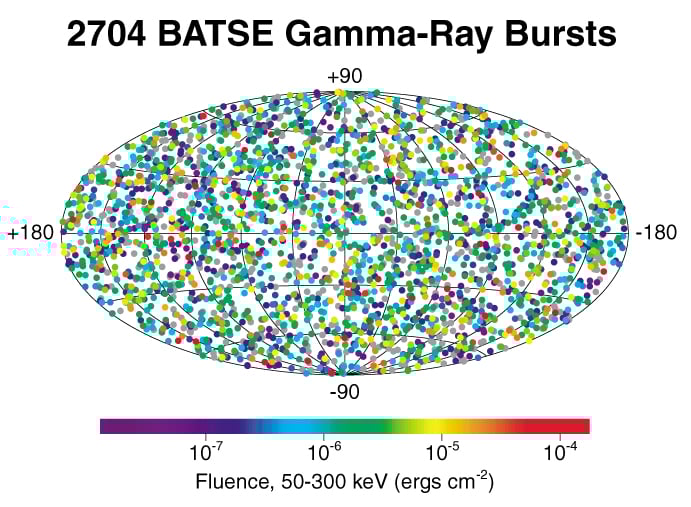
Gamma-ray bursts are known as some of the universe’s most violent explosions. In moments, they can release more energy than the Sun will emit over its entire ten billion-year lifespan. Since the recognition of gamma-ray bursts in 1973, around 15,000 have been catalogued. Most of these events arise from one-time occurrences, such as neutron star collisions or the collapse of massive stars. However, GRB 250702B defies these patterns, leading to speculation about its origin.
Potential Explanations and Theories
A new study published in the Monthly Notices of the Royal Astronomical Society highlights one of the most intriguing possibilities: that the burst was caused by an intermediate mass black hole (IMBH). Black holes exist in various sizes; stellar mass black holes form when massive stars die, while supermassive black holes reside at the centers of galaxies. The intermediate mass black holes, theorized to be common, range from hundreds to over a hundred thousand solar masses. Despite their predicted prevalence, finding these black holes has proven challenging.
Researchers propose that GRB 250702B was triggered when a star similar to our Sun ventured too close to an IMBH and was torn apart by its tidal forces. As the stellar material was shredded and spiraled inward, it likely generated a relativistic jet of particles moving close to the speed of light, producing the gamma-ray emissions detected by Fermi. The repeating bursts suggest that the star may not have been entirely destroyed in one encounter. Instead, it could have experienced multiple close passes, each generating a fresh burst of emission, which aligns with the timing of the three distinct Fermi triggers.
Significance of the Discovery
The location of GRB 250702B adds another layer to the mystery. Situated approximately 5.7 kiloparsecs from the center of its host galaxy, it is well outside the region typically associated with supermassive black holes. This positioning aligns with where one might expect an IMBH to exist, further supporting the hypothesis of its involvement in the gamma-ray burst.
If the interpretation of GRB 250702B as a product of an IMBH is confirmed, it would mark a significant milestone in astronomy—potentially the first observation of a relativistic jet produced by such a black hole consuming a star. This discovery could reshape our understanding of black holes and their role in the universe.
The scientific community continues to explore various competing models regarding the origins of GRB 250702B. The unresolved nature of this event exemplifies the complexities of astronomical research, where the most impactful discoveries often emerge unexpectedly. As scientists delve deeper into this seven-hour explosion, it serves as a reminder of the mysteries that still lie beyond our understanding in the cosmos.