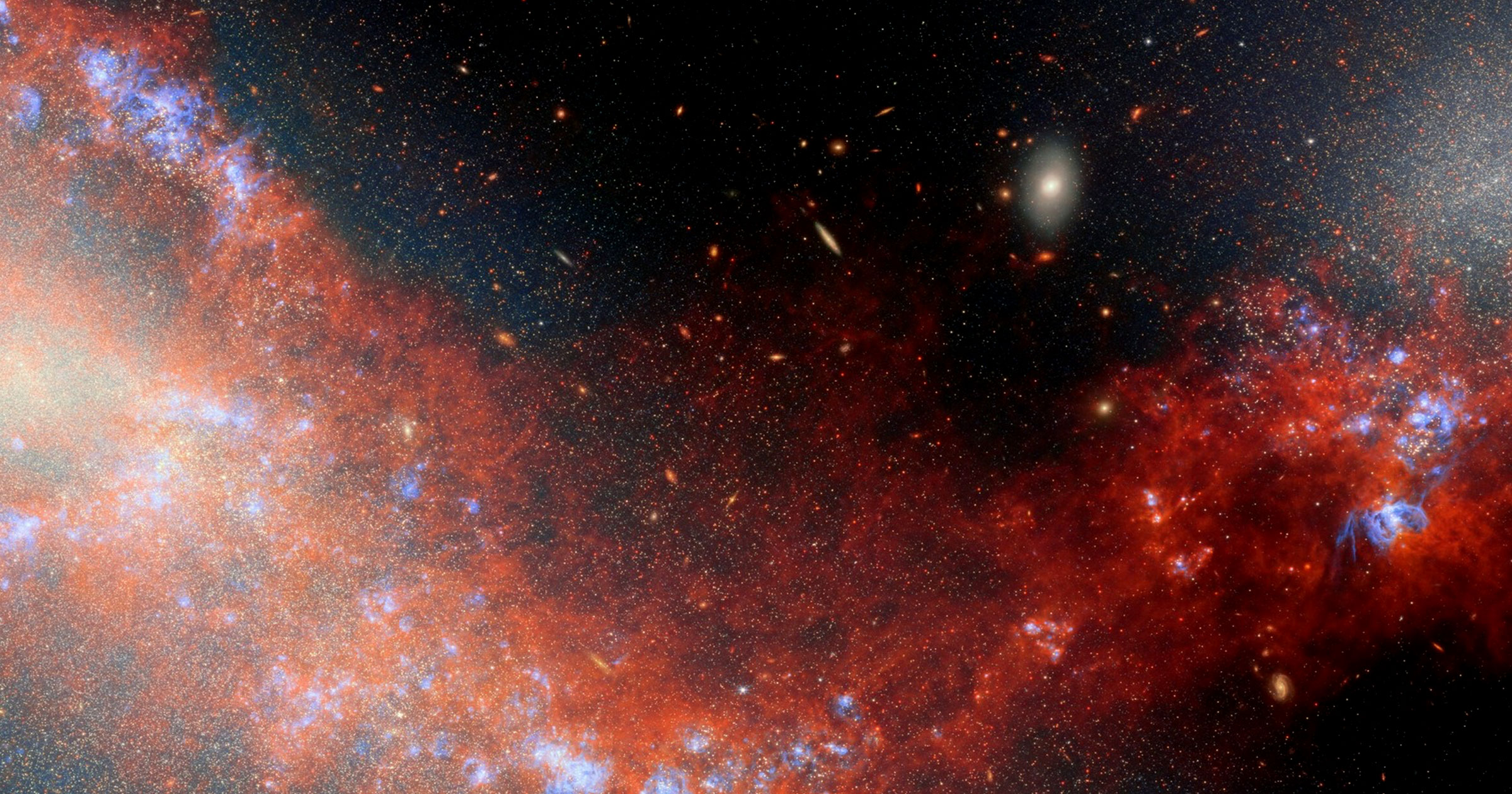
Astronomers have made a groundbreaking discovery in the field of astrophysics by identifying a colossal rotating structure in the universe. This structure consists of immense filaments of galaxies interwoven with dark matter, which is believed to account for approximately 85 percent of the universe’s total mass. The findings, detailed in a study published in the journal Monthly Notices of the Royal Astronomical Society, reveal that some of these massive structures rotate in unison, forming a cosmic pattern that spans tens of millions of light-years.
An international team of researchers, led by the University of Oxford, utilized data from South Africa’s MeerKAT radio telescope, an array of 64 linked satellite dishes, to identify the largest known rotating cosmic structure. The researchers observed 14 galaxies arranged in a remarkably thin string measuring approximately 5.5 million light-years in length and 117,000 light-years across. This string is part of a much larger filament that contains an additional 280 galaxies and extends up to 50 million light-years.
Many of the galaxies within this structure exhibit a synchronized rotation that mirrors the motion of the filament itself. According to Lyla Jung, a postdoctoral researcher at the University of Oxford and co-lead author of the study, “This is the largest individual spinning structure so far detected. Statistically, we believe there are other spinning structures, some of which could be larger. However, we have not been able to detect them directly with our current data and telescopes.”
The discovery offers new insights into the influence of these structures on the spin of galaxies, suggesting that they can affect the rotation of galaxies over more extended periods and with greater intensity than previously understood. Jung elaborates, “What makes this structure exceptional is not just its size, but the combination of spin alignment and rotational motion.” She likens this phenomenon to a theme park ride: “Each galaxy is like a spinning teacup, but the whole platform—the cosmic filament—is rotating too. This dual motion gives us rare insight into how galaxies gain their spin from the larger structures they inhabit.”
The researchers also found that this filament is relatively young, as evidenced by its “dynamically cold” state. The hydrogen-rich galaxies within the filament may still be accumulating the necessary fuel to form stars, providing a fascinating glimpse into the early stages of galaxy evolution. “This filament is a fossil record of cosmic flows,” remarked Madalina Tudorache, a postdoctoral research assistant at the University of Cambridge and co-lead author.
The study also sheds light on the swirling gas within the filament, which could enhance future observational efforts. Upcoming missions, such as the European Space Agency’s Euclid mission and the Vera C. Rubin Observatory in Chile, are anticipated to delve deeper into these cosmic structures. Tudorache expressed enthusiasm for the future of this research, stating, “This is a very exciting time to work in this field, as our capacity for discovering such structures is increasing with the advent of better radio and optical surveys. It will deepen our understanding of the universe.”
The implications of this research extend beyond mere academic interest, as understanding these cosmic filaments can reshape current models of galaxy formation and their evolutionary processes. As scientists continue to explore the complexities of the universe, discoveries like this provide critical pieces of the cosmic puzzle.